
You think you’ve got AI transformation figured out. Your strategy deck is polished. Your budget is approved. Your timeline is aggressive but achievable.
Think again.
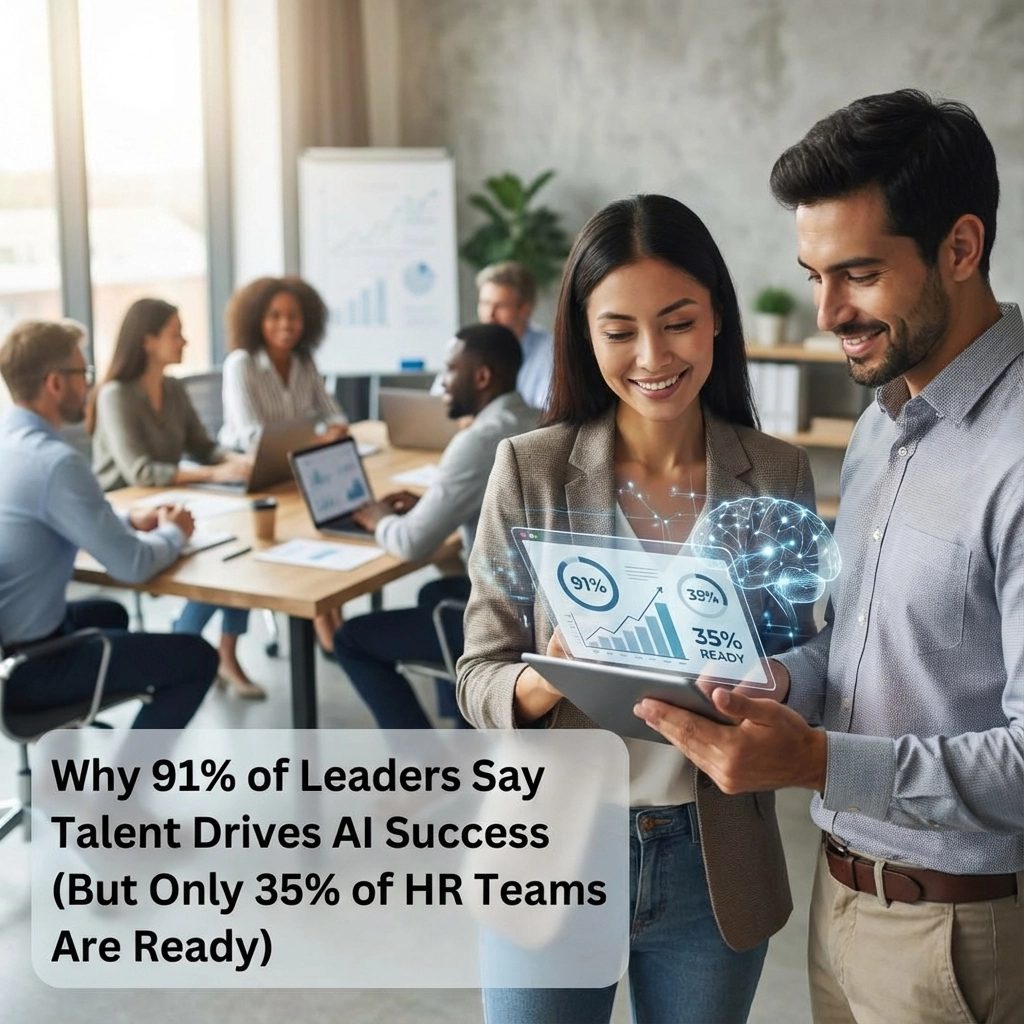
While you’re busy mapping out your AI roadmap, there’s a massive breakdown happening right under your nose. 91% of leaders recognize that talent drives AI success, yet organizations are catastrophically unprepared to actually develop that talent. The numbers don’t lie: only 35% of employees feel confident they have the skills needed to succeed in their evolving roles.
This isn’t a training problem. This is a leadership alignment crisis that’s about to torpedo your AI transformation before it even begins.
The Great AI Talent Disconnect
Here’s what’s really happening in boardrooms across America right now:
Executive teams are making bold AI commitments → HR teams are getting zero input on strategy → Employees are panicking about job security → Training programs are failing spectacularly → AI initiatives stall out.

The breakdown starts at the top. Only 21% of organizations involve HR leadership in AI strategy decisions. You’re essentially planning a talent revolution without consulting the people who actually understand your talent.
This is the executive mask problem in action. You’re performing confidence about AI readiness while ignoring the human infrastructure required to make it work.
Why Your AI Training Is Already Failing
Let’s get real about what’s happening with your current talent development:
• 62% of employees rate their organization’s AI training as average to poor
• Only 25% of employees consider their company’s talent development programs highly effective
• 43% of workers cite AI/machine learning skills as their biggest gap
• 31% identify leadership skills as their greatest weakness
The critical issue? 78% of leaders believe they have AI figured out, but only 39% of employees agree.
You’re not seeing what your people are actually experiencing. While you’re confident about your AI strategy, your workforce is drowning in skill gaps and uncertainty.
The Hidden Cost of This Misalignment
This talent-strategy disconnect isn’t just an HR problem. It’s a growth bottleneck that will cost you millions.
When People Risk Consulting analyzes failed AI transformations, we consistently find the same pattern:
Technical implementation succeeds → Human adoption fails → ROI never materializes → Leadership blames the technology
The real culprit? You treated AI transformation like a technology project instead of a people transformation project.
Organizations with leadership-driven AI adoption strategies report significantly higher engagement and positive workplace culture. Yet only 17% of companies have leadership-driven AI adoption with clear strategies and policies. The majority? They’re winging it.
The 5-Step Framework to Bridge the AI Talent Gap
You’re not broken. You’re at a critical opportunity to get this right before your competition does. Here’s how executive leaders are closing the talent-strategy divide:
Step 1: Include HR Leadership in AI Strategy From Day One
Stop treating HR as an implementation partner. Make them a strategy partner.
The shift: HR leadership sits at the AI strategy table, not in the training room afterward.
The result: Talent implications get baked into every AI decision, not retrofitted later.
Step 2: Audit Your Real Talent Readiness (Not Your Assumed Readiness)
Your leadership team’s confidence in AI readiness is likely overinflated by 40%.
The shift: Conduct confidential skill assessments that reveal actual capability gaps, not perceived ones.
The result: You build training programs based on reality, not assumptions.
Step 3: Create AI Learning Cohorts, Not Individual Training
Only 25% of employees rate traditional talent development programs as highly effective. The problem? Isolated learning doesn’t stick.
The shift: Build peer-learning cohorts where employees experiment with AI tools together.
The result: Knowledge transfer happens organically, and adoption accelerates naturally.

Step 4: Address the Leadership Skills Crisis First
Here’s the uncomfortable truth: 31% of your people say leadership skills are their biggest gap, yet you’re focused entirely on technical AI skills.
The shift: Develop AI leadership capabilities before AI technical capabilities.
The result: Your managers can actually guide their teams through transformation instead of just mandating it.
Step 5: Measure Talent Development ROI, Not Just Training Completion
The old metric: How many employees completed AI training?
The new metric: How many employees are successfully applying AI tools to improve their work?
The shift: Track behavioral change and performance improvement, not attendance.
The result: You know if your talent development is actually working or just checking boxes.
The Innovation Opportunity Hidden in This Crisis
Most executives are treating the AI talent gap like a problem to solve. Smart executives are treating it like a competitive advantage to capture.
While your competitors are struggling with the same 35% confidence crisis, you can leapfrog them by getting talent alignment right from the start.
The companies that figure out how to develop AI-ready talent will dominate their industries. The companies that don’t will be disrupted by the companies that do.
Which category are you choosing?
The Real Question Every CEO Should Ask
It’s not “How do we implement AI?”
It’s “How do we build an organization where our people can successfully partner with AI to drive unprecedented growth?”
That’s a fundamentally different question. And it requires a fundamentally different approach.
Ready to Close the Gap?
The 91% of leaders who recognize talent drives AI success aren’t wrong. They’re just approaching it wrong.
You don’t need better AI training. You need better AI leadership development. You need to stop treating this like a technology transformation and start treating it like the business model innovation it actually is.
At People Risk Consulting, we’ve developed frameworks that help executive leaders bridge the talent-strategy divide before it becomes a growth bottleneck. Our masterclass program brings together cohorts of executives who are navigating this exact challenge.
The bottom line: Your AI transformation will succeed or fail based on your people’s ability to adapt, not your technology’s ability to perform.
The question is whether you’re going to address the talent reality or keep performing the strategy fantasy.
Registration is open. Seats are limited. Your competition is already making the shift.
Apply now.