

Why Experimentation Isn’t Innovation (But Strategy Is Your Real Secret Weapon)
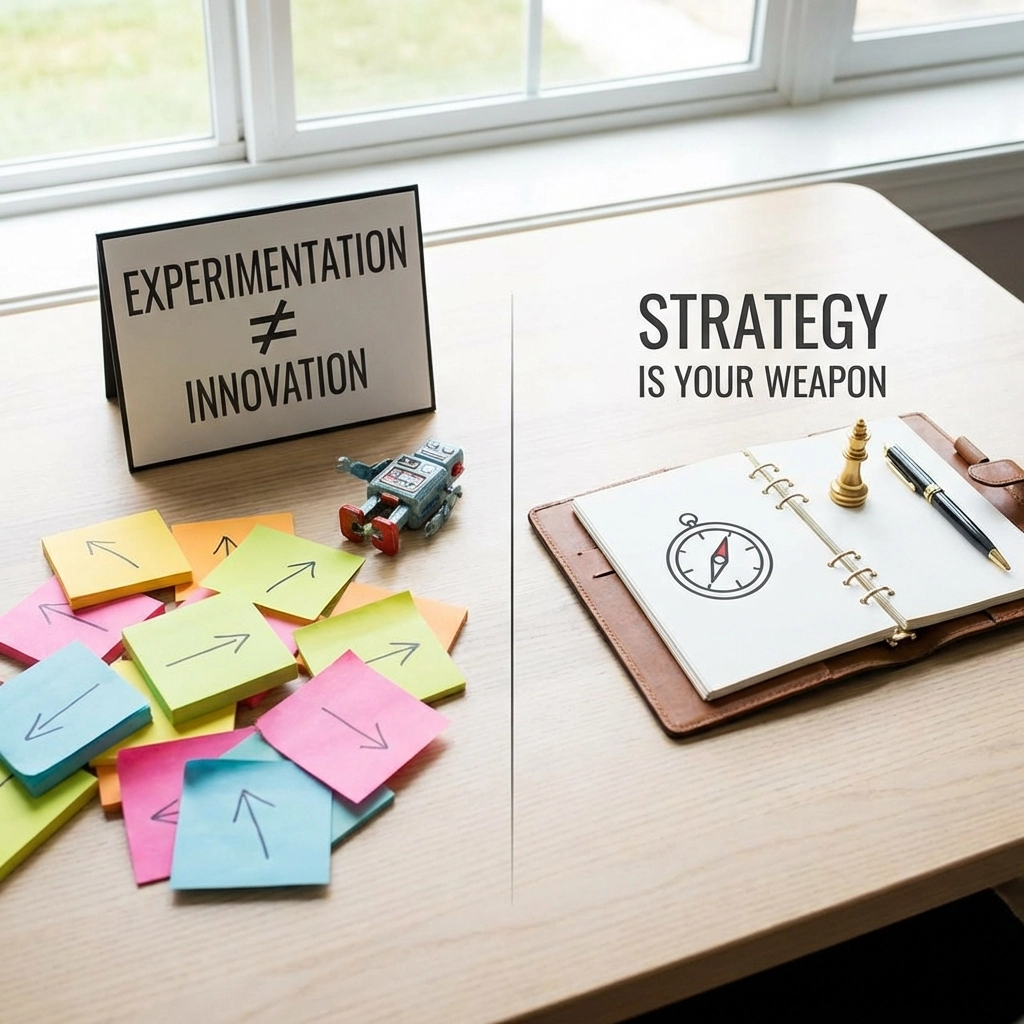
Let’s get something straight right from the start.
Just trying things isn’t innovation.
It’s motion. Sometimes very expensive motion.
And if you’ve been leading a team through rounds of “let’s just see what happens” initiatives, you already know the cost. Burned-out employees. Skeptical stakeholders. A growing pile of abandoned projects that never quite delivered what everyone hoped.
Here’s the truth that People Risk Consulting sees play out with executive leaders time and time again: the companies that actually innovate aren’t the ones trying the most things. They’re the ones learning faster than their problems can outrun them.
The difference? Strategy.
The Expensive Illusion of “Innovation Theater”
Real talk: there’s a massive gap between genuine innovation and what we might call innovation theater.
Innovation theater looks busy. It feels productive. Leaders launch pilots, greenlight new initiatives, and encourage teams to “think outside the box.” There are brainstorms. There are whiteboards covered in sticky notes. There’s a lot of energy.
But here’s the problem: without a clear strategic framework, all that activity often leads nowhere meaningful.
Random ideas. Gut swings. Throwing spaghetti at the wall and hoping something sticks. Or worse, dipping your whole hand into a boiling pot and flinging the spaghetti as you burn your company with lost profitability and a stressed out team.
That’s not innovation. That’s chaos dressed up in corporate buzzwords.
And chaos has consequences. Teams get tired. Leaders lose credibility. The organization develops a kind of “initiative fatigue” where every new idea is met with eye rolls instead of enthusiasm.
Sound familiar?
You’re not alone. At People Risk Consulting, we work with CEOs and senior leaders who’ve been stuck in this cycle. They know something needs to change, but they can’t quite pinpoint why all their experimentation efforts aren’t translating into actual results.
The answer is almost always the same: they’re missing the strategy layer.
Experimentation Without Strategy Is Just Expensive Guessing
Here’s where it gets interesting.
Experimentation isn’t the problem. In fact, systematic experimentation is absolutely foundational to innovation. Research consistently shows that the ability to test ideas in controlled environments: to learn what works and what doesn’t: is what separates companies that innovate from companies that stagnate.
But there’s a crucial distinction that most organizations miss.
Experimentation and innovation are closely linked, but they’re distinct stages. Experimentation is the process. Innovation is what emerges when that process is guided by clear strategic intent.
Without strategy, experimentation becomes a random walk. You might stumble onto something useful eventually, but you’ll waste enormous resources along the way. Your team will lose faith. Your board will start asking uncomfortable questions.
With strategy, experimentation becomes something entirely different: a decision engine.
What Strategic Experimentation Actually Looks Like
So what separates strategic experimentation from the spaghetti-throwing approach?
It starts with a clear question.
Not “what should we try next?” but something much more specific:
- What is actually blocking momentum right now?
- Where is the risk hiding in our current approach?
- What belief, behavior, or system needs to change for results to move?
These questions force you to get honest about your real situation. They cut through the noise and point you toward experiments that actually matter.
Once you’ve identified the real barrier, you design what People Risk Consulting calls contained experiments:
Small enough to be safe. You’re not betting the company on every test. You’re creating low-risk opportunities to learn.
Serious enough to matter. This isn’t busywork. Each experiment should address a genuine strategic question with real implications for your business.
Measured enough to learn fast. You need clear criteria for success and failure before you start. What will you look for? What data will tell you whether this worked?
This is where most organizations fall apart. They launch experiments without defining what success looks like. They run pilots without clear metrics. Then, six months later, no one can agree on whether the initiative worked or not.
Strategic experimentation eliminates that ambiguity.
Strategy Turns Experimentation Into Leverage
Here’s the real power move.
When experimentation is guided by strategy, every test becomes a lever. It tells you:
- What to test (based on your most pressing strategic questions)
- Why it matters (connected to real business outcomes)
- What decision you’ll make next (based on what you learn)
That last point is critical. Too many organizations run experiments and then… do nothing with the results. The data sits in a report somewhere. The insights never translate into action.
Strategic experimentation builds in the next step before you even start. You know going in: “If we see X result, we’ll do Y. If we see Z result, we’ll do W.”
This transforms experimentation from a passive learning exercise into an active decision-making tool.
Without strategy, experimentation feels chaotic and exhausting.
With it, experimentation becomes the engine that drives your organization forward.
The Real Definition of Innovation
Let’s reframe what innovation actually means.
Innovation isn’t about trying more things. It’s not about having the most ideas or launching the most pilots or being the most “disruptive.”
Innovation is about learning faster than the problem can outrun you.
Read that again.
The companies that consistently innovate aren’t necessarily smarter or more creative than their competitors. They’ve just built systems that allow them to learn and adapt at speed.
They ask better questions. They design smarter experiments. They move from insight to action without getting stuck in analysis paralysis.
And they do it all with strategy as their foundation.
At People Risk Consulting, Dr. Diane Dye and our team help executive leaders build exactly these kinds of systems. We’ve seen firsthand what happens when organizations shift from random experimentation to strategic learning: faster decisions, more confident leadership, teams that actually believe in the initiatives they’re executing.
Your Next Move: From Motion to Momentum
If you’ve been feeling stuck in the experimentation trap: lots of activity, not enough results: it’s time to step back and ask some hard questions.
Are your experiments connected to clear strategic barriers?
Do you know what success looks like before you start?
Are you building a decision engine, or just generating motion?
These aren’t easy questions. But they’re the questions that separate organizations that innovate from organizations that just stay busy.
The good news? You don’t have to figure this out alone.
Experience what strategic experimentation looks like in action. Join us for the Brave Business Masterclass and Podcast, where Dr. Diane Dye and the People Risk Consulting team break down exactly how senior leaders can build the systems, strategies, and frameworks that turn experimentation into real competitive advantage.
You can watch passively live or register to join our interactive studio audience and get your specific questions answered in real time.
👉 Register now for the Brave Business Masterclass and Podcast
Stop spinning your wheels with expensive motion. Start building the strategic experimentation engine your organization actually needs.
Because innovation isn’t about trying more things.
It’s about learning faster than the problem can outrun you.
And that journey starts with strategy.
