The Proven 5-Step Framework to Stop Internal Friction From Killing Your Growth

Your business is bleeding money. And you don’t even know it.

Think you’ve got your operations dialed in? Think again. While you’re obsessing over market share and revenue targets, internal friction is quietly strangling your growth potential: and it’s happening in plain sight.

Here’s what’s really happening: 78% of executive teams report feeling “stuck” despite having solid strategies and talented people. The culprit? Five invisible friction points that transform high-performing organizations into energy vampires.

You’re not broken. You’re at opportunity.

The Hidden Cost of Business Friction

Let me be direct. Your ignored friction quietly trains your business to be harder than necessary. What you tolerate becomes your operating standard.

→ Decision paralysis costs companies an average of $3.1 million annually in lost productivity
→ Role confusion increases project timelines by 40%
→ Unclear expectations drive 67% of workplace conflict
→ Energy drains reduce executive effectiveness by up to 50%

This isn’t about perfection. It’s about unmasking the bottlenecks that are keeping your talented team trapped in operational quicksand.

image_1

Framework Overview: The 5 Friction Fixes

At People Risk Consulting, we’ve identified exactly where high-growth companies get stuck. Not in strategy. Not in talent. In the spaces between decisions, roles, and expectations.

Here’s your breakthrough framework:

Step 1: Decision Friction → Default Decision Rules
Step 2: Role Friction → Outcome Naming
Step 3: Expectation Friction → Write Once, Say Twice
Step 4: Energy Friction → Drain Identification
Step 5: Momentum Friction → Feedback Loop Creation

Remember: Drag is feedback, not failure. These friction points are signaling exactly where your attention needs to go.

Step 1: Eliminate Decision Friction

The Problem: Your leadership team is drowning in micro-decisions.

Every “quick question” pulls focus. Every approval request creates delays. Your executives spend 40% of their time on decisions that should be automatic.

The Fix: Create default decision rules.

Stop re-deciding the same things repeatedly. Make rules for yourself.

Practical Implementation:

Hiring decisions: Pre-define non-negotiables vs. nice-to-haves
Budget approvals: Set clear thresholds and delegation levels
Meeting requests: Establish standard criteria for yes/no
Priority conflicts: Create decision trees for resource allocation

Real Talk: If you’re still personally approving expense reports under $500, you’re not leading: you’re micromanaging.

Step 2: Resolve Role Friction

The Problem: It’s unclear who needs to do what.

This isn’t just about job descriptions. Role friction happens when talented people waste energy figuring out who owns what outcome instead of delivering results. Our company CEO Dr. Diane Dye puts it like this, “people have to know what game they are playing, how it’s scored, what tools to use, and what winning looks like. Otherwise its like handing someone a basketball and saying go play baseball and go figure that out.”

The Fix: Name your outcomes clearly.

Stop defining roles by activities. Start defining roles by outcomes.

Outcome Naming Formula:

  1. Who is accountable for the result?
  2. What specific outcome are they delivering?
  3. When will success be measured?
  4. How will we know they’ve succeeded?

Example Transformation:

  • Before: “Sarah handles marketing”
  • After: “Sarah owns quarterly lead generation targets (500 qualified leads/quarter) and brand positioning initiatives”

You’re not creating bureaucracy. You’re creating clarity that unleashes performance.

Step 3: Fix Expectation Friction

The Problem: Assumptions live in the shadows.

When expectations remain unspoken, misalignment creates drag. Teams work hard in different directions. Good intentions produce bad results.

The Fix: Write it once, say it twice.

Document expectations visibly. Then communicate them clearly. Repetition without rigidity.

The Write Once, Say Twice Method:

Write Once:
• Document project expectations in shared spaces
• Create visible dashboards for key metrics
• Establish written protocols for recurring situations

Say Twice:
• Verbal confirmation in team meetings
• One-on-one alignment conversations
• Regular check-ins on shared understanding

Critical Insight: You think you’re being clear. Your team thinks you’re being vague. Bridge that gap intentionally.

Step 4: Address Energy Friction

The Problem: Certain activities drain disproportionate energy.

Not all tasks are created equal. Some activities energize your team. Others create invisible exhaustion that compounds over time. Energy friction is performance poison.

The Fix: Identify and eliminate energy drains.

Energy Audit Process:

  1. Track energy levels: Monitor team engagement across different activities
  2. Identify patterns: What consistently drains vs. energizes?
  3. Redesign workflows: Minimize drains, maximize energizers
  4. Delegate strategically: Move drains to people who find them energizing

Common Energy Drains:
• Repetitive manual processes → Automate or systematize
• Unclear communication channels → Streamline information flow
• Misaligned skill-to-task matching → Reorganize responsibilities
• Constant context switching → Create focused work blocks

Remember: Your best people will leave energy-draining environments before they’ll complain about them.

Step 5: Create Momentum Through Feedback Loops

The Problem: Friction accumulates without detection systems.

Most organizations only notice friction when it becomes crisis. By then, the damage is done. You need early warning systems.

The Fix: Build systematic feedback loops.

Momentum Monitoring System:

Weekly Pulse Checks:
• What felt effortless this week?
• Where did we hit unexpected friction?
• What decisions took longer than necessary?

Monthly Friction Audits:
• Review decision-making patterns
• Assess role clarity across teams
• Evaluate energy levels and engagement

Quarterly Framework Reviews:
• Update default decision rules
• Refine outcome definitions
• Streamline communication protocols

The 72-Hour Rule: When friction emerges, address it within 72 hours. Don’t let it become your new normal.

Implementation: Your Next 30 Days

Stop waiting for perfect conditions. Start experimenting immediately.

Week 1: Decision Friction Audit

  • List your 20 most frequent decisions
  • Create default rules for top 10
  • Test with leadership team

Week 2: Role Friction Assessment

  • Map unclear outcome ownership
  • Redefine top 5 critical roles by outcomes
  • Communicate changes clearly

Week 3: Expectation Documentation

  • Identify top 3 assumption-heavy areas
  • Implement “write once, say twice” protocol
  • Create visible expectation dashboards

Week 4: Energy and Momentum Setup

  • Conduct team energy audit
  • Establish weekly pulse check rhythm
  • Plan monthly friction review process

The Breakthrough Moment

Here’s what happens when you systematically eliminate friction: Your talented people finally perform at their actual capacity.

Companies using this framework report 35% faster decision-making, 50% clearer role execution, and 60% reduction in internal conflict within 90 days.

You don’t need more strategy. You don’t need more talent. You need less friction.

The question isn’t whether you have friction. The question is whether you’ll address it before it addresses your growth targets for you.

Your breakthrough is waiting on the other side of this framework. Stop tolerating what’s stealing your momentum.

Ready to eliminate the friction that’s keeping your team stuck? Join me live for the Brave Business Masterclass and Podcast from People Risk Consulting. Watch the livestream passively, or register to be in the interactive studio audience with your peer cohort. Register now — seats are limited.

Because your growth can’t wait for someday. It’s waiting for today.

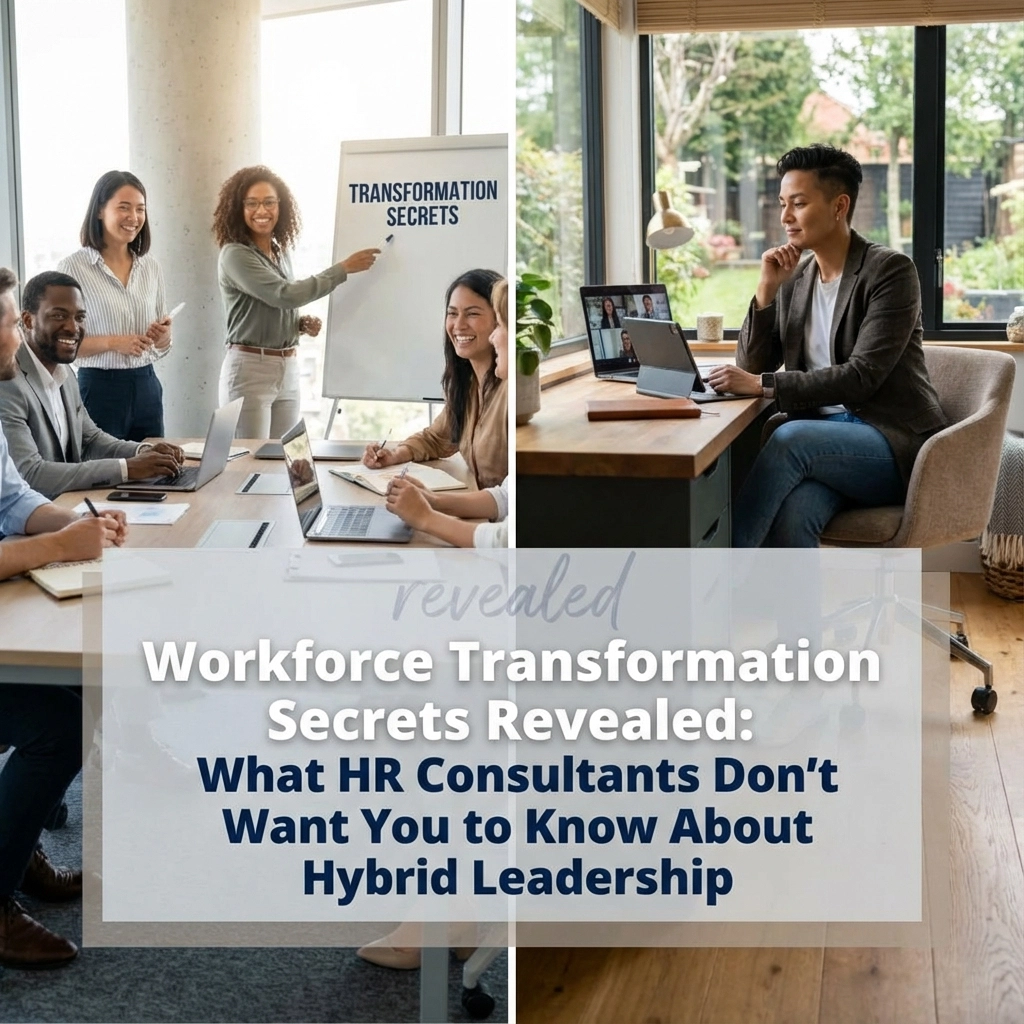
Workforce Transformation Secrets Revealed: What HR Consultants Don’t Want You to Know About Hybrid Leadership

heroImage

Think your HR consultant is giving you the full story about hybrid leadership? Think again.

You’ve been sold a polished version of workforce transformation. The sanitized playbook. The one that keeps everyone comfortable and consultants employed for years of “implementation phases.”

But here’s what really happens when 91% of companies claim they’re “hybrid-ready” but only 35% of their leaders can actually manage distributed teams effectively.

You’re not getting the real talk. You’re getting the performance.

The Dirty Truth About “Hybrid Leadership”

Most HR consultants won’t tell you this: Your hybrid strategy isn’t failing because you need more technology. It’s failing because you’re still managing like it’s 1995.

Here’s what’s actually happening in your organization right now:

→ Your managers are pretending to trust remote workers while secretly checking if they’re “really working”

→ Your in-office employees are getting better opportunities because proximity equals visibility

→ Your remote workers are burning out trying to prove they’re productive

→ Your hybrid workers are stuck in the middle, unsure which performance rules apply

78% of HR leaders admit leadership mindset is a bigger challenge than technical skills when creating successful hybrid models. But how many are actually addressing the mindset problem?

Almost none.

Secret #1: Trust Is Your Biggest Breakdown Point

Your executives say they trust their teams. Your policies claim flexibility. Your values poster mentions autonomy.

But your systems scream surveillance.

Here’s the uncomfortable reality: if you’re measuring hybrid success by hours logged, meetings attended, or response times to Slack messages, you’re not running a hybrid organization. You’re running a distributed micromanagement experiment.

The companies winning at hybrid? They measure outcomes. Period.

→ Traditional approach: Track when work happens
→ Transformation approach: Track what work produces

This isn’t just feel-good leadership philosophy. Hybrid employees who work under outcome-based management are 57% more engaged compared to 49% of in-office workers and 42% of remote workers.

Secret #2: Your Performance Reviews Are Sabotaging Hybrid Success

Nobody talks about this one. Your annual performance review process is fundamentally incompatible with hybrid leadership.

Why? Because traditional reviews reward:

  • Face time over output
  • Visibility over value creation
  • Political positioning over problem-solving

Meanwhile, hybrid workers excel at:

  • 79% understanding how their work connects to company goals (vs. 62% remote)
  • 71% expressing confidence in senior management (vs. 62% in-office, 58% remote)
  • 72% receiving clear vision communication from leadership (vs. 62% for both in-office and remote)

You’re using the wrong measurement tool for the job. It’s like using a ruler to weigh gold.

Secret #3: The “Equity” Problem No One Addresses

Here’s what your diversity and inclusion team won’t say out loud: Hybrid work is creating a two-tier employee system. And it’s not what you think.

The real divide isn’t remote vs. in-office. It’s between managers who’ve evolved their leadership approach and those who haven’t.

Evolved hybrid leaders create:

  • Equal access to opportunities regardless of location
  • Structured mentorship programs that work virtually
  • Career advancement paths that don’t require face time
  • Recognition systems based on impact, not presence

Traditional managers create:

  • Proximity bias disguised as “collaboration”
  • Informal networks that exclude remote workers
  • Advancement bottlenecks for anyone not physically present
  • Culture gaps between location-based worker groups

You can’t solve this with a handbook. You solve it by transforming how leaders actually lead.

The Real Transformation Framework

Stop implementing hybrid policies. Start transforming hybrid leaders.

Here’s the framework that actually works:

Phase 1: Mindset Conversion

Week 1-2: Audit your management layer. Who’s genuinely bought in vs. who’s compliance-performing?

Week 3-4: Intensive leader coaching on outcome-based management (not more Zoom training)

Phase 2: System Realignment

Month 2: Restructure all performance metrics around deliverables and impact

Month 3: Redesign communication protocols for location equity

Phase 3: Culture Evolution

Month 4-6: Implement peer mentorship systems that work across locations

Ongoing: Continuous measurement of engagement disparity between worker groups

image_2

What This Actually Costs (And Saves)

The real business case nobody mentions: Organizations implementing authentic hybrid leadership realize significant cost savings through reduced real estate needs, lower overhead expenses, and expanded talent pools unconstrained by geography.

But here’s the kicker: You can reinvest those savings into the leadership development that makes hybrid actually work.

→ Traditional approach: Cut costs, hope culture survives
→ Transformation approach: Redirect savings into leader evolution

Stop Performing. Start Transforming.

You have a critical opportunity right now. While your competitors are stuck in “pilot programs” and “phased rollouts,” you can actually transform how work gets done.

But only if you stop believing the sanitized version of hybrid leadership.

The companies winning aren’t the ones with the best technology. They’re the ones with leaders who’ve fundamentally changed how they think about trust, measurement, and human performance.

You’re not behind. You’re at opportunity.

The question is: Are you ready to stop performing transformation and start actually doing it?


Ready to move beyond surface-level hybrid strategies? The executive leaders in our confidential peer learning masterclass are tackling these exact challenges with frameworks that actually work. Limited seats available for Q1 2026.

Because real transformation happens in small groups of committed leaders, not in company-wide initiatives that change nothing.

Apply now. Your hybrid workers; and your bottom line: will thank you.

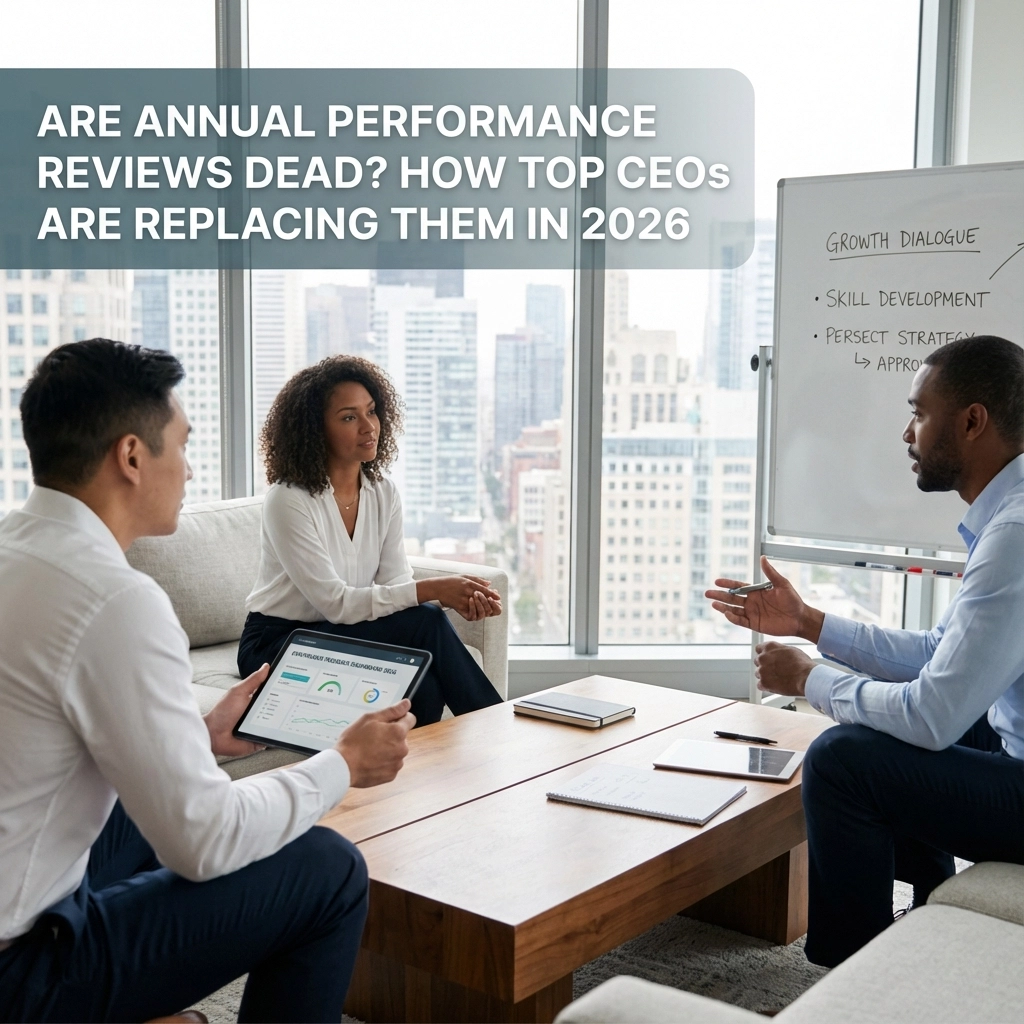
Are Annual Performance Reviews Dead? How Top CEOs Are Replacing Them in 2026

heroImage

Think your annual performance review process is working? Think again.

Here’s the brutal truth: 91% of companies still cling to annual performance reviews, yet only 14% of employees believe they actually drive performance improvement. You’re spending months preparing elaborate review cycles that deliver zero growth.

Your competitors aren’t just abandoning this broken system. They’re replacing it with something that actually works.

The Performance Review Breakdown Is Real

Let’s stop pretending everything’s fine. The data from People Risk Consulting’s executive research reveals a devastating disconnect:

72% of employees don’t trust their organization’s performance management systems
61% of managers admit the current process fails to drive results
$3.5 billion wasted annually on performance review administration that produces no measurable outcomes

→ Traditional annual reviews create delayed feedback loops
→ Employees receive unusable insights months after the fact
→ Critical growth opportunities vanish while you wait for “review season”

You’re not broken. You’re at a critical opportunity to unlock performance potential your competitors are missing.

image_1

What Top CEOs Discovered in 2026

The executives who cracked this code didn’t just tweak their review process. They completely reimagined performance management.

Apple’s CEO eliminated annual reviews entirely. Block’s leadership team replaced them with continuous growth conversations. One Fortune 100 financial services firm saw 23% higher employee engagement within six months of overhauling their approach.

The secret? They stopped performing and started partnering.

Here’s what they implemented instead:

1. Real-Time Performance Intelligence

Traditional approach: Wait 12 months to address performance gaps.
New framework: Continuous performance visibility with weekly check-ins.

• Managers identify skill gaps within 30 days, not 365
• Goals adjust as business priorities evolve
• Employees receive coaching when it actually matters

Result: Companies using this approach report 31% faster skill development and 28% higher goal achievement rates.

2. AI-Powered Bias Detection

Annual reviews are contaminated with recency bias, favoritism, and subjective interpretation. Smart leaders deployed artificial intelligence to:

Eliminate rating bias through data-backed performance insights
Surface early warning signals of disengagement before talent walks
Automate workflow management so managers focus on growth, not paperwork

One People Risk Consulting client discovered their “top performers” in annual reviews were actually contributing 15% less value than previously overlooked team members. The AI revealed the truth their subjective process missed.

3. The Trust-Building Revolution

Here’s where most leaders get it wrong. They think performance management is about evaluation. The breakthrough companies understand it’s about collaboration.

Instead of: “Here’s what you did wrong.”
They say: “What can we work on together?”

This shift creates:
→ More honest conversations about actual challenges
→ Earlier insights into barriers blocking success
→ Employees feeling “respected, heard, and treated like a partner”

4. Dynamic Goal Architecture

Static annual objectives are organizational death. By the time December arrives, your January priorities are irrelevant.

The new model: Goals that breathe with your business.

• Monthly recalibration based on market shifts
• Cross-functional alignment that prevents silos
• Employee ownership of their growth trajectory

Companies using dynamic goal-setting report 47% higher adaptability to market changes.

The Implementation Framework That Actually Works

You can’t just replace annual reviews with “continuous feedback” and expect magic. Here’s the step-by-step approach that drives results:

Phase 1: Foundation (Weeks 1-4)

Audit current system gaps through employee and manager feedback
Define performance partnership principles that guide all conversations
Train managers on growth-focused dialogue techniques

Phase 2: Pilot Launch (Weeks 5-12)

Select 2-3 high-performing teams for initial rollout
Implement weekly check-in structure with clear conversation frameworks
Measure early indicators: engagement scores, goal progression, retention signals

Phase 3: Scale and Optimize (Weeks 13-24)

Expand to remaining departments based on pilot learnings
Integrate AI tools for bias detection and performance insights
Establish quarterly calibration sessions for system refinement

image_2

The Competitive Advantage You’re Missing

While your competitors debate whether to keep annual reviews, the leaders who eliminated them are capturing talent, accelerating development, and building cultures where peak performers actually want to stay.

The mask is off. Your people know the current system doesn’t work. They’re waiting for you to lead the change.

Your choice: Keep performing the annual review theater, or start building a performance partnership that drives real growth.

This isn’t about HR innovation. This is about competitive survival.

The executives mastering this transformation aren’t just improving employee satisfaction. They’re seeing:

23% reduction in voluntary turnover among high performers
31% faster skill development and capability building
$2.3 million average annual savings from reduced hiring and training costs
47% improvement in cross-functional collaboration and goal alignment

Your Next Move

The annual performance review era ended in 2025. The question isn’t whether to evolve: it’s how fast you can implement what’s already working.

Ready to stop performing and start partnering?

People Risk Consulting’s Performance Partnership Masterclass shows you exactly how to implement the frameworks driving results for Fortune 500 leaders. We’ll walk you through the AI tools, conversation templates, and measurement systems that eliminate performance management waste.

Limited seats available. Registration closes this quarter.

Apply now and join the executives who’ve already made the shift.

Your people are waiting for real performance partnership. Your competitors are already building it.

Don’t let another review cycle pass you by.