
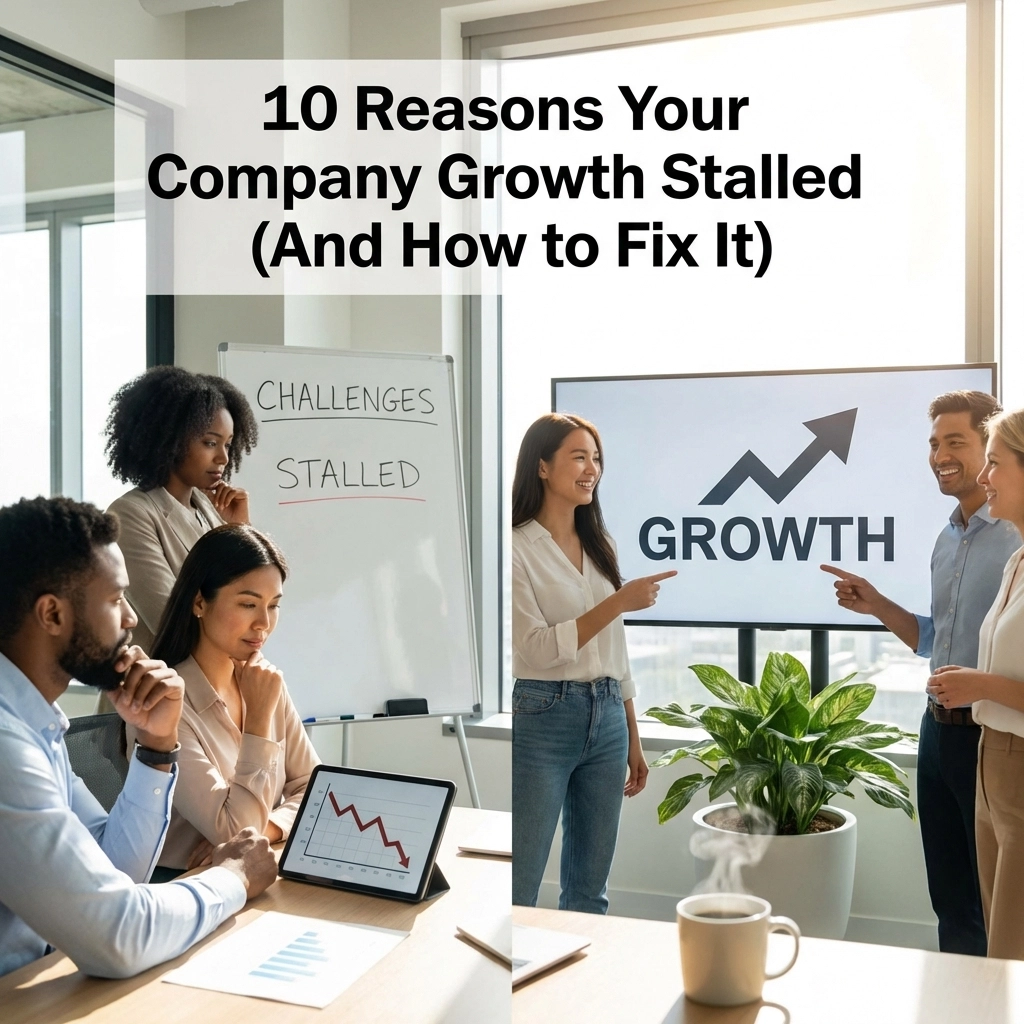
Growth doesn’t stop with a loud crash. It fades quietly, so quietly that most leaders don’t notice until revenue flatlines, talent walks out the door, and the competition pulls ahead.
At People Risk Consulting, we’ve seen this pattern play out across industries. The companies that stall aren’t failing because of one catastrophic decision. They’re failing because small, invisible risks compound over time. Friction builds. Processes calcify. Teams disengage. And suddenly, the momentum that once felt unstoppable… stops.
Here’s the good news: growth stalls are diagnosable, and they’re fixable. But only if you’re willing to look at what’s actually happening beneath the surface.
Let’s break down the 10 most common reasons your company growth has stalled, and what you can do about each one.
1. Leadership Alignment Is an Illusion
The Problem: Your executive team believes they’re aligned. They’re not. Subtle differences in priorities, definitions of success, and strategic direction create invisible fractures that widen over time. These gaps don’t surface in meetings, they surface in conflicting decisions, mixed signals to teams, and competing initiatives that drain resources.
The Fix: Schedule dedicated alignment sessions, not operational check-ins, where leadership explicitly defines shared priorities and success metrics. Create space for constructive disagreement. Silence isn’t alignment; it’s avoidance.
2. Every Decision Runs Through the Same Three People
The Problem: When your company was small, centralized decision-making made sense. Now it’s a bottleneck. Opportunities pass you by while waiting for approval. Teams lose initiative because they’ve learned that nothing moves without executive sign-off.
The Fix: Build decision-making frameworks that delegate authority within clear boundaries. Define what decisions teams can make autonomously, what requires consultation, and what escalates to leadership. Then trust the framework.
3. Your Processes Were Built for a Company That No Longer Exists
The Problem: The systems that carried you through early growth weren’t designed to scale. But instead of redesigning them, your organization clings to familiar structures, even when they create friction at every turn.
The Fix: Conduct a quarterly process audit. Identify where bottlenecks consistently appear. Then invest in streamlining or replacing those systems. This isn’t about change for change’s sake, it’s about removing the drag that’s slowing you down.
4. Truth Doesn’t Reach Power
The Problem: Without structured feedback loops, leaders make decisions in a vacuum. Employees see problems but don’t report them. Clients experience friction but don’t complain, they just leave. And leadership keeps steering based on outdated assumptions.
The Fix: Create formal channels for feedback from employees, clients, and frontline operations. More importantly, make it safe to deliver bad news. The organizations that learn fastest are the ones where truth speaks to power, without consequences for the messenger.
5. Your Culture Has Become Allergic to Change
The Problem: Strong cultures are an asset, until they calcify. When stability becomes the dominant value, innovation gets quietly strangled. Teams grow comfortable. Execution drifts from strategy. And the organization loses its ability to adapt.
The Fix: Foster a learning culture that values calculated risk-taking alongside stability. Address cultural resistance directly when implementing new tools or processes. Buy-in before rollout prevents the workarounds that undermine change initiatives.
6. Nobody Actually Knows What Success Looks Like
The Problem: Mismatched goals between leadership and teams create conflicting priorities. One group optimizes for growth, another for profitability, another for operational efficiency. Without clarity, everyone works hard in different directions: and progress stalls.
The Fix: Establish explicit definitions of success at the company, department, and individual levels. Make goals transparent. Revisit them regularly. Alignment isn’t a one-time conversation: it’s an ongoing discipline.
7. You’re Solving Problems Your Customers Don’t Have
The Problem: Many growth stalls trace back to a fundamental disconnect: the company is building solutions based on assumptions about customer needs rather than actual market research. Products don’t resonate. Sales cycles lengthen. Churn increases.
The Fix: Invest in genuine market research. Talk to customers: not to validate your assumptions, but to challenge them. Stay in touch with external market realities. The market doesn’t care what you think it needs; it cares about what actually solves its problems.
8. Your Talent Strategy Is Reactive, Not Strategic
The Problem: People Risk Consulting sees this constantly: companies treat talent as an operational issue rather than a strategic asset. They hire reactively, develop inconsistently, and retain haphazardly. Then they’re surprised when key people leave and institutional knowledge walks out with them.
The Fix: Build a proactive talent strategy that addresses recruitment, development, and retention as interconnected systems. Identify your critical roles and create succession plans. Invest in leadership development before you need it: not after someone gives notice.
9. Customer Churn Is Quietly Destroying Your Growth
The Problem: Acquisition metrics look healthy, but customers leave almost as fast as they arrive. High churn creates a treadmill effect: you’re running hard just to stay in place. Growth becomes mathematically impossible.
The Fix: Analyze why customers leave. Look at onboarding friction, product-market fit, service quality, and competitive alternatives. Then address root causes systematically. Retention improvements often deliver faster ROI than acquisition investments.
10. Cash Flow Constraints Are Choking Your Options
The Problem: Poor cash flow management limits your ability to invest in growth opportunities, weather disruptions, or respond to competitive threats. Inadequate working capital creates a perpetual state of financial firefighting.
The Fix: Implement strong financial controls and forecasting tools. Create contingency plans for different scenarios with specific budgetary triggers. Address receivables promptly. Cash flow discipline isn’t glamorous: but it’s the oxygen that keeps growth possible.
The Common Thread: Invisible Risk
Here’s what these 10 factors have in common: they develop quietly and become normalized over time. They’re invisible to leadership: until they’re not.
The companies that break through growth stalls aren’t necessarily smarter or better resourced. They’re more honest. They’re willing to diagnose what’s actually happening rather than what they wish were happening. And they take action before problems become crises.
At People Risk Consulting, we specialize in helping leaders see the risks hiding in plain sight: the friction, the talent gaps, the process failures, the cultural blind spots that stall growth. Because you can’t fix what you can’t see.
Ready to Diagnose Your Growth Stall?
If any of these 10 factors resonated, you’re not alone. Most growing companies hit these walls at some point. The question is whether you’ll address them proactively: or wait until the damage forces your hand.
Join us for the Brave Business Masterclass and Podcast, where we break down exactly these kinds of challenges with real-world strategies you can implement immediately. Watch passively live, or register to join the interactive studio audience where you can bring your specific questions to the conversation.
Register for the Brave Business Masterclass and Podcast →
Growth stalls are fixable. But only if you’re brave enough to look at what’s actually in the way.