
How to Create “Stagility” in Your Organization: The 5-Step Framework for Scaling Without Breaking

heroImage

Think you need to choose between stability and agility to scale your business? Think again.

Most CEOs believe they’re facing an impossible choice: maintain the stability that got them here, or embrace the agility needed for tomorrow. This false dilemma is killing growth at organizations across every industry.

Here’s what 73% of executives don’t realize: The companies winning at scale aren’t choosing sides. They’re mastering “stagility”: the art of being simultaneously stable and agile.

You’re not stuck between two bad options. You’re sitting on the biggest competitive advantage of the next decade.

The Scale-Breaking Problem Most CEOs Can’t See

Your organization is probably breaking right now. Not failing: breaking. There’s a difference.

→ Processes that worked at $10M revenue are suffocating growth at $50M
→ Teams that thrived with 50 people are drowning with 200
→ Systems that felt agile now feel like cement

87% of fast-growing companies report that their original structures become growth barriers within 18 months of major expansion.

But here’s the real problem: Most leaders respond by choosing extremes. They either lock down everything (stability) or tear everything apart (agility). Both approaches destroy what they’re trying to protect.

What Stagility Actually Means (And Why It’s Your Secret Weapon)

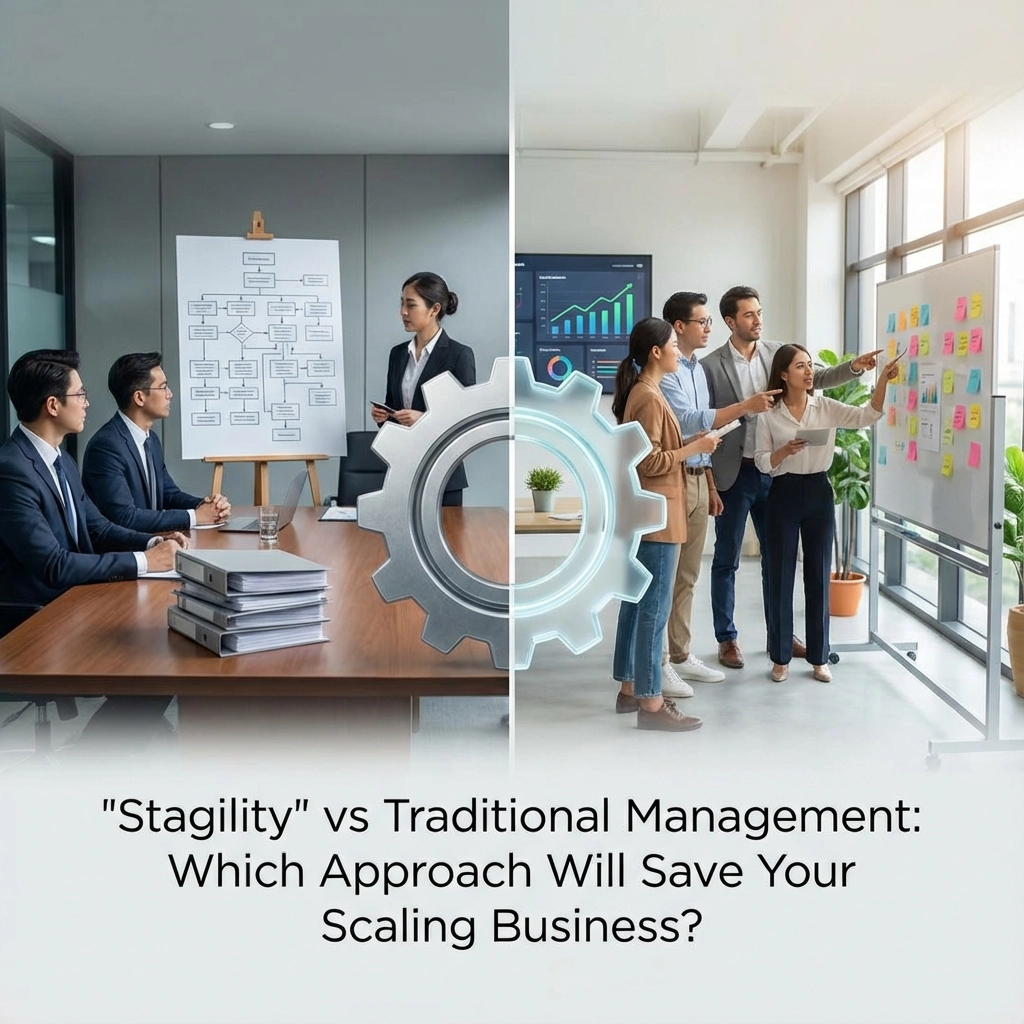
Stagility isn’t a buzzword: it’s a survival strategy. The term combines stability and agility into a framework that lets you scale without snapping.

Think of it like this: A skyscraper doesn’t sway in the wind because it’s rigid. It sways because it’s designed to flex while maintaining its foundation. That’s stagility in action.

Companies mastering stagility are seeing remarkable results:

  • 35% faster time-to-market on new initiatives
  • 42% improvement in employee retention during growth phases
  • 28% reduction in operational breakdowns during scaling
image_1

The 5-Step Stagility Framework That’s Changing Everything

Here’s the step-by-step system People Risk Consulting has developed working with hundreds of scaling organizations. This isn’t theory: this is what actually works in the real world.

Step 1: Anchor Your Identity (Before Everything Else Changes)

The Problem: When everything’s changing, people lose their sense of who the company is and what it stands for.

The Solution: Create three unshakeable anchors:

  • Purpose Anchor: What will never change about why you exist
  • Values Anchor: The non-negotiables that guide every decision
  • Culture Anchor: How people actually behave when no one’s watching

Action Items:
□ Define your company’s unchangeable core in one sentence
□ Identify 3-5 values that you’d fire people for violating
□ Document the behaviors that represent your culture at its best
□ Communicate these anchors to every person, every quarter

Real Example: When Haier transformed into 4,000+ micro-enterprises, they anchored around “inverted triangle” customer-first thinking. Everything else could change, but that couldn’t.

Step 2: Build Flexible Job Architecture (Not Rigid Job Descriptions)

The Problem: Traditional job descriptions become straitjackets during rapid growth.

The Solution: Design roles around capabilities and outcomes, not tasks.

→ Move from “Marketing Manager” to “Growth Capability Owner”
→ Shift from task lists to outcome expectations
→ Create skill clusters that can be combined in different ways

Action Items:
□ Map every role to 3-5 core capabilities instead of 20+ tasks
□ Define success metrics that stay constant regardless of how work gets done
□ Create “capability swap” opportunities between teams
□ Build skills inventories that show who can do what

The Bottom Line: When people own outcomes instead of tasks, they adapt naturally as needs change.

Step 3: Implement Selective Automation with Human Guardrails

The Problem: Organizations either automate everything or nothing: both approaches fail during scaling.

The Solution: Automate the routine, amplify the human.

The Stagility Automation Rules:

  • Automate anything that happens the same way 80%+ of the time
  • Keep humans in charge of exceptions, relationships, and strategy
  • Build manual override capabilities into every automated process
  • Train teams to work with automation, not despite it

Action Items:
□ Audit your processes: Which repeat identically? Which require judgment?
□ Start with your highest-volume, lowest-stakes processes first
□ Create “human checkpoints” in every automated workflow
□ Train teams on when to override automation

Step 4: Create Adaptive Leadership Structures

The Problem: Traditional hierarchies either strangle innovation or create chaos.

The Solution: Build leadership that can be both directive and distributed.

Here’s how the best scaling companies are restructuring leadership:

Distributed Decision Rights:

  • Strategic decisions: Executive team
  • Operational decisions: Department heads
  • Tactical decisions: Individual contributors

Adaptive Communication Loops:

  • Weekly: Tactical coordination
  • Monthly: Strategic alignment
  • Quarterly: Vision and priorities reset
image_2

Action Items:
□ Map every type of decision to the right leadership level
□ Create escalation paths that don’t require 5 approvals
□ Establish regular “reality check” sessions between leadership levels
□ Build feedback loops that flow up, down, and across the organization

Step 5: Install Continuous Capability Building

The Problem: Most companies either overtrain (wasting money) or undertrain (limiting growth).

The Solution: Build learning that adapts to your actual growth needs.

The Stagility Learning Framework:

  • Foundation Skills: Everyone needs these, regardless of role
  • Function Skills: Department-specific capabilities
  • Future Skills: Emerging capabilities you’ll need in 6-12 months

Action Items:
□ Define the 5 foundation skills every employee must have
□ Map function-specific skill requirements to business outcomes
□ Identify 3 future skills your organization will need next year
□ Create learning paths that people can pursue based on business needs and personal interest

Key Insight: The companies winning at stagility aren’t just training people: they’re building internal capability to continuously upskill based on changing needs.

Where Most Organizations Get Stagility Wrong

Mistake #1: Thinking Stagility Means “Stable Sometimes, Agile Sometimes”
Wrong. True stagility means being stable and agile simultaneously. Your core identity stays rock-solid while your methods stay flexible.

Mistake #2: Implementing Stagility from the Bottom Up
Stagility starts with leadership. If your executive team isn’t modeling the balance, your organization can’t achieve it.

Mistake #3: Measuring the Wrong Things
Most companies measure efficiency OR innovation. Stagile organizations measure both: and the relationship between them.

The Real Return on Stagility Investment

Here’s what happens when you get stagility right:

Year 1: Teams stop breaking under growth pressure
Year 2: Innovation accelerates without sacrificing quality
Year 3: You become the company others try to copy

Organizations implementing stagility frameworks report 67% fewer “growth crises” and 45% faster recovery from operational disruptions.

But here’s the thing most CEOs miss: Stagility isn’t a destination. It’s a capability. The moment you think you’ve “achieved” it is the moment you start losing it.

Your Stagility Starting Point

You don’t need to overhaul everything tomorrow. Start with Step 1: anchoring your identity. Once people know what won’t change, they can handle everything that will.

This Week:
□ Gather your leadership team
□ Define your three anchors
□ Communicate them to your organization

This Month:
□ Implement flexible job architecture for one department
□ Identify your first automation opportunities
□ Establish new decision rights

This Quarter:
□ Launch your continuous capability building program
□ Measure both stability and agility metrics
□ Iterate based on what’s working

The companies mastering stagility aren’t the ones with perfect processes. They’re the ones with adaptive processes. They’re the ones willing to stay anchored in purpose while staying flexible in method.

Your organization isn’t broken because it can’t choose between stability and agility. You’re at a critical opportunity to master both.

Ready to build stagility into your organization’s DNA? People Risk Consulting’s executive masterclasses dive deep into implementing these frameworks with peer groups of scaling CEOs. Registration is limited to maintain intimate cohort dynamics.

The question isn’t whether your organization needs stagility. The question is whether you’ll build it before your competitors do.

Stuck at $50M? The Hidden Growth Barriers 87% of Executives Don’t See Coming

heroImage

Think your $50M revenue plateau is about market conditions? Competition? Economic headwinds?

Think again.

87% of executives blame external factors for their growth stagnation. But here’s the uncomfortable truth most CEOs refuse to face: Your biggest growth barriers aren’t outside your company. They’re sitting in your boardroom.

At People Risk Consulting, we’ve dissected dozens of companies stuck at the $50M mark. What we’ve discovered will challenge everything you believe about scaling.

The $50M Mirage: Why Smart Leaders Hit Invisible Walls

You built something incredible. From startup to $50M feels like conquering Everest. Your systems worked. Your team delivered. Your leadership style got results.

But the very strengths that got you here are now killing your growth.

Governance and operational inefficiencies become the primary constraints at exactly the $50M threshold. The processes that supported your scrappy $5M company? They’re fracturing under the weight of complexity.

Here’s what’s really happening → Your success created the perfect conditions for failure.

image_1

The Five Hidden Assassins of $50M+ Growth

1. The CEO Bottleneck Trap

You’re still making decisions that should happen three levels down. Every approval runs through you. Your calendar is packed with operational meetings instead of strategic planning.

The brutal reality? Founders who built their companies often struggle to delegate decision-making authority, creating bottlenecks that slow execution.

This isn’t about ego. It’s about unconscious control patterns that worked when you were smaller but now choke growth at scale.

The fix → Implement decision rights frameworks. Define what decisions require your input versus what can be delegated. Time-box your involvement in operational issues.

2. The Scalability Breakdown

Your once-efficient systems are now digital duct tape holding everything together. Customer onboarding takes weeks instead of days. Your team spends more time fighting internal friction than serving clients.

Systems become overloaded, workflows break down, and operational infrastructure cannot sustain expanded business.

The reality check → What got you to $50M won’t get you to $100M. Period.

The solution → Audit every system, process, and workflow. Anything that requires manual intervention at scale needs reimagining. Build for 10x, not 2x growth.

3. The Decision Paralysis Disease

Remember when you could pivot in 24 hours? Now simple decisions take weeks. Bureaucratic approvals pile up. Cross-functional collaboration moves at the speed of molasses.

Slow decision-making extends cycles from days to weeks, causing market opportunities to slip away.

Here’s what’s happening → You’ve created organizational diabetes. Information flow is clogged. Decision pathways are unclear.

The intervention → Create decision velocity metrics. Track how long key decisions take. Identify bottlenecks. Eliminate approval layers that don’t add real value.

4. The Talent Hemorrhage Crisis

Your best performers are walking out the door. Not because of money. Because they see what you don’t: structural constraints that limit their impact.

Top performers recognize structural constraints before leadership often does, departing when they encounter inefficiencies.

The wake-up call → High performers don’t leave companies. They leave broken systems.

The retention strategy → Exit interview honestly. What friction are they experiencing? What opportunities do they see that you’re missing? Fix the environment, not just the compensation.

5. The Innovation Strangulation

You’re so focused on optimizing existing revenue streams that innovation dies. New product development stalls. Market expansion gets shelved. Risk tolerance plummets.

The dangerous pattern → Success breeds conservatism. Conservatism breeds stagnation.

The breakthrough → Allocate specific resources to experimentation. Create protected space for innovation. Measure learning, not just revenue.

image_2

The $50M Breakthrough Framework

Phase 1: Diagnostic Reality Check

Week 1-2: Complete organizational health assessment

  • Map current decision flows
  • Identify system breaking points
  • Survey talent retention risks
  • Audit innovation pipeline

Phase 2: Infrastructure Redesign

Week 3-8: Rebuild for scale

  • Implement automated workflows
  • Redesign org structure for delegation
  • Create clear decision rights
  • Establish performance dashboards

Phase 3: Talent Transformation

Week 9-12: Unlock human potential

  • Address top performer concerns
  • Eliminate bureaucratic friction
  • Create advancement pathways
  • Build learning culture

Phase 4: Growth Acceleration

Week 13+: Execute with precision

  • Launch innovation initiatives
  • Expand market presence
  • Scale successful systems
  • Monitor velocity metrics

The Hidden Truth About $50M Companies

Most executives at this level aren’t broken. They’re at a critical opportunity.

The skills that made you successful → analytical thinking, hands-on leadership, personal accountability → are exactly what you need to solve this challenge.

But you need new frameworks. New systems. New approaches.

Breaking Through: The People Risk Consulting Advantage

We’ve guided 200+ executives through this exact transition. Not through generic consulting frameworks, but through peer learning cohorts with leaders facing identical challenges.

The difference? You’re not getting advice from someone who’s never built what you’ve built. You’re learning from executives who’ve broken through the $50M barrier and scaled to $100M+.

Recent client results:

  • 152% revenue growth in 18 months (Manufacturing CEO)
  • Eliminated 40% of operational friction (SaaS Founder)
  • Reduced decision cycles from weeks to days (Services Executive)
image_3

Your Next Move

The $50M plateau isn’t permanent. It’s a transition point.

The question isn’t whether you can break through. The question is how quickly you can identify and eliminate the hidden barriers holding you back.

Ready to unmask what’s really limiting your growth?

Our next executive cohort starts in February. Seats are limited to 12 senior leaders. No PowerPoint presentations. No generic frameworks. Just real solutions from executives who’ve solved exactly what you’re facing.

Apply for the executive breakthrough masterclass here.

Or keep doing what you’ve always done. Just don’t expect different results.

The choice → and your company’s future → is yours.


Dr. Diane Dye, Founder and CEO of People Risk Consulting, has guided 200+ executives through critical growth transitions. Her executive peer learning cohorts have generated over $2.3B in additional revenue for member companies.

7 Mistakes You’re Making with AI Implementation (and How to Fix Them Before They Tank Your Business)

heroImage

You think you’re ready for AI. You’ve got the budget. The board approval. The consultants lined up.

Think again.

87% of AI initiatives fail within the first 18 months. Not because the technology doesn’t work. But because leaders like you are making the same seven critical mistakes that transform promising AI investments into expensive learning experiences.

Here’s the real talk: You’re not broken. You’re at critical opportunity.

The companies winning with AI aren’t necessarily smarter. They’re just avoiding these predictable pitfalls while their competitors burn through budgets and blame the technology.

Mistake #1: Starting Without Strategic North Star

The breakdown: You’re implementing AI because everyone else is. No clear connection to business outcomes. No measurable objectives. Just expensive technology theater.

The opportunity: Transform AI from cost center to profit driver.

Your fix:

  • Define success metrics before selecting any AI tools
  • Connect every AI initiative to revenue, cost reduction, or competitive advantage
  • Ask: “What specific business problem does this solve?” If you can’t answer in one sentence → stop

The real test: Can your CFO explain the ROI to the board without using the word “innovative”?

Mistake #2: Treating Data Like an Afterthought

The surface problem: Your AI models aren’t accurate enough.

The real problem: → Garbage data in = garbage decisions out.

You’re feeding your AI system the equivalent of junk food and expecting Olympic performance. Clean, organized data is the foundation 73% of executives overlook while chasing the latest AI trends.

Your transformation strategy:

  • Audit current data quality before any AI investment
  • Establish data governance protocols with clear ownership
  • Test for bias across diverse datasets
  • Create data pipelines that update in real-time

Critical question: Would you make million-dollar decisions based on your current data quality? If not, neither should your AI.

Mistake #3: Ignoring the Human Element

The mask you’re wearing: “Our people will adapt. They always do.”

The truth behind the mask: → Your team is quietly sabotaging AI initiatives because nobody asked for their input.

image_1

Change management isn’t HR fluff. It’s the difference between AI adoption and AI rebellion.

Your people-first approach:

  • Involve end-users in AI solution selection
  • Create feedback loops throughout implementation
  • Position AI as augmentation, not replacement
  • Celebrate early wins publicly

Remember: Technology transforms processes. People transform businesses.

Mistake #4: Chasing Complexity Over Value

The trap: Building sophisticated AI models that impress engineers but confuse executives.

The opportunity: → Simple solutions that drive measurable results.

You don’t need the most complex algorithm. You need the most effective one. The best AI implementation is the one your team actually uses.

Your simplification framework:

  • Start with business outcome, work backward to technology
  • Choose interpretable models over black boxes
  • Prioritize user experience over technical sophistication
  • Measure adoption rates, not just accuracy metrics

Test: Can a new employee understand and use your AI solution within their first week? If not, you’ve overcomplicated it.

Mistake #5: Rushing to Production

The pressure: Board wants results. Competition is moving. Time to market matters.

The reality: → Premature AI deployment creates bigger problems than delayed launches.

Quality compromises compound exponentially in AI systems. What starts as a minor accuracy issue becomes a customer trust crisis.

Your phased deployment strategy:

  • Pilot with limited scope and controlled variables
  • Validate results with broader team before scaling
  • Build quality checkpoints into your timeline
  • Plan for iteration, not perfection

Critical mindset shift: Fast failure beats slow disaster.

Mistake #6: Believing Your Own AI Hype

The dangerous assumption: AI will solve everything perfectly from day one.

The costly reality: → Unrealistic expectations create stakeholder disappointment and project abandonment.

AI is powerful. Not magical. Set expectations based on evidence, not enthusiasm.

Your reality-check protocol:

  • Benchmark current performance before AI implementation
  • Set incremental improvement targets
  • Communicate limitations as clearly as capabilities
  • Plan for ongoing optimization, not one-time implementation

Truth bomb: AI that improves your current process by 20% is more valuable than AI that promises 200% improvement but never delivers.

Mistake #7: Treating AI Like a One-Time Project

The project mentality: Build it, launch it, move on to the next initiative.

The growth mindset: → AI requires continuous iteration and improvement.

Successful AI implementations evolve constantly. Market conditions change. Data patterns shift. Customer behaviors evolve.

Your continuous improvement framework:

  • Schedule regular model performance reviews
  • Gather user feedback systematically
  • Monitor for data drift and model degradation
  • Build experimentation into your AI culture

Key insight: Companies that treat AI as ongoing experimentation outperform those treating it as one-time implementation by 340%.

Your Next Move: From AI Mistakes to AI Mastery

These seven mistakes aren’t character flaws. They’re predictable patterns that derail AI initiatives across industries.

You’re not behind. You’re at critical opportunity.

The question isn’t whether to implement AI. It’s whether you’ll learn from others’ expensive mistakes or repeat them yourself.

Ready to turn AI uncertainty into competitive advantage?

The same frameworks we use to help executives navigate these AI implementation challenges are detailed in our Creating Critical Opportunity workbook – including specific tools for evaluating AI readiness and building stakeholder alignment.

At People Risk Consulting, we’ve guided leadership teams through successful AI implementations by addressing the people risks that technology-focused consultants miss. Because AI transformation isn’t a technology problem. It’s a leadership opportunity.

Your AI implementation doesn’t have to join the 87% failure rate.

Applications are open for our executive masterclass on leading through technological uncertainty. Limited seats available for senior executives ready to transform AI challenges into strategic advantages.

Apply now – because your competition is making these mistakes right now.

Stop Wasting Time on Generic Change Management: Try These 7 Quick Hacks That Actually Work for Established Companies

heroImage

Your last change initiative failed. Again.

You spent months planning. Hired consultants. Rolled out training. Held all-hands meetings. And six months later? Your people are still doing things the old way.

Here’s what nobody tells you: Generic change management is designed for startups, not established companies.

Think your organization needs another change management framework? Think again.

Established companies don’t fail at change because they lack methodology. They fail because they’re using cookie-cutter approaches designed for companies without legacy systems, entrenched cultures, and decades of “this is how we’ve always done it.”

You’re not broken. You’re at a critical opportunity to abandon the playbook that’s been wasting your time.

The Real Problem Behind Your Change Failures

87% of change initiatives fail in established organizations – not because of poor planning, but because of poor understanding of organizational DNA.

Your company has momentum. History. Embedded processes that run deeper than any consultant’s 90-day plan can touch.

Generic change management treats your organization like a blank slate. It’s not.

Every established company has invisible networks. Unwritten rules. Cultural antibodies that reject foreign approaches faster than you can say “transformation roadmap.”

The 7 Hacks That Actually Work for Established Companies

Hack #1: Turn Your Middle Managers Into Change Champions (Not Change Victims)

Stop cascading mandates down the chain. Start empowering from the middle out.

Your middle managers aren’t obstacles to change. They’re your secret weapon. But only if you give them autonomy instead of marching orders.

Here’s how:
→ Give them decision-making authority within clear boundaries
→ Let them customize implementation for their teams
→ Make them co-creators, not just executors

Diane’s insight: At People Risk Consulting, we’ve seen companies transform in 90 days when they stopped treating managers like message-passers and started treating them like innovation partners.

Hack #2: Create “Ask Us Anything” Channels (And Actually Answer Everything)

Your communication strategy is probably one-way traffic. All announcements, no dialogue.

Flip the script:
→ Monthly town halls where ANY question gets answered
→ Anonymous feedback channels with public responses
→ Pulse surveys that actually influence decisions

The moment your people believe their voices matter? Resistance drops by 65%.

Hack #3: Build Your Internal Change Coalition (Before You Need It)

Don’t wait for the next initiative to identify your change champions. Build your network now.

The coalition hack:
→ Map your informal influencers across every department
→ Create quarterly “change practitioner” meetings
→ Give them advance notice and input on upcoming changes

When change comes, you’re not starting from zero. You’re activating an existing network.

Hack #4: Use the “Slow Roll, Fast Stick” Method

Established companies try to change everything overnight. Big mistake.

Your people need time to metabolize change. But once they commit, they need to see it stick.

The formula:
→ 6-month rollout timeline minimum
→ Multiple touchpoints for questions and feedback
→ Zero tolerance for regression once implemented

Fast implementation = fast failure. Slow adoption = lasting transformation.

Hack #5: Provide Role-Based Coaching (Not Generic Training)

Stop treating your 20-year veterans like new hires. They don’t need basic training. They need contextualized support.

What works:
→ Peer mentoring from early adopters
→ Role-specific implementation guides
→ Real-time coaching during transition periods

Your experienced people aren’t resistant to change. They’re resistant to being treated like beginners.

Hack #6: Connect Every Change to Your Company Story

Your organization has history. Values. A reason for existing that goes beyond profit margins.

Make the connection explicit:
→ Show how change honors your founding principles
→ Connect new processes to existing success stories
→ Position change as evolution, not revolution

When change feels like betrayal of company culture, it fails. When it feels like the next chapter of your story? It succeeds.

Hack #7: Celebrate Implementation Wins (Not Just Launch Events)

You probably celebrated when you announced the change. Wrong milestone.

Celebrate when people actually start using new processes. When behaviors shift. When results improve.

The celebration hack:
→ Monthly “adoption spotlights” featuring real teams
→ Specific recognition for implementation innovation
→ Success metrics that focus on behavior, not just outcomes

Recognition drives repetition. And repetition drives permanence.

Why These Hacks Work When Everything Else Fails

Traditional change management assumes your organization is a machine that needs new programming.

Your organization is an ecosystem. It has relationships, rhythms, and established patterns that can’t be overwritten – only evolved.

These seven hacks work because they respect your organizational DNA while introducing new elements. They work with your company’s natural tendencies instead of against them.

The Breakthrough Moment

Here’s the moment you’ll know these hacks are working: Your people will start suggesting improvements to the new processes.

When your team moves from compliance to innovation? That’s when you know you’ve cracked the code on change that sticks.

Your Next Move

Stop planning another generic change initiative. Start implementing these seven hacks in your next transformation project.

The companies that master established-organization change aren’t just surviving disruption – they’re leading it.

Want to dive deeper into proven frameworks for navigating uncertainty and driving sustainable change in established organizations? Explore advanced strategies at our People Risk Consulting Training Center.

Your competition is still using outdated change management playbooks. You don’t have to.

The question isn’t whether change is coming to your industry. The question is whether you’ll be the company that knows how to navigate it successfully.

Ready to turn your next change initiative into a competitive advantage?