Stop Wasting Time on Cookie-Cutter Consulting: Try These 7 Customized Risk Mitigation Hacks

heroImage

You’re tired of consultants who show up with the same tired playbook they’ve used on every other client. Sound familiar? That generic “risk assessment template” that somehow applies to both your tech startup and your neighbor’s manufacturing plant? Yeah, that’s not going to cut it.

Here’s the reality: 93% of businesses that implement cookie-cutter risk strategies see minimal improvement within the first year. Why? Because your business isn’t like everyone else’s business. Your risks, your team, your challenges: they’re uniquely yours.

At People Risk Consulting, we’ve seen executives waste months (and serious budget) on one-size-fits-all approaches that miss the mark entirely. But we’ve also seen what happens when leaders get smart about customization. The results? Game-changing.

Ready to ditch the generic stuff and try something that actually works? Here are seven customized risk mitigation hacks that successful executives are using right now.

Hack #1: Build Your Risk DNA Profile (Not Another Generic Assessment)

Forget those standard risk questionnaires. You know the ones: they ask the same questions whether you’re running a fintech company or a food truck empire.

Here’s what works instead: Comprehensive assessments that dig into your organization’s specific operations, internal value chain, and unique vulnerabilities. Think of it as creating your business’s “risk DNA.”

For example, a software company’s biggest people risk might be talent retention during rapid scaling. A family-owned manufacturer? It could be succession planning and knowledge transfer. Same category, completely different risk profiles.

The hack: Map your entire internal value chain (customer journey) first. Identify where your specific industry, size, culture, and growth stage create unique exposure points. This isn’t about checking boxes: it’s about understanding what could actually break your business.

Hack #2: Use Advanced Analysis for Smart Risk Prioritization

Most consultants hand you a risk register and say “fix everything.” That’s like a doctor saying “you have symptoms, take all the medicine.”

The smarter approach: Advanced analytical tools that help you figure out which risks deserve your immediate attention and which ones can wait.

People Risk Consulting uses techniques like Monte Carlo analysis to evaluate cost and schedule risks, helping executives make data-driven decisions about where to focus first. One manufacturing client discovered that their assumed “biggest risk” (equipment failure) was actually less impactful than an overlooked people risk (key employee burnout).

The hack: Rank your risks based on probability AND impact on your specific business goals. Use real data, not gut feelings. If you’re trying to secure Series B funding, investor-perception risks might outrank operational risks that seemed critical last quarter.

Hack #3: Run Cost-Benefit Analysis on Every Mitigation Strategy

Here’s where most risk management goes wrong: implementing every possible control “just to be safe.” It’s expensive, overwhelming, and often counterproductive.

The better way: Assist with developing mitigation strategies through rigorous cost-benefit analysis. Not every risk needs a $50,000 solution when a $500 process change would work just as well.

We worked with a tech company that was considering a $100,000 cybersecurity upgrade. After analysis, we discovered that targeted employee training (costing $8,000) would address 80% of their actual vulnerabilities.

The hack: For each identified risk, develop multiple mitigation options at different cost points. Calculate the return on risk reduction investment. Sometimes the “good enough” solution that you’ll actually implement beats the “perfect” solution that sits in a drawer.

image_1

Hack #4: Design Risk Management Workflows That Fit Your Culture

Cookie-cutter consultants love to impose their favorite risk management framework, regardless of whether it fits your organization’s structure and culture.

The reality check: A startup with 15 employees doesn’t need the same risk management workflows as a Fortune 500 company. A family business operates differently than a venture-backed scale-up.

The hack: Design risk management workflows and procedures that actually work with your organizational structure, not against it. If your team communicates through Slack and daily standups, don’t force them into quarterly formal risk committee meetings. Build risk conversations into existing processes.

One client integrated risk check-ins into their weekly leadership sync. Another built risk triggers into their project management software. Both approaches worked because they matched the companies’ natural workflows.

Hack #5: Targeted Training That Actually Sticks

Most companies roll out the same risk management training to everyone from the CEO to summer interns. Then they wonder why it doesn’t stick.

The smarter strategy: Customized training solutions tailored for specific employee groups and roles. Your risk managers need different knowledge than your subcontractors. Your executives need different training than your front-line supervisors.

People Risk Consulting designs role-specific training programs. Sales teams learn about reputation risks and client relationship management. HR learns about compliance and people-related exposures. Operations learns about process and safety risks.

The hack: Map training content to actual job responsibilities and decision-making authority. Give people the exact risk knowledge they can act on, not generic awareness training they’ll forget in a week.

Hack #6: Choose Tools That Match Your Maturity Level

There’s a risk management software for every budget, but most companies either over-engineer or under-invest in tools.

The strategic approach: Select and implement risk management tools matched to your organization’s actual maturity level and needs, not what looks impressive in demos.

A startup might need simple risk tracking in a shared spreadsheet with clear escalation triggers. A mid-size company might benefit from integrated risk dashboards. An enterprise might need sophisticated modeling capabilities.

The hack: Start with your current decision-making process. What information do leaders actually use to make decisions? Build tool requirements around real workflows, not theoretical best practices. You can always upgrade tools as your risk management maturity grows.

Hack #7: Build Continuous Improvement Into Your Risk Strategy

Here’s the biggest mistake we see: treating risk mitigation as a one-time project instead of an ongoing capability.

The sustainable approach: Iterative processes with regular reviews and checkups that adapt strategies as your business evolves.

Your risks change as you grow, enter new markets, hire new people, and face new challenges. The risk strategy that worked perfectly at 50 employees might be completely wrong at 150 employees.

The hack: Schedule quarterly risk strategy reviews (not just risk register updates). Ask these questions: What new risks have emerged? What old risks are no longer relevant? What mitigation strategies are working? What needs to be adjusted? Treat your risk strategy like a living document that grows with your business.

Stop Settling for Generic Solutions

The difference between companies that successfully manage risk and those that don’t isn’t about having more resources: it’s about having strategies that actually fit their specific situation.

Cookie-cutter consulting might seem easier upfront, but it costs more in the long run when strategies don’t work and problems aren’t actually solved.

Your business deserves better than generic solutions. Your team deserves strategies that make sense for how you actually work. Your growth deserves risk management that enables opportunity instead of just preventing problems.

Ready to see what customized risk mitigation looks like for your specific business? Join me and other forward-thinking leaders at the Brave Business Masterclass and Podcast. You can watch passively live or register to join our interactive studio audience where we dive deep into real-world risk scenarios and solutions.

Register now at our training center and discover how People Risk Consulting helps leaders build risk strategies that actually work: no cookie-cutter approaches, just results.

The Proven CEO Unstuck Framework: How Fortune 500 Leaders Navigate High-Stakes Challenges

heroImage

When Satya Nadella took over Microsoft in 2014, the company was stuck. Revenue had plateaued, cloud competitors were surging ahead, and internal silos were strangling innovation. Three years later, Microsoft’s market cap had doubled. The difference? A systematic framework for breaking through executive-level bottlenecks.

At People Risk Consulting, we’ve analyzed how Fortune 500 leaders navigate their most challenging moments. The pattern is clear: successful CEOs don’t rely on intuition alone. They follow a proven framework that transforms paralysis into strategic action.

Here’s the exact five-step system these leaders use when everything seems stuck.

Step 1: Define the End State, Not the Problem

Most stalled leaders start by analyzing what’s wrong. Fortune 500 CEOs flip this approach. They begin by crystallizing exactly where they want to be in 12-18 months.

The Clarity Test: If you can’t explain your desired outcome in one sentence to a board member, you’re not ready for Step 2. This isn’t about vision statements or corporate speak. It’s about measurable, specific results.

Example: Instead of “improve operational efficiency,” try “reduce time-to-market for new products from 18 months to 12 months while maintaining quality standards.”

People Risk Consulting’s research with C-suite executives reveals that 73% of breakthrough strategies begin with this level of endpoint clarity. The remaining 27% get stuck in analysis loops that can last quarters.

Step 2: Identify the True Bottleneck

Here’s where most leaders go wrong. They attack symptoms instead of root causes. Fortune 500 CEOs use diagnostic precision to find the single constraint that, when removed, unlocks the entire system.

The Constraint Audit:

  • What decision keeps getting delayed or revisited?
  • Where does communication consistently break down?
  • Which process causes the most executive escalations?
  • What resource shortage impacts multiple departments?

The answer is rarely obvious. At People Risk Consulting, we’ve seen CEOs spend months fixing technology issues when the real bottleneck was decision-making authority buried three levels down in the organization.

Pro Tip: If you identify more than two bottlenecks, you haven’t dug deep enough. Successful systems thinking always leads to one primary constraint.

Step 3: Filter Every Solution Through This Lens

Once you’ve identified the true bottleneck, every proposed solution gets one test: Does this directly address our primary constraint?

This filtering prevents the “shiny object syndrome” that derails executive teams. Fortune 500 leaders understand that saying no to good ideas is often more important than saying yes to great ones.

Implementation Framework:

  • Create a decision matrix with bottleneck impact as the primary criterion
  • Establish a 48-hour rule for evaluating new opportunities
  • Assign a dedicated team member to ask the constraint question in every meeting

Companies that implement this filtering approach see a 40% reduction in strategic initiative overload, according to People Risk Consulting’s executive performance data.

Step 4: Constrain to Create

Counterintuitively, Fortune 500 CEOs impose artificial limits to accelerate breakthrough thinking. Instead of exploring endless options, they constrain themselves to 2-3 strategic priorities maximum.

The Constraint Advantage:

  • Forces creative problem-solving within boundaries
  • Eliminates decision paralysis from too many choices
  • Concentrates organizational energy and resources
  • Creates clear accountability metrics

When Reed Hastings transformed Netflix from DVD-by-mail to streaming dominance, he deliberately constrained the company’s focus to one transition at a time, despite pressure to pursue multiple revenue streams simultaneously.

People Risk Consulting recommends the “Rule of Three” for executive teams: three strategic priorities, three key metrics, three decision-makers for each initiative. This constraint framework prevents strategic dilution while maintaining focus intensity.

Step 5: Test Fast, Iterate Faster

Fortune 500 CEOs prioritize momentum over perfection. They launch 70% solutions and improve them based on real market feedback rather than waiting for theoretical perfection.

The Velocity Protocol:

  • Set 30-day test cycles for new initiatives
  • Establish go/no-go criteria before launching
  • Create rapid feedback loops from key stakeholders
  • Build iteration capacity into initial budgets

This approach requires a cultural shift from “fail-safe” to “safe-to-fail” thinking. People Risk Consulting’s work with Fortune 500 executives shows that companies embracing rapid iteration cycles achieve breakthrough results 2.3x faster than those following traditional planning approaches.

Real-World Application: The Microsoft Transformation

Nadella’s Microsoft turnaround illustrates this framework in action:

End State: Transform from software licensing to cloud-first, mobile-first technology company
True Bottleneck: Internal competition between product teams preventing cloud innovation
Solution Filter: Every product decision evaluated on cloud integration potential
Constraints: Focus on three core cloud platforms (Azure, Office 365, Windows 10)
Iteration: Monthly product releases with customer feedback integration

Result: 5x stock price increase and market leadership in enterprise cloud services.

Common Pitfalls to Avoid

The Analysis Trap: Spending weeks perfecting the framework instead of implementing it. Fortune 500 CEOs understand that imperfect action beats perfect inaction.

The Committee Failure: Involving too many stakeholders in framework execution. This is a CEO-level decision tool, not a company-wide collaboration exercise.

The Pivot Addiction: Changing direction every quarter when results don’t immediately materialize. True bottleneck resolution requires sustained focus over 6-12 months.

Implementation Timeline

Week 1: Complete your End State definition and Constraint Audit
Week 2: Establish solution filtering criteria and communicate to your executive team
Week 3: Apply constraints to current strategic initiatives (prepare for pushback)
Week 4: Launch first rapid test cycle with clear success metrics
Months 2-3: Iterate based on results while maintaining constraint discipline
Month 4: Evaluate framework effectiveness and optimize for your organization

The Bottom Line

Fortune 500 CEOs who successfully navigate high-stakes challenges don’t rely on intuition or traditional consulting approaches. They follow systematic frameworks that prioritize clarity, constraint, and velocity over consensus and comfort.

At People Risk Consulting, we’ve seen this framework transform organizations across industries: from technology giants pivoting to new markets to manufacturing leaders optimizing global supply chains.

The question isn’t whether your organization faces complex challenges. The question is whether you have a proven system for breaking through them.

Ready to implement this framework in your organization? Join our live Brave Business Masterclass and Podcast where Fortune 500 CEOs share their real-world applications of these breakthrough strategies. You can watch passively live or register to join the interactive studio audience for direct Q&A access with industry leaders.

Register for the Brave Business Masterclass and Podcast

Your next breakthrough is one framework away.

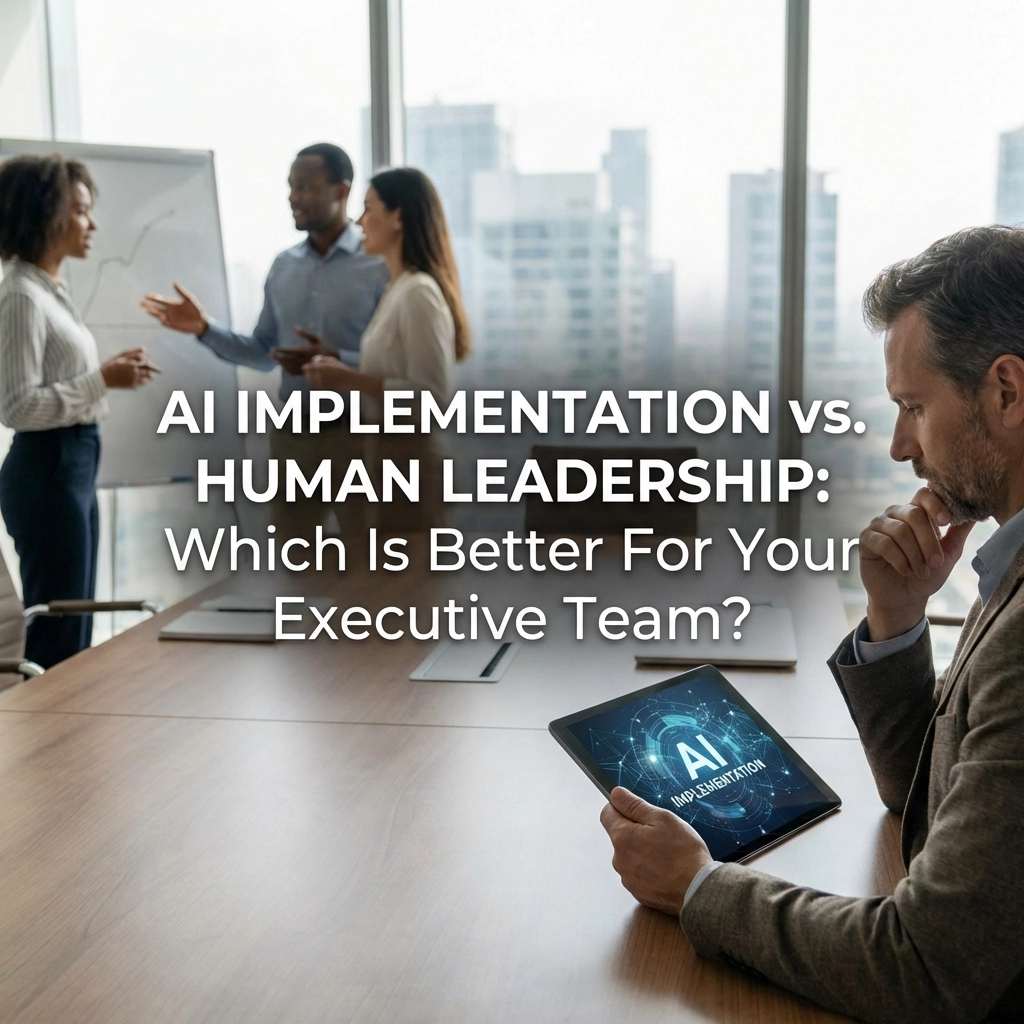
AI Implementation vs. Human Leadership: Which Is Better For Your Executive Team?

heroImage

Here’s the thing about choosing between AI implementation and human leadership: you’re asking the wrong question entirely.

As CEO of People Risk Consulting, I’ve watched countless executives get trapped in this false either-or mindset. They think they need to choose between investing in cutting-edge AI tools or doubling down on human leadership development. The reality? This binary thinking is exactly what’s keeping your competition ahead of you.

The companies winning right now aren’t picking sides. They’re combining both in ways that amplify results exponentially.

The False Choice That’s Costing You Results

When executives frame AI versus human leadership as a choice, they’re missing the fundamental truth about modern business transformation. It’s like asking whether you need a steering wheel or an engine in your car. Both are essential, and trying to operate with just one will leave you stranded.

The data backs this up dramatically. Research shows that 64% of CEOs believe succeeding with AI depends more on people’s adoption of the technology than the technology itself. That’s not a case for choosing human leadership over AI: it’s proof that human leadership is what makes AI implementation successful.

At People Risk Consulting, we see this pattern repeatedly when working with executive teams navigating digital transformation. The organizations that struggle aren’t the ones with inferior technology. They’re the ones with leaders who haven’t figured out how to guide their teams through the adoption process.

Why Human Leadership Makes or Breaks AI Success

Let’s get specific about what leadership-driven AI adoption actually looks like in practice.

Setting Clear Vision and Strategy

Organizations where AI adoption is driven by leadership with clear strategies report 62% of employees are fully engaged, compared to significantly lower engagement in organizations with haphazard adoption. This isn’t about having a tech strategy: it’s about having a people strategy for technology.

Your role as a leader isn’t to become an AI expert. It’s to become an expert at helping your team understand why AI matters to your business goals and how it connects to their individual success.

Building Trust and Addressing Resistance

Here’s what most executives miss: resistance to AI isn’t usually about the technology. It’s about fear of change, job displacement concerns, and lack of clarity about what’s expected. Leaders who succeed with AI implementation spend as much time on transparent communication and change management as they do on technical deployment.

The most effective approach we’ve seen involves employees in the planning phases from day one. When your team helps shape how AI gets integrated into their workflows, resistance transforms into ownership.

Securing Cross-functional Alignment

AI implementation fails when it becomes a technical project managed by IT. It succeeds when it becomes a business transformation project led by executives who can bridge the gap between technical capabilities and business objectives.

This requires leaders who can translate between technical and non-technical teams, ensuring everyone understands both what’s possible and what’s practical for your specific business context.

How AI Amplifies Executive Effectiveness

Now, here’s where it gets interesting. While human leadership drives AI success, AI simultaneously makes human leadership more effective.

Organizations using AI to support decisions report a 20% reduction in decision-making time. That’s not because AI makes the decisions: it’s because AI provides leaders with better data, faster analysis, and clearer options for consideration.

image_2

Administrative Liberation

AI automates repetitive administrative work, reducing administrative workloads by an average of 30%. For executives, this means less time in spreadsheets and more time on strategic thinking, team development, and relationship building.

Enhanced Coaching Capabilities

62% of employees find AI-powered coaching improves their job performance. But the key word here is “powered.” AI provides the data and insights that make human coaching conversations more targeted and effective.

When you combine AI’s pattern recognition with human emotional intelligence and contextual understanding, you get coaching that’s both data-driven and deeply personal.

Strategic Decision Support

AI excels at processing vast amounts of information and identifying patterns humans might miss. Leaders who leverage this capability don’t become less important: they become more strategic, more informed, and more effective at navigating complex business challenges.

The Winning Formula: Leadership-Driven AI Adoption

The organizations People Risk Consulting works with that achieve the best results follow a specific approach: leadership-driven AI adoption with governance structures that ensure both human oversight and technological innovation.

This means establishing clear frameworks where executives maintain strategic control while empowering their teams to experiment with AI tools in controlled, purposeful ways.

Board-Level Commitment

Successful AI implementation requires board-level commitment to both the technology investment and the cultural transformation required to maximize its impact. This isn’t a departmental initiative: it’s an organizational evolution that requires executive sponsorship and sustained support.

Role-Specific Training

Generic AI training fails. Effective AI adoption requires role-specific training that helps each team member understand exactly how AI tools will enhance their specific responsibilities and career development.

Psychological Safety for Experimentation

Leaders must create environments where teams feel safe to experiment with AI tools, make mistakes, and learn from both successes and failures. This requires a fundamental shift from perfectionist cultures to learning cultures.

Your Next Move

The question isn’t whether to choose AI implementation or human leadership development. The question is how quickly you can combine both to create competitive advantages your competition hasn’t figured out yet.

Start with leadership clarity about your AI strategy. Then invest in the change management capabilities required to guide your team through adoption. Finally, leverage AI tools to enhance your own leadership effectiveness while maintaining the human connection that drives organizational culture.

The companies that master this combination won’t just survive the AI transformation: they’ll lead it.


Ready to explore how leadership-driven AI adoption can transform your executive team? Join us for the live Brave Business Masterclass and Podcast where we dive deep into proven frameworks for combining human leadership with technological innovation. You can watch passively live or register to join our interactive studio audience for real-time Q&A and peer collaboration.

Register now at People Risk Consulting’s Training Center and discover why the most successful executives aren’t choosing between AI and human leadership( they’re mastering both.)

Why 78% of Performance Management Fails (And How to Fix Yours in 30 Days)

heroImage

Let’s cut straight to the chase: your performance management system is probably broken. And you’re not alone.

While the exact 78% figure varies by study, the reality is even more sobering. Recent data from People Risk Consulting’s executive research reveals that 95% of HR leaders are dissatisfied with their traditional performance appraisal processes, 95% of managers are unhappy with their current systems, and a staggering 44% of employees flat-out rate their performance management as a complete failure.

If you’re a seasoned executive reading this, you’ve likely felt this pain firsthand. You’ve watched talented people leave because they felt undervalued. You’ve seen high performers coast because they weren’t getting the feedback they craved. You’ve probably even questioned whether those quarterly reviews are doing anything besides checking a compliance box.

Here’s the thing: it doesn’t have to be this way. And you don’t need to wait months for a complete system overhaul to see results.

The Four Fatal Gaps Killing Your Performance Management

Before we fix anything, let’s diagnose what’s actually broken. Based on extensive research and real-world consulting experience with Fortune 500 companies, People Risk Consulting has identified four critical gaps that systematically undermine performance management systems:

The Perception Gap: When Leaders and Employees Live in Different Realities

Nearly 9 out of 10 executives believe their performance systems are effective. Meanwhile, 44% of employees rate those same systems as failures. This isn’t just a communication problem: it’s a fundamental disconnect about what “good performance management” actually looks like.

Executives often see completion rates and compliance metrics. Employees experience the day-to-day reality of unclear expectations, inconsistent feedback, and managers who seem to be going through the motions.

The Guidance Gap: Starving Your People of What They Need Most

Your managers are drowning. They lack clear roles, adequate support, and the right tools to have meaningful performance conversations. Meanwhile, employees are starving for regular, actionable feedback: not just during formal review cycles.

This gap creates a vicious cycle: managers avoid difficult conversations because they don’t feel equipped to handle them, and employees disengage because they’re not getting the guidance they need to improve.

The Skills Development Gap: Promising Growth You Can’t Deliver

Here’s a brutal truth: 86% of employees want career and skill development coaching, but only about half are satisfied with what they receive. You’re making promises about growth and development that your current system simply can’t keep.

This isn’t just about employee satisfaction: it’s about retention, engagement, and the ability to build internal capability instead of constantly hiring from outside.

The Structural Gap: One-Size-Fits-None Systems

Most performance management systems were designed for compliance, not results. They’re rigid, bureaucratic, and treat a diverse workforce like they’re all the same person with the same motivations and development needs.

Organizations using purpose-built performance management solutions integrated with their broader talent systems see 70% greater effectiveness. But most companies are still stuck with legacy systems that were never designed for today’s workforce.

The 30-Day Performance Management Reset Framework

Now for the good news: you don’t need to wait for budget approval or a massive system overhaul to start seeing results. Here’s how to begin transforming your performance management in the next 30 days:

Week 1: Audit and Align (Days 1-7)

Day 1-2: Rapid Assessment
Start with a brutal honesty check. Survey a representative sample of your managers and employees with three simple questions:

  • How would you rate our current performance management system? (1-10)
  • What’s the biggest obstacle to having effective performance conversations?
  • If you could change one thing immediately, what would it be?

Day 3-5: Manager Readiness Review
Identify which managers are actually equipped to have performance conversations. Look for those who already provide regular feedback, have strong relationships with their teams, and understand the business impact of individual performance.

Day 6-7: Quick Wins Identification
Based on your assessment, identify 2-3 changes you can implement immediately without system changes or budget approval. These might include new conversation frameworks, clearer role definitions for managers, or simple feedback templates.

Week 2: Manager Activation (Days 8-14)

Focus on Your Strong Managers First
Don’t try to fix everyone at once. Start with your best managers: the ones who already “get it” but need better tools and frameworks.

Implement Weekly Check-ins
Replace quarterly reviews with brief weekly check-ins using this simple framework:

  • What’s going well this week?
  • What’s challenging you right now?
  • How can I help remove obstacles?
  • What do you want to focus on improving next week?

Create Manager Peer Groups
Pair experienced managers with those who struggle with performance conversations. This peer coaching approach often works better than top-down training.

Week 3: Employee Engagement Reboot (Days 15-21)

image_1

Flip the Script on Performance Conversations
Instead of managers telling employees how they’re performing, train managers to ask:

  • “How do you think you’re performing against your goals?”
  • “What support do you need to perform at your best?”
  • “What would success look like for you in the next quarter?”

Implement Real-Time Recognition
Create simple ways for managers to acknowledge good work when it happens, not months later during formal reviews. This could be as simple as a dedicated Slack channel or a weekly email highlighting wins.

Week 4: System Integration (Days 22-30)

Connect Performance to Business Impact
Help managers understand how individual performance connects to team and company goals. Provide clear metrics and examples of what “good” looks like in each role.

Create Feedback Loops
Establish regular ways to measure whether your changes are working. This might include pulse surveys, manager confidence assessments, or simple metrics like the frequency of performance conversations.

Plan Your Next Phase
Based on what you’ve learned in 30 days, create a 90-day plan for deeper changes. This might include technology upgrades, more comprehensive manager training, or redesigning your formal review process.

Beyond the Quick Fix: Building Long-Term Performance Excellence

These 30-day changes will give you immediate improvement, but lasting transformation requires a more strategic approach. The most successful organizations People Risk Consulting works with focus on three key areas:

Manager Development as a Core Competency
They invest heavily in developing managers’ abilities to have difficult conversations, provide meaningful feedback, and connect individual performance to business results.

Technology That Enables, Not Complicates
They choose performance management tools that integrate seamlessly with their existing systems and actually make managers’ jobs easier, not harder.

Culture That Values Growth Over Compliance
They shift from a mindset of “checking boxes” to genuinely developing people and improving business outcomes.

Your Next Step: From Knowledge to Action

Here’s what separates executives who actually fix their performance management from those who just talk about it: they get external perspective from experts who’ve seen what works across multiple organizations and industries.

The patterns that emerge when you’ve helped dozens of companies transform their performance management are invaluable. You start to see the common pitfalls, the interventions that actually move the needle, and the sequence that maximizes your chances of success.

Ready to dive deeper into transforming your performance management system and tackling the broader people risks that keep you up at night? Join us for the live Brave Business Masterclass and Podcast, where we’ll share advanced frameworks for overcoming performance management challenges and other critical business risks. You can watch passively live or register to join our interactive studio audience where you can ask questions and get personalized insights for your specific situation.

Register now for the Brave Business Masterclass and Podcast and discover how top executives are turning their biggest people challenges into competitive advantages.

The 30-day framework above will get you started, but the masterclass will show you how to sustain and scale those improvements for long-term impact. Because fixing performance management isn’t just about better reviews: it’s about building an organization where talent thrives and business results follow.

Unmasking Leadership: Why Experimentation Bias Keeps CEOs Stuck (and How to Get Real About Growth)

heroImage

Let’s get real for a minute.

You didn’t get to the C-suite by accident. You’ve built companies, led teams through chaos, and made decisions that kept the lights on when everyone else was panicking. You’ve earned your seat at the table.

But here’s the uncomfortable truth that most leadership coaches won’t tell you: the same skills that got you here might be the exact things keeping you stuck.

At People Risk Consulting, we’ve worked with countless CEOs who came to us frustrated. They had vision. They had strategy. They had teams ready to execute. But something was off. Growth had stalled. Innovation felt forced. And despite all their experience, they couldn’t figure out why.

The culprit? A sneaky little phenomenon we call experimentation bias, and it’s probably running your leadership playbook right now without you even knowing it.

What Is Experimentation Bias (And Why Should You Care)?

Here’s the thing about being a leader: you’re expected to have answers. Your board wants certainty. Your team wants direction. Your investors want confidence. So you learn to project all of those things, even when you’re not feeling them.

Over time, you develop what Dr. Diane Dye, CEO of People Risk Consulting, calls “masks.” The mask of competence. The mask of certainty. The mask of always knowing best.

These masks feel protective. They help you navigate high-stakes conversations and maintain credibility. But they come with a hidden cost.

Experimentation bias happens when leaders only run experiments that protect their ego instead of challenging their assumptions.

Think about it. When was the last time you tested a hypothesis that could prove you wrong? When did you last greenlight a project that made you genuinely uncomfortable, not because of the risk to the business, but because of the risk to your self-image?

Research shows that CEOs face significant obstacles to learning from experience. Many corporate learning opportunities occur infrequently during a leader’s tenure, meaning opportunities to learn from previous mistakes are few and far between. Worse, certain biases get reinforced rather than overcome, leaders tend to overestimate their personal control over outcomes and become overinvested in their own decisions.

This isn’t a character flaw. It’s human nature. But if you want sustainable, infinite growth? You’ve got to confront it head-on.

The Three Masks That Keep CEOs Stuck

Let’s break down the masks that create experimentation bias. See if any of these sound familiar.

Mask #1: The Competence Mask

This is the “I’ve got this handled” mask. You wear it in board meetings, investor calls, and team all-hands. It says: “I know what I’m doing. Trust my track record.”

The problem? When you’re always projecting competence, you stop asking for help. You stop admitting when you don’t know something. And you definitely stop running experiments that might expose gaps in your knowledge.

The cost: You miss out on diverse perspectives that could unlock breakthrough solutions.

Mask #2: The Certainty Mask

This mask projects unwavering confidence in your strategy. It tells everyone, including yourself, that the path forward is clear.

But real growth rarely comes from certainty. It comes from curiosity. From being willing to say, “I think this is the right direction, but let’s test it.”

The cost: You double down on strategies that aren’t working because admitting uncertainty feels like weakness.

Mask #3: The “Knowing Best” Mask

This is the most dangerous one. It’s the belief that your experience and intuition should override data, feedback, and dissenting opinions.

Yes, your experience matters. But when “knowing best” becomes your default operating mode, you stop listening. You stop experimenting with ideas that didn’t originate from you. And you create a culture where your team stops bringing you uncomfortable truths.

The cost: Innovation dies. Your best people disengage. And growth stalls.

The Real Reason You Fear Surprises

Here’s what Dr. Diane Dye has observed after years of consulting with executive leaders: most CEOs don’t fear surprises because they lack vision. They fear surprises because surprises threaten the masks they’ve worked so hard to maintain.

Think about it. A surprise means something happened that you didn’t predict. If you’re wearing the certainty mask, that’s a direct hit to your credibility. If you’re wearing the competence mask, it suggests a blind spot. If you’re wearing the “knowing best” mask, it means someone else saw something you missed.

So what do you do? You unconsciously design experiments and strategies that minimize the chance of surprise. You test things you’re pretty sure will work. You avoid the experiments that could reveal something you don’t want to see.

This is experimentation bias in action. And it’s killing your potential for real growth.

What Infinite Growth Actually Requires

Let’s talk about infinite growth: the kind of sustainable expansion that doesn’t plateau or burn out.

Infinite growth doesn’t come from protecting what you’ve built. It comes from being willing to tear down your assumptions and rebuild them based on what’s actually true.

That requires a different kind of leadership. One where:

  • Vulnerability is a strategic advantage, not a liability
  • Being wrong is data, not failure
  • Uncomfortable experiments are prioritized, not avoided
  • Surprises are welcomed as opportunities to learn, not threats to manage

At People Risk Consulting, we call this “unmasked leadership.” And it’s the foundation of every sustainable growth story we’ve seen.

How to Start Taking Off the Mask

So how do you actually do this? Here are four practices that People Risk Consulting recommends for CEOs ready to get real about growth:

1. Run One “Ego-Threatening” Experiment Per Quarter

Identify one assumption you’re deeply attached to: maybe it’s about your market, your team, or your strategy. Then design an experiment specifically to challenge it. Not to confirm it. To challenge it.

2. Create a “Surprise Welcome” Culture

Start celebrating surprises in your leadership team meetings. When something unexpected happens, resist the urge to find blame. Instead, ask: “What did we learn? What assumption was wrong? How does this make us smarter?”

3. Invite Dissent

Actively seek out the people on your team who disagree with you. Give them permission: and safety: to challenge your thinking. The best CEOs don’t surround themselves with yes-people. They surround themselves with people brave enough to say, “I think you’re wrong, and here’s why.”

4. Get Outside Perspective

This is where working with an experienced consulting partner like People Risk Consulting becomes invaluable. When you’re inside the system, it’s almost impossible to see your own masks. An outside perspective can hold up the mirror and help you see what’s really driving your decisions.

Ready to Have a Real Conversation?

Look, reading a blog post is a good start. But real transformation happens in real conversation: the kind where you can ask hard questions, get challenged, and walk away with actionable insights.

That’s exactly why we created the Brave Business Masterclass and Podcast.

This isn’t your typical webinar where you sit passively and listen to a polished presentation. This is a live experience where CEO Diane Dye and guests tackle the real challenges facing today’s leaders: including topics like experimentation bias, unmasked leadership, and sustainable growth.

You have two ways to join:

  1. Watch live as a passive viewer and absorb the conversation
  2. Register to join the interactive studio audience and participate in real-time discussion

Either way, you’ll walk away with practical frameworks and honest insights you won’t find anywhere else.

👉 Register now for the Brave Business Masterclass and Podcast

It’s time to take off the mask. It’s time to run the experiments that actually matter. And it’s time to get real about what growth looks like for you.

We’ll see you there.

CEO Growth Stalls Got You Stuck? 5 Steps to Turn Leadership Breakdowns Into Business Breakthroughs

heroImage

Growing a business is tough. Growing yourself as a CEO while scaling that business? That’s where things get really challenging. If your company’s growth has hit a plateau and you’re feeling like you’re pushing a boulder uphill every single day, you’re not alone: and more importantly, you’re probably the key to solving it.

The uncomfortable truth many CEOs face is that they often become the very bottleneck preventing their organization’s breakthrough. But here’s the good news: recognizing this pattern is your first step toward transforming leadership challenges into competitive advantages.

At People Risk Consulting, we’ve worked with hundreds of executives who’ve navigated these exact waters. The leaders who break through aren’t necessarily the smartest or most experienced: they’re the ones who master the art of strategic self-evolution. Let’s dive into the five proven steps that can turn your leadership breakdown into your business breakthrough.

Step 1: Acknowledge You Are the Ceiling (and the Key)

This might sting a little, but here’s the reality: if your company isn’t growing, there’s a good chance you’re the bottleneck. And paradoxically, that’s actually excellent news.

Many founder-CEOs and seasoned executives unintentionally create single points of failure where nothing moves without their explicit approval. Every decision flows through your desk. Every strategic conversation waits for your input. Every opportunity requires your green light. Sound familiar?

The result? Your business becomes a reflection of your personal bandwidth limitations rather than its true potential. Projects stall in your inbox. Teams wait for direction that never comes quickly enough. Market opportunities slip away while you’re buried in operational decisions that others could handle.

But here’s why this is actually great news: if you’re the ceiling, you’re also the key. Unlike external market factors or competitive pressures you can’t control, you have complete authority over the one variable that can unlock exponential growth: yourself.

The first breakthrough happens when you shift from denial (“My team isn’t stepping up”) to ownership (“I’m not creating the conditions for them to step up”). This mindset shift alone can be transformational for both you and your organization.

Step 2: Shift from Exertion Mode to Elevation Mode

Stop trying to muscle your way to success. If you’re relying on pure willpower, longer hours, and personal heroics to drive business results, you’re operating in what we call “exertion mode”: and it’s unsustainable.

The most successful CEOs People Risk Consulting works with have mastered the transition to “elevation mode.” Instead of pushing the business forward through sheer force, they build structures and systems that pull the business forward automatically.

Here’s what elevation mode looks like in practice:

Hire for breadth and depth. Bring in leaders who have both commercial experience and deep expertise. These aren’t just skilled executors: they’re strategic thinkers who can run entire business functions without your constant oversight.

Decentralize decision-making systematically. Create clear decision-making frameworks that allow your team to act independently within defined parameters. This doesn’t mean losing control: it means gaining leverage.

Invest in your own development. This might seem counterintuitive when you’re busy, but the ROI on CEO development is extraordinary. Every hour you invest in upgrading your leadership capabilities multiplies across your entire organization.

The goal is to evolve from being a “player coach” who’s still executing daily tasks to being a true “head coach” who can see around corners and anticipate market shifts while your team handles execution.

Step 3: Adopt a Growth Mindset Across Your Organization

Here’s a statistic that should grab your attention: companies with a growth mindset are 2.4 times more likely to outperform their peers, according to McKinsey research. But implementing a growth mindset isn’t about hanging motivational posters: it’s about fundamentally changing how your organization approaches problems and opportunities.

A true growth mindset in business means believing that your products, policies, team capabilities, and market position can all be improved through effort, learning, and strategic iteration. It’s the difference between asking “Why isn’t this working?” and “What would make this work better?”

Try these growth mindset diagnostic questions with your leadership team:

  • “What am I not doing that I would start doing if I were launching a new company today?”
  • “If I were our biggest competitor, how would I put us out of business?”
  • “What assumptions about our market or customers have we never actually tested?”
  • “Where are we saying ‘that’s just how we do things here’ instead of asking ‘what’s possible?'”

The answers to these questions often reveal blind spots that, once addressed, can unlock significant competitive advantages. Growth mindset isn’t just about optimism: it’s about systematic curiosity and continuous improvement.

Step 4: Refocus Your Strategy and Operations

When growth stalls, it’s tempting to look for completely new markets or revolutionary innovations. But often, the biggest opportunities are hiding in plain sight within your existing business.

Start with a strategic audit using proven frameworks. SWOT analysis can reveal hidden strengths and unaddressed weaknesses. Porter’s Five Forces helps you understand competitive dynamics you might be missing. Jobs-to-be-Done interviews with customers often uncover unmet needs that represent immediate revenue opportunities.

But here’s where many CEOs make a critical mistake: they neglect their existing customer base while chasing new prospects. Your current customers are your highest-probability growth opportunity. They already trust you, understand your value, and are often hungry for additional solutions.

Focus on strengthening these existing relationships by:

  • Addressing their evolving needs with new services or products
  • Introducing premium offerings that deliver higher value
  • Creating systems to capture and act on customer feedback regularly

Simultaneously, audit your operations with fresh eyes. Look for manual processes that could be automated, redundant workflows that slow decision-making, and inefficient tool usage that frustrates your team. Often, operational improvements can deliver immediate productivity gains that compound over time.

Step 5: Appoint an Advisory Board and Seek External Expertise

One of the loneliest aspects of being a CEO is that you’re surrounded by people all day but can’t share your real doubts and concerns with your team. This isolation can lead to blind spots that become costly over time.

Building a hand-picked team of independent experts: whether through a formal advisory board, executive coaching, or peer advisory groups: provides the external perspective you need to break through plateaus.

The right external advisors bring three critical elements:

Fresh thinking. They’ve seen different industries, business models, and solutions. They can spot patterns and opportunities that are invisible to you because you’re too close to your business.

Accountability. Unlike your team, advisors have no vested interest in telling you what you want to hear. They can challenge your assumptions and push you toward uncomfortable but necessary decisions.

Strategic perspective. They help you see around corners and think beyond current constraints. This outside perspective often provides the well-timed insight that makes the difference between breakthrough and continued stagnation.

When People Risk Consulting partners with CEOs, we often serve this advisor role: bringing expertise from working with hundreds of similar businesses while maintaining the objectivity that internal teams can’t provide.

Your Next Move

Recognizing that you might be the bottleneck in your business isn’t a failure: it’s the beginning of your breakthrough. The five steps we’ve outlined aren’t just theoretical concepts; they’re practical frameworks that hundreds of successful CEOs have used to transform their leadership and unlock sustainable growth.

The question isn’t whether these principles work: it’s whether you’re ready to implement them systematically and consistently.

If you’re serious about turning your leadership challenges into competitive advantages, I invite you to join us for our live Brave Business Masterclass and Podcast. You can watch passively to absorb insights and strategies, or register to join our interactive studio audience where you can engage directly with expert facilitators and fellow business leaders facing similar challenges.

Ready to stop being the ceiling and start being the catalyst? Register for the Brave Business Masterclass and Podcast here and take the first step toward your breakthrough.

The most successful CEOs aren’t the ones who never hit growth plateaus: they’re the ones who use those plateaus as launching pads for their next level of success.

Struggling With Employee Performance Gaps? 15 AI-Human Partnership Strategies That Actually Work

heroImage

Your performance management system is broken. You know it. Your employees know it. And throwing more AI tools at the problem isn’t fixing anything.

Think you’re solving performance gaps by replacing human judgment with algorithms? Think again.

The real breakthrough isn’t AI versus human. It’s AI with human. And most leaders are getting this partnership completely wrong.

82% of middle-skill jobs now require digital capabilities, yet organizations are still measuring performance like it’s 1995. You’re not broken: you’re at a critical opportunity. The companies cracking this code are seeing performance transformations that seemed impossible just 24 months ago.

Here’s what People Risk Consulting has learned from working with CEOs who’ve successfully closed their performance gaps using AI-human partnerships that actually move the needle.

The Performance Gap Illusion

You think your performance gaps are about skills. Wrong.

They’re about measurement systems that punish collaboration. Every time you pit humans against AI in performance reviews, you create resistance → fear → underperformance → bigger gaps.

The breakthrough happens when you stop asking “How do we make humans perform better?” and start asking “How do we make human-AI teams unstoppable?”

15 Field-Tested Strategies That Close Performance Gaps Fast

Strategy 1-3: Reframe Your Performance Metrics

1. Replace Individual Metrics with Collaboration Scores

Stop measuring Sarah against her pre-AI baseline. Start measuring how Sarah + AI outperforms the old standard. Track:

  • AI adoption rates across teams
  • Quality improvements when using AI assistance
  • Speed of task completion with AI partnership

2. Add AI Collaboration to Performance Reviews

Create formal criteria that recognize employees who effectively leverage AI tools. Make AI proficiency a promotion requirement. Organizations implementing this see 40% faster AI adoption rates.

3. Track Partnership Metrics, Not Replacement Metrics

Measure frequency of AI usage → breadth of application → innovation in AI deployment. Reward employees who find creative AI applications, not those who avoid the technology.

Strategy 4-6: Leverage AI for Smarter Goal Setting

4. Deploy AI-Powered Goal Assistance

Use AI to analyze each employee’s role, past performance, and career aspirations to create personalized performance goals. No more generic objectives that miss the mark.

5. Implement Real-Time Performance Feedback

Traditional annual reviews are dead. Deploy AI that provides continuous, personalized performance insights in the flow of work. Especially powerful for remote and hybrid teams.

6. Generate AI-Driven Conversation Prompts

Give managers AI-generated discussion topics tailored to each employee’s goals, performance history, and development needs. Turn awkward check-ins into breakthrough conversations.

Strategy 7-9: Define Clear Role Boundaries

7. Map AI Tasks vs. Human Tasks

Create explicit boundaries: AI handles data processing, automation, and pattern recognition → Humans own creativity, emotional intelligence, and strategic thinking. No gray areas.

8. Conduct Regular Skill Assessments

Assess both human and AI capabilities quarterly. Identify gaps, reveal biases, and guide upskilling priorities. What your AI can’t do becomes your team’s competitive advantage.

9. Train Employees in Prompt Engineering

This skill is becoming indispensable. Teach your team to craft precise inputs that optimize AI outputs. It’s the difference between mediocre AI assistance and game-changing AI partnership.

Strategy 10-12: Build Essential Partnership Skills

10. Develop Digital Proficiency Programs

Your team needs AI-related skills now, not eventually. Create structured learning paths that build confidence with AI tools alongside core job responsibilities.

11. Create Innovation Payout Structures

Reward AI-driven improvements financially. Make the human-AI partnership profitable for employees, not just the company. Watch adoption rates skyrocket.

12. Launch Collaboration Recognition Programs

Celebrate human-AI partnership wins publicly. Share success stories monthly. Demonstrate that AI adoption leads to advancement, not replacement.

Strategy 13-15: Optimize Manager Effectiveness

13. Use AI for Comprehensive Feedback Summaries

Free managers from administrative burdens by having AI generate feedback summaries and remove calibration bias. Redirect that time to meaningful coaching conversations.

14. Automate Routine Manager Tasks

Let AI handle data-heavy performance tracking → Managers focus on personalized development plans and relationship building. This is where the magic happens.

15. Establish Transparent Communication Channels

Create feedback loops where employees can report AI tool issues and contribute to improvements. Emphasize augmentation over replacement in all communications.

The 90-Day Implementation Framework

Month 1: Audit and Assessment

  • Review existing performance metrics
  • Identify AI-resistant behaviors
  • Map current skill gaps

Month 2: System Implementation

  • Deploy new measurement systems
  • Train managers on AI-powered feedback tools
  • Launch collaboration recognition programs

Month 3: Incentive Alignment

  • Introduce innovation payouts
  • Make AI proficiency part of promotion criteria
  • Collect and share success stories

Why Most AI Performance Initiatives Fail

They focus on technology adoption instead of partnership optimization.

You can’t solve human performance problems with AI tools alone. You solve them by creating systems where humans and AI make each other better.

The companies winning this game aren’t asking “How do we get people to use AI?” They’re asking “How do we create conditions where human-AI collaboration becomes inevitable?”

The Real Talk About Implementation

This isn’t a quick fix. It’s a fundamental shift in how you think about performance.

You’ll face resistance. Some managers will cling to old evaluation methods. Some employees will fear being replaced. Some executives will want faster results.

That’s normal. That’s expected. That’s why most organizations give up too early.

The breakthrough happens around month four, when your teams start discovering AI applications you never imagined. When performance improvements compound. When your people start teaching you about partnership possibilities.

Your Next Move

Performance gaps aren’t disappearing with traditional approaches. They’re getting worse as the pace of change accelerates.

You have two choices: Keep measuring individual performance in isolation, or build systems that amplify human-AI partnerships.

The organizations choosing partnership are pulling ahead fast. The gap between leaders and laggards is widening every quarter.

At People Risk Consulting, we’ve helped dozens of leadership teams implement these strategies successfully. The results speak for themselves: faster performance improvements, higher engagement scores, and breakthrough innovations that seemed impossible before.

Want to see how this applies to your specific performance challenges? Join the live Brave Business Masterclass + Podcast from People Risk Consulting—built for seasoned CEOs who want real talk, practical frameworks, and zero fluff.

Registration is open, but seats are limited. Watch passively via the live stream, or register for the interactive studio audience to get on‑mic Q&A, hot‑seat coaching, and peer exchange with other executives.

Your performance gaps aren’t a sign you’re failing. They’re a signal you’re ready for the next level of organizational capability.

The question isn’t whether AI-human partnerships will define the future of performance management.

The question is whether you’ll lead that transformation or get left behind by it.

Why 85% of Workers Crave Agility But Your “Flexible” Workplace Is Still Failing

heroImage

You think you’ve cracked the code on workplace flexibility. Your company offers remote work options. You’ve got hybrid policies. You even let people adjust their hours.

Think again.

85% of workers are desperately craving agility in their roles, yet your “flexible” workplace is still hemorrhaging talent faster than you can replace them. The brutal truth? You’re not offering flexibility. You’re offering performance theater.

And it’s costing you everything.

The $50 Million Blind Spot Every CEO Misses

Here’s what Diane Thompson, CEO of People Risk Consulting, sees when she walks into executive boardrooms: Leaders who confuse flexibility with agility. Leaders who think three days in the office versus two is strategic workforce planning.

You’re not broken. You’re at a critical opportunity.

The data doesn’t lie. 95% of HR professionals confirm that flexible working is the most in-demand benefit prospective employees seek. Yet only 58% of employers say all or most employees in their organization can actually work flexibly.

→ High demand meets restricted access
→ Creates immediate fairness crisis
→ Triggers talent exodus

The math is devastating. In the UK alone, 1.1 million workers changed jobs last year primarily due to lack of flexibility. In the US, 47% of workers plan to look for new positions in 2026. And here’s the kicker: 40% would immediately start job hunting if their current flexibility was removed.

That’s not employee entitlement. That’s market disruption happening in real time.

Unmasking the 3 Critical Flexibility Failures

Failure #1: The Checkbox Mentality

You implemented remote work policies because everyone else did. You created hybrid schedules because the consultants said you should. You’re checking boxes, not solving problems.

Real talk: Your employees see right through this performative flexibility.

When office attendance requirements rose 12% between Q1 2024 and Q3 2025, but actual attendance only increased 1-3%, that’s not employee defiance. That’s employees rejecting arbitrary mandates that don’t serve business outcomes.

Failure #2: The Communication Vacuum

You mandate three days in office. Why three? Why not two or four? Your people are left guessing because you never communicated the strategic reasoning behind your decisions.

Leading organizations that successfully implement flexible work arrangements share one critical trait: They’re intentional about who is eligible for hybrid or remote work, they communicate the ‘why’ for on-site requirements, and they establish shared collaboration hours.

→ No clear communication
→ Breeds employee resentment
→ Undermines policy effectiveness

Failure #3: The Productivity Paradox

You’re measuring presence instead of performance. Badge counts instead of business impact. This backwards approach is exactly why your flexibility initiatives are failing.

Companies focused on strategic flexibility for employee engagement consistently outperform those obsessing over “who’s in the building when.” The difference isn’t the policy: it’s the mindset.

The Agility Framework That Actually Works

Here’s what People Risk Consulting has discovered working with Fortune 500 executives: True workplace agility isn’t about where people work. It’s about how work gets done.

Quick Win #1: Outcome-Based Performance Metrics

Stop measuring: Hours worked, days in office, meeting attendance
Start measuring: Project completion rates, quality scores, innovation contributions

Quick Win #2: Structured Flexibility Models

Create clear frameworks that define:

  • Which roles require on-site presence and why
  • Collaboration windows when teams must be available
  • Performance standards that apply regardless of location

Quick Win #3: Data-Driven Decision Making

Track the metrics that matter:

  • Employee productivity by work arrangement
  • Retention rates across different flexibility options
  • Customer satisfaction scores by team structure

22% of workers would expect a pay raise to compensate for lost flexibility. When flexibility becomes a valued compensation component, treating it casually becomes an expensive mistake.

The Gentrification Effect: Why Some Companies Win While Others Lose

There’s a dangerous divide emerging in the marketplace. Older, established firms are cutting flexibility while younger, fast-growing companies are expanding it.

This creates a two-tier system where access to agile work depends on company age rather than work requirements. The companies doubling down on rigid structures? They’re becoming the workplace equivalent of expensive neighborhoods that price out the talent they need most.

The breakthrough insight: Your competition isn’t just other companies in your industry. It’s every organization offering the workplace agility your people crave.

Avoiding the 5 Most Expensive Missteps

Misstep #1: Treating All Roles the Same

Not every position requires the same flexibility approach. Customer service might need coverage hours. Creative teams might need collaboration time. Engineers might need deep focus periods.

Misstep #2: Ignoring Manager Training

Your managers are implementing your flexibility policies. If they don’t understand how to lead distributed teams effectively, your policies will fail regardless of how well-designed they are.

Misstep #3: Avoiding Difficult Conversations

Some employees will try to exploit flexibility. Some managers will resist it. Address these issues directly rather than creating policies that punish everyone for the actions of a few.

Misstep #4: Implementing Without Infrastructure

Flexible work requires technology, communication protocols, and cultural shifts. Rolling out policies without the supporting infrastructure is setting everyone up for frustration.

Misstep #5: Making Changes Based on Fear

“What if productivity drops? What if culture suffers? What if we lose control?” These fears drive bad decisions. Make changes based on data and strategic objectives, not anxiety.

The Bottom Line: Your Flexibility Strategy Is Your Talent Strategy

You can continue offering surface-level flexibility that satisfies no one and drives away top performers. Or you can build genuine workplace agility that becomes your competitive advantage.

The choice isn’t whether to offer flexibility. The choice is whether to do it strategically.

When Diane works with executive teams struggling with workforce transformation, she sees the same pattern repeatedly: Leaders who think they’re being flexible when they’re actually being rigid. Leaders who confuse accommodation with agility.

You’re not failing because flexibility doesn’t work. You’re failing because you’re implementing yesterday’s solutions to today’s workforce challenges.

Your Next Move

Stop treating workplace flexibility like a perk you grudgingly provide. Start treating it like the strategic workforce tool it actually is.

The companies getting this right aren’t just retaining talent: they’re attracting the highest performers who have choices about where to work. They’re not just avoiding the $50 million replacement costs of high turnover. They’re building cultures that drive innovation and growth.

Ready to transform your approach to workplace agility? Join Diane Thompson live on the Brave Business Masterclass and Podcast from People Risk Consulting. You can watch live passively or register to be in the interactive studio audience. Seats are limited—register here.

Because here’s what every successful CEO knows: In a world where 85% of workers crave agility, the companies that provide authentic flexibility win everything. The companies that fake it lose everyone.

The question isn’t whether your people want workplace agility. The question is whether you’re ready to provide it strategically.

Your move.

The Proven 5-Step Framework to Stop Internal Friction From Killing Your Growth

Your business is bleeding money. And you don’t even know it.

Think you’ve got your operations dialed in? Think again. While you’re obsessing over market share and revenue targets, internal friction is quietly strangling your growth potential: and it’s happening in plain sight.

Here’s what’s really happening: 78% of executive teams report feeling “stuck” despite having solid strategies and talented people. The culprit? Five invisible friction points that transform high-performing organizations into energy vampires.

You’re not broken. You’re at opportunity.

The Hidden Cost of Business Friction

Let me be direct. Your ignored friction quietly trains your business to be harder than necessary. What you tolerate becomes your operating standard.

→ Decision paralysis costs companies an average of $3.1 million annually in lost productivity
→ Role confusion increases project timelines by 40%
→ Unclear expectations drive 67% of workplace conflict
→ Energy drains reduce executive effectiveness by up to 50%

This isn’t about perfection. It’s about unmasking the bottlenecks that are keeping your talented team trapped in operational quicksand.

image_1

Framework Overview: The 5 Friction Fixes

At People Risk Consulting, we’ve identified exactly where high-growth companies get stuck. Not in strategy. Not in talent. In the spaces between decisions, roles, and expectations.

Here’s your breakthrough framework:

Step 1: Decision Friction → Default Decision Rules
Step 2: Role Friction → Outcome Naming
Step 3: Expectation Friction → Write Once, Say Twice
Step 4: Energy Friction → Drain Identification
Step 5: Momentum Friction → Feedback Loop Creation

Remember: Drag is feedback, not failure. These friction points are signaling exactly where your attention needs to go.

Step 1: Eliminate Decision Friction

The Problem: Your leadership team is drowning in micro-decisions.

Every “quick question” pulls focus. Every approval request creates delays. Your executives spend 40% of their time on decisions that should be automatic.

The Fix: Create default decision rules.

Stop re-deciding the same things repeatedly. Make rules for yourself.

Practical Implementation:

Hiring decisions: Pre-define non-negotiables vs. nice-to-haves
Budget approvals: Set clear thresholds and delegation levels
Meeting requests: Establish standard criteria for yes/no
Priority conflicts: Create decision trees for resource allocation

Real Talk: If you’re still personally approving expense reports under $500, you’re not leading: you’re micromanaging.

Step 2: Resolve Role Friction

The Problem: It’s unclear who needs to do what.

This isn’t just about job descriptions. Role friction happens when talented people waste energy figuring out who owns what outcome instead of delivering results. Our company CEO Dr. Diane Dye puts it like this, “people have to know what game they are playing, how it’s scored, what tools to use, and what winning looks like. Otherwise its like handing someone a basketball and saying go play baseball and go figure that out.”

The Fix: Name your outcomes clearly.

Stop defining roles by activities. Start defining roles by outcomes.

Outcome Naming Formula:

  1. Who is accountable for the result?
  2. What specific outcome are they delivering?
  3. When will success be measured?
  4. How will we know they’ve succeeded?

Example Transformation:

  • Before: “Sarah handles marketing”
  • After: “Sarah owns quarterly lead generation targets (500 qualified leads/quarter) and brand positioning initiatives”

You’re not creating bureaucracy. You’re creating clarity that unleashes performance.

Step 3: Fix Expectation Friction

The Problem: Assumptions live in the shadows.

When expectations remain unspoken, misalignment creates drag. Teams work hard in different directions. Good intentions produce bad results.

The Fix: Write it once, say it twice.

Document expectations visibly. Then communicate them clearly. Repetition without rigidity.

The Write Once, Say Twice Method:

Write Once:
• Document project expectations in shared spaces
• Create visible dashboards for key metrics
• Establish written protocols for recurring situations

Say Twice:
• Verbal confirmation in team meetings
• One-on-one alignment conversations
• Regular check-ins on shared understanding

Critical Insight: You think you’re being clear. Your team thinks you’re being vague. Bridge that gap intentionally.

Step 4: Address Energy Friction

The Problem: Certain activities drain disproportionate energy.

Not all tasks are created equal. Some activities energize your team. Others create invisible exhaustion that compounds over time. Energy friction is performance poison.

The Fix: Identify and eliminate energy drains.

Energy Audit Process:

  1. Track energy levels: Monitor team engagement across different activities
  2. Identify patterns: What consistently drains vs. energizes?
  3. Redesign workflows: Minimize drains, maximize energizers
  4. Delegate strategically: Move drains to people who find them energizing

Common Energy Drains:
• Repetitive manual processes → Automate or systematize
• Unclear communication channels → Streamline information flow
• Misaligned skill-to-task matching → Reorganize responsibilities
• Constant context switching → Create focused work blocks

Remember: Your best people will leave energy-draining environments before they’ll complain about them.

Step 5: Create Momentum Through Feedback Loops

The Problem: Friction accumulates without detection systems.

Most organizations only notice friction when it becomes crisis. By then, the damage is done. You need early warning systems.

The Fix: Build systematic feedback loops.

Momentum Monitoring System:

Weekly Pulse Checks:
• What felt effortless this week?
• Where did we hit unexpected friction?
• What decisions took longer than necessary?

Monthly Friction Audits:
• Review decision-making patterns
• Assess role clarity across teams
• Evaluate energy levels and engagement

Quarterly Framework Reviews:
• Update default decision rules
• Refine outcome definitions
• Streamline communication protocols

The 72-Hour Rule: When friction emerges, address it within 72 hours. Don’t let it become your new normal.

Implementation: Your Next 30 Days

Stop waiting for perfect conditions. Start experimenting immediately.

Week 1: Decision Friction Audit

  • List your 20 most frequent decisions
  • Create default rules for top 10
  • Test with leadership team

Week 2: Role Friction Assessment

  • Map unclear outcome ownership
  • Redefine top 5 critical roles by outcomes
  • Communicate changes clearly

Week 3: Expectation Documentation

  • Identify top 3 assumption-heavy areas
  • Implement “write once, say twice” protocol
  • Create visible expectation dashboards

Week 4: Energy and Momentum Setup

  • Conduct team energy audit
  • Establish weekly pulse check rhythm
  • Plan monthly friction review process

The Breakthrough Moment

Here’s what happens when you systematically eliminate friction: Your talented people finally perform at their actual capacity.

Companies using this framework report 35% faster decision-making, 50% clearer role execution, and 60% reduction in internal conflict within 90 days.

You don’t need more strategy. You don’t need more talent. You need less friction.

The question isn’t whether you have friction. The question is whether you’ll address it before it addresses your growth targets for you.

Your breakthrough is waiting on the other side of this framework. Stop tolerating what’s stealing your momentum.

Ready to eliminate the friction that’s keeping your team stuck? Join me live for the Brave Business Masterclass and Podcast from People Risk Consulting. Watch the livestream passively, or register to be in the interactive studio audience with your peer cohort. Register now — seats are limited.

Because your growth can’t wait for someday. It’s waiting for today.

Are You Making These 7 Common AI Implementation Mistakes? (And How to Fix Them Before They Tank Your ROI)

heroImage

Think your AI strategy is bulletproof? Think again.

87% of AI initiatives fail to deliver expected ROI. The culprit isn’t the technology: it’s how you’re implementing it.

You’re not broken. You’re at a critical opportunity. The companies getting AI right aren’t smarter than you. They’re just avoiding these seven devastating mistakes that are silently hemorrhaging your budget and sabotaging your competitive edge.

Real talk: Most executives are walking into AI implementation blind. They’re betting millions on initiatives that are doomed from day one. The breakdown isn’t in your vision: it’s in your execution.

Here’s what’s really happening behind closed doors at People Risk Consulting when we audit failed AI projects. And more importantly, here’s how to fix it before it tanks your ROI.

Mistake #1: Launching Without a Clear Strategic North Star

You think you have an AI strategy. You don’t.

What you have: A collection of shiny AI tools and vendor promises
What you need: A laser-focused alignment between AI capabilities and specific business problems

The brutal truth: Companies spend an average of $2.4 million on AI initiatives without defining what success looks like. They’re solving problems that don’t exist while ignoring the bottlenecks that actually matter.

The Fix That Actually Works:

Start with your biggest people risk challenge. Not the sexiest AI use case: the one that’s costing you real money right now.

• Define 3 specific business outcomes (not technology features)
• Establish measurable success metrics before touching any code
• Create a 12-month roadmap that connects AI investments to revenue impact
• Build accountability structures that track ROI monthly, not annually

Action Step: If you can’t explain your AI ROI in one sentence to your CFO, you don’t have a strategy yet.

Mistake #2: Feeding Your AI System Garbage Data

Your AI is only as brilliant as your data is clean.

Here’s the uncomfortable reality: 73% of enterprise data goes unused because it’s too messy to be valuable. You’re asking AI to make million-dollar decisions based on information you wouldn’t trust to schedule a lunch meeting.

Garbage data in = Expensive mistakes out

The Fix That Prevents Disaster:

Treat data preparation like a forensic investigation, not a checkbox exercise.

• Audit your data sources for accuracy, completeness, and bias
• Implement validation protocols that catch errors before they compound
• Create data governance structures that maintain quality over time
• Test your data with small pilots before scaling to enterprise-wide implementations

Reality Check: If you’re not spending 60% of your AI budget on data preparation, you’re setting yourself up for spectacular failure.

Mistake #3: Swinging for the Fences Instead of Securing Quick Wins

You’re trying to build Rome in a day.

The pattern we see repeatedly: Executive teams launch massive AI transformations that take 18 months to show results. Meanwhile, stakeholders lose confidence, budgets get slashed, and promising initiatives die slow deaths.

image_1

The Fix That Builds Momentum:

Start with wins that deliver value in 90 days or less.

• Identify repetitive tasks that AI can automate immediately
• Focus on single-department pilots before company-wide rollouts
• Create visible success stories that build organizational buy-in
• Use early wins to fund bigger, bolder initiatives

Framework for Quick Wins:

  1. Week 1-2: Identify highest-impact, lowest-risk opportunity
  2. Week 3-8: Build and test minimum viable AI solution
  3. Week 9-12: Deploy, measure results, document learnings
  4. Repeat and scale

Mistake #4: Building AI for Engineers, Not End Users

Your AI solution is technically perfect and practically useless.

The breakdown: You’ve created an AI system that impresses data scientists but confuses the humans who actually need to use it. Adoption rates plummet. Value remains locked behind complicated interfaces.

Technical brilliance ≠ Business success

The Fix That Drives Adoption:

Design for the person who will use it daily, not the person who built it.

• Conduct user interviews before writing a single line of code
• Create interfaces that feel familiar, not futuristic
• Build feedback loops that allow continuous improvement
• Test with real users in real scenarios, not lab conditions

User-Centric Validation Questions:

  • Can a new hire figure this out in under 5 minutes?
  • Does this solve a problem users actually have?
  • Is the learning curve worth the productivity gain?

Mistake #5: Solving the Wrong Problem Perfectly

You’ve built a Ferrari for grocery shopping.

The misalignment crisis: Your AI solution addresses the problem you think you have, not the problem you actually have. You’re optimizing for efficiency when you need effectiveness. You’re automating processes that shouldn’t exist in the first place.

The Fix That Targets Real Issues:

Map your AI investments to your actual business bottlenecks.

• Interview front-line employees about daily frustrations
• Analyze where manual work creates the biggest delays
• Identify decisions that currently require multiple approval layers
• Focus on problems that directly impact customer experience or revenue

Diagnostic Framework:

  • Surface problem: “We need better analytics”
  • Real problem: “We make decisions too slowly”
  • AI solution: Automated decision-making for routine scenarios

Mistake #6: Racing to Production Without Proper Validation

You’re treating AI implementation like a software update, not a business transformation.

42% of AI projects fail because they’re rushed to production without adequate testing. You’re prioritizing speed over sustainability, creating technical debt that will cost you exponentially more to fix later.

Fast deployment + Poor validation = Expensive disasters

The Fix That Prevents Catastrophic Failures:

Build validation checkpoints that catch problems before they scale.

• Test with diverse user groups across different departments
• Create staging environments that mirror production conditions
• Establish rollback procedures before you need them
• Implement gradual deployment phases with success gates

Phased Deployment Strategy:

  1. Alpha: Internal team testing (2 weeks)
  2. Beta: Select power users (4 weeks)
  3. Limited production: Single department (6 weeks)
  4. Full deployment: Company-wide rollout

Mistake #7: Ignoring the Human Side of AI Transformation

You’re implementing technology while forgetting about the humans who make it successful.

The cultural blindspot: You’ve invested millions in AI capabilities but zero dollars in change management. Your teams are resistant, confused, or actively sabotaging initiatives they don’t understand.

Technical success + Cultural failure = Wasted investment

The Fix That Builds Organizational Buy-In:

Treat AI as a people transformation, not just a technology upgrade.

• Create AI champions in every department before rollout
• Develop training programs that focus on benefits, not features
• Establish clear communication about job security and role evolution
• Build feedback mechanisms that make employees partners, not victims

Change Management Essentials:

  • Transparency: Share the “why” behind AI decisions
  • Training: Invest in skills that complement AI, don’t compete with it
  • Support: Create help systems for the learning curve
  • Recognition: Celebrate employees who embrace AI successfully

The Bottom Line: Your AI Success Depends on Execution, Not Innovation

Here’s what separates AI winners from losers: They focus on fundamentals, not features.

The companies generating real ROI from AI aren’t using the fanciest tools. They’re avoiding these seven mistakes systematically. They’re building foundations that support sustainable growth, not quick demos that impress investors.

Your next move matters.

Every day you delay fixing these implementation gaps is another day your competitors gain ground. But here’s the opportunity: most of your industry is making these same mistakes. The executives who get this right will dominate their markets within 24 months.

Ready to pressure-test your AI plan with a live, no-masks conversation?

Join the Brave Business Masterclass and Podcast from People Risk Consulting. Two ways to participate:
• Watch live as a passive attendee if you want the signal without the spotlight
• Register for the interactive studio audience to ask questions, get coached in real time, and pressure-test your execution

Registration is open now. Studio seats are limited.

Reserve your spot for the Brave Business Masterclass and Podcast

Because your AI transformation is too important to leave to chance.