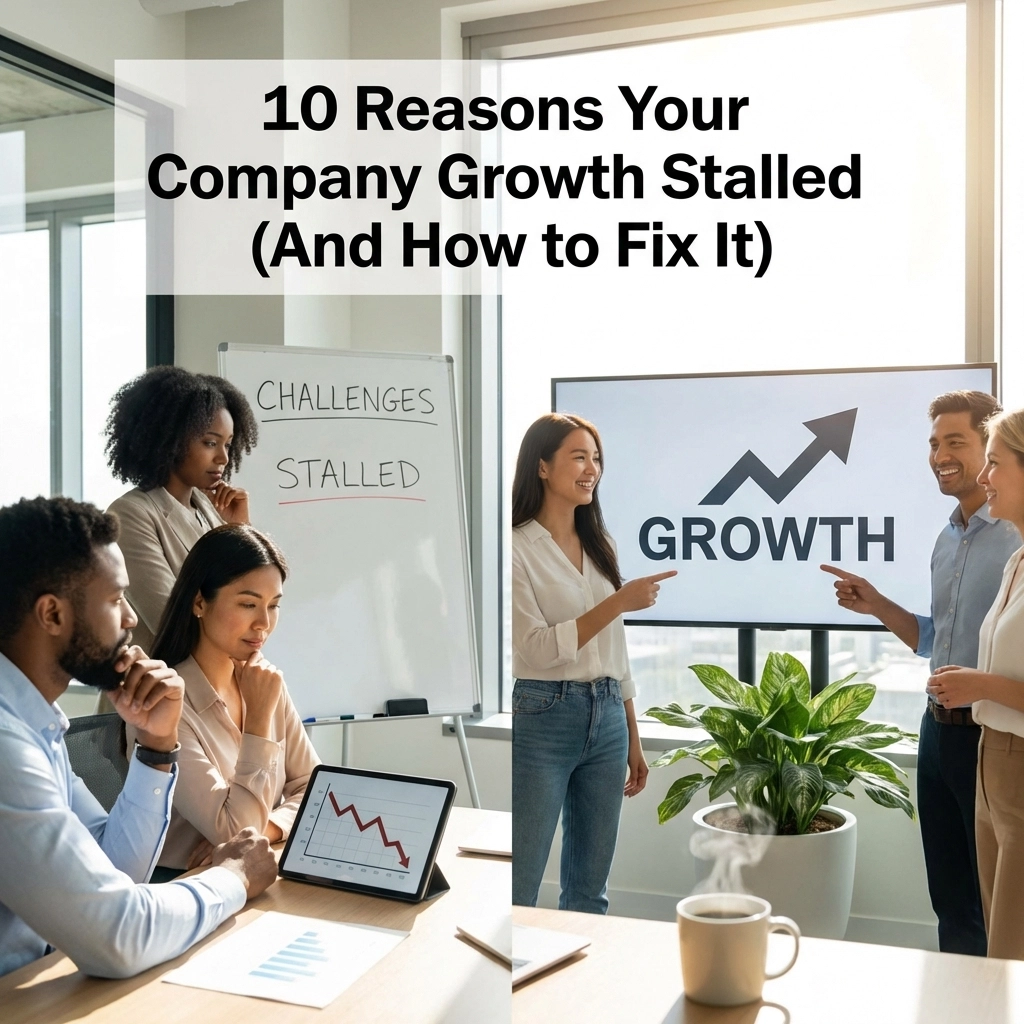
10 Reasons Your Company Growth Stalled (And How to Fix It)

heroImage

Growth doesn’t stop with a loud crash. It fades quietly, so quietly that most leaders don’t notice until revenue flatlines, talent walks out the door, and the competition pulls ahead.

At People Risk Consulting, we’ve seen this pattern play out across industries. The companies that stall aren’t failing because of one catastrophic decision. They’re failing because small, invisible risks compound over time. Friction builds. Processes calcify. Teams disengage. And suddenly, the momentum that once felt unstoppable… stops.

Here’s the good news: growth stalls are diagnosable, and they’re fixable. But only if you’re willing to look at what’s actually happening beneath the surface.

Let’s break down the 10 most common reasons your company growth has stalled, and what you can do about each one.

1. Leadership Alignment Is an Illusion

The Problem: Your executive team believes they’re aligned. They’re not. Subtle differences in priorities, definitions of success, and strategic direction create invisible fractures that widen over time. These gaps don’t surface in meetings, they surface in conflicting decisions, mixed signals to teams, and competing initiatives that drain resources.

The Fix: Schedule dedicated alignment sessions, not operational check-ins, where leadership explicitly defines shared priorities and success metrics. Create space for constructive disagreement. Silence isn’t alignment; it’s avoidance.


2. Every Decision Runs Through the Same Three People

The Problem: When your company was small, centralized decision-making made sense. Now it’s a bottleneck. Opportunities pass you by while waiting for approval. Teams lose initiative because they’ve learned that nothing moves without executive sign-off.

The Fix: Build decision-making frameworks that delegate authority within clear boundaries. Define what decisions teams can make autonomously, what requires consultation, and what escalates to leadership. Then trust the framework.


3. Your Processes Were Built for a Company That No Longer Exists

The Problem: The systems that carried you through early growth weren’t designed to scale. But instead of redesigning them, your organization clings to familiar structures, even when they create friction at every turn.

The Fix: Conduct a quarterly process audit. Identify where bottlenecks consistently appear. Then invest in streamlining or replacing those systems. This isn’t about change for change’s sake, it’s about removing the drag that’s slowing you down.


4. Truth Doesn’t Reach Power

The Problem: Without structured feedback loops, leaders make decisions in a vacuum. Employees see problems but don’t report them. Clients experience friction but don’t complain, they just leave. And leadership keeps steering based on outdated assumptions.

The Fix: Create formal channels for feedback from employees, clients, and frontline operations. More importantly, make it safe to deliver bad news. The organizations that learn fastest are the ones where truth speaks to power, without consequences for the messenger.


5. Your Culture Has Become Allergic to Change

The Problem: Strong cultures are an asset, until they calcify. When stability becomes the dominant value, innovation gets quietly strangled. Teams grow comfortable. Execution drifts from strategy. And the organization loses its ability to adapt.

The Fix: Foster a learning culture that values calculated risk-taking alongside stability. Address cultural resistance directly when implementing new tools or processes. Buy-in before rollout prevents the workarounds that undermine change initiatives.


6. Nobody Actually Knows What Success Looks Like

The Problem: Mismatched goals between leadership and teams create conflicting priorities. One group optimizes for growth, another for profitability, another for operational efficiency. Without clarity, everyone works hard in different directions: and progress stalls.

The Fix: Establish explicit definitions of success at the company, department, and individual levels. Make goals transparent. Revisit them regularly. Alignment isn’t a one-time conversation: it’s an ongoing discipline.


7. You’re Solving Problems Your Customers Don’t Have

The Problem: Many growth stalls trace back to a fundamental disconnect: the company is building solutions based on assumptions about customer needs rather than actual market research. Products don’t resonate. Sales cycles lengthen. Churn increases.

The Fix: Invest in genuine market research. Talk to customers: not to validate your assumptions, but to challenge them. Stay in touch with external market realities. The market doesn’t care what you think it needs; it cares about what actually solves its problems.


8. Your Talent Strategy Is Reactive, Not Strategic

The Problem: People Risk Consulting sees this constantly: companies treat talent as an operational issue rather than a strategic asset. They hire reactively, develop inconsistently, and retain haphazardly. Then they’re surprised when key people leave and institutional knowledge walks out with them.

The Fix: Build a proactive talent strategy that addresses recruitment, development, and retention as interconnected systems. Identify your critical roles and create succession plans. Invest in leadership development before you need it: not after someone gives notice.


9. Customer Churn Is Quietly Destroying Your Growth

The Problem: Acquisition metrics look healthy, but customers leave almost as fast as they arrive. High churn creates a treadmill effect: you’re running hard just to stay in place. Growth becomes mathematically impossible.

The Fix: Analyze why customers leave. Look at onboarding friction, product-market fit, service quality, and competitive alternatives. Then address root causes systematically. Retention improvements often deliver faster ROI than acquisition investments.


10. Cash Flow Constraints Are Choking Your Options

The Problem: Poor cash flow management limits your ability to invest in growth opportunities, weather disruptions, or respond to competitive threats. Inadequate working capital creates a perpetual state of financial firefighting.

The Fix: Implement strong financial controls and forecasting tools. Create contingency plans for different scenarios with specific budgetary triggers. Address receivables promptly. Cash flow discipline isn’t glamorous: but it’s the oxygen that keeps growth possible.


The Common Thread: Invisible Risk

Here’s what these 10 factors have in common: they develop quietly and become normalized over time. They’re invisible to leadership: until they’re not.

The companies that break through growth stalls aren’t necessarily smarter or better resourced. They’re more honest. They’re willing to diagnose what’s actually happening rather than what they wish were happening. And they take action before problems become crises.

At People Risk Consulting, we specialize in helping leaders see the risks hiding in plain sight: the friction, the talent gaps, the process failures, the cultural blind spots that stall growth. Because you can’t fix what you can’t see.


Ready to Diagnose Your Growth Stall?

If any of these 10 factors resonated, you’re not alone. Most growing companies hit these walls at some point. The question is whether you’ll address them proactively: or wait until the damage forces your hand.

Join us for the Brave Business Masterclass and Podcast, where we break down exactly these kinds of challenges with real-world strategies you can implement immediately. Watch passively live, or register to join the interactive studio audience where you can bring your specific questions to the conversation.

Register for the Brave Business Masterclass and Podcast →

Growth stalls are fixable. But only if you’re brave enough to look at what’s actually in the way.


The CEO’s Guide to Psychological Safety at Scale

You built the culture when it was just you and a handful of believers. Everyone felt safe to speak up, challenge ideas, and admit mistakes. The trust was real.

Now you’re scaling. Fifty people. Two hundred. Maybe more. And somewhere along the way, that psychological safety you never had to think about? It started slipping through the cracks.

Here’s what most CEOs get wrong: they assume psychological safety scales automatically with good intentions. It doesn’t. In fact, the very pressures of growth: speed, performance demands, new leadership layers: can actively erode the environment you worked so hard to create.

At People Risk Consulting, we work with executive leaders navigating exactly this challenge. The companies that win aren’t the ones that hope culture survives growth. They’re the ones that architect psychological safety into the operating system of their organization.

Let’s break down how.

What Psychological Safety Actually Means at Scale

Psychological safety isn’t about being nice. It’s not about avoiding conflict or making everyone comfortable all the time.

It’s the shared belief that team members can take interpersonal risks: speak up, disagree, ask questions, admit errors: without fear of punishment or humiliation.

When you had ten people, this happened naturally. You knew everyone. They knew you. Trust was personal.

At scale, trust has to become structural.

This means psychological safety can’t live only in your leadership team’s behavior. It has to be embedded in:

  • How managers at every level run meetings
  • How feedback flows (up, down, and sideways)
  • How failures are discussed and learned from
  • How decisions get made and communicated

The moment you have middle managers, department heads, and team leads who weren’t in the room when you built the original culture? You need systems, not just vibes.

The Real Risks of Ignoring Psychological Safety

Let’s be direct about what’s at stake here.

A McKinsey survey found that only 26% of business leaders consistently demonstrate the behaviors that promote psychological safety. That means roughly three out of four leaders are unknowingly creating environments where people stay quiet, play it safe, and hide problems until they explode.

Here’s what that costs you:

Innovation dies quietly. People stop bringing bold ideas because they’ve learned it’s safer to stay in their lane. You won’t hear the objection that could have saved a product launch. You won’t get the creative solution from someone three levels down who sees the problem clearly.

Retention suffers invisibly. Your best people don’t complain: they leave. And exit interviews rarely capture the real reason: “I didn’t feel safe being myself here.”

Risk compounds in silence. When people are afraid to flag problems early, small issues become crises. The harassment complaint that wasn’t escalated. The project timeline everyone knew was unrealistic but no one challenged. The burnout spreading through a team that no one talked about.

Trust fractures unevenly. Research shows that some team members: particularly those from underrepresented groups: may experience significantly less psychological safety than others. If you’re not actively monitoring this, you’re building a culture that works for some and fails for others.

The CEO’s Framework for Scaling Psychological Safety

At People Risk Consulting, we’ve helped executive leaders build psychological safety into organizations ranging from fast-growth startups to established enterprises under pressure. Here’s the framework that works.

1. Make It an Explicit Strategic Priority

Psychological safety can’t be a nice-to-have buried in your HR initiatives. It needs to be named, measured, and connected to business outcomes.

This means:

  • Including psychological safety metrics in leadership evaluations
  • Discussing it in board meetings and all-hands communications
  • Tying it directly to your innovation, retention, and performance goals

When your organization sees that the CEO treats this as a strategic lever: not a soft skill: behavior changes.

2. Develop Leaders at Every Level

The greatest impact comes from training and developing managers at all levels, not just your senior team.

Your frontline managers have more daily influence on psychological safety than you do. They’re the ones running the meetings, giving the feedback, responding to mistakes in real time.

Invest in teaching all managers to:

  • Seek feedback actively and respond non-defensively
  • Model vulnerability by sharing their own challenges and uncertainties
  • Recognize early signs of burnout and enforce healthy boundaries
  • Create space for dissent without punishment

A 2022 Deloitte study found that 80% of employees trust leaders who openly discuss mental health and workload challenges. That trust is built in hundreds of small moments: and your managers are the ones creating those moments.

3. Implement Consistent Practices Organization-Wide

Scaling requires standardized approaches that still allow for team-level adaptation.

Communication norms: Establish clear expectations around transparency. Regular updates on business challenges and successes. No after-hours emails unless genuinely urgent. Open acknowledgment when things aren’t going well.

Feedback channels: Create multiple ways for people to raise concerns: anonymous surveys, regular one-on-ones, skip-level meetings, open-door policies. And crucially, demonstrate that input actually influences decisions.

Failure rituals: Normalize learning from mistakes. Some organizations run “failure forums” or post-mortems that celebrate what was learned rather than assigning blame. When people see that admitting errors leads to learning (not punishment), they start speaking up earlier.

4. Monitor Patterns and Adapt Continuously

Psychological safety isn’t a program you implement once. It’s a living system that requires ongoing attention.

Pay close attention to patterns:

  • Are certain teams or demographics reporting lower safety?
  • Where are the gaps between stated values and lived experience?
  • What’s happening to safety scores during high-pressure periods?

Use pulse surveys, stay interviews, and qualitative conversations to keep your finger on the pulse. And be willing to adapt your approach based on what you learn.

Why This Is a CEO-Level Priority

You might be wondering: shouldn’t this be HR’s job?

Here’s the truth. HR can design programs and track metrics. But psychological safety is fundamentally about power dynamics: and you hold the most power in your organization.

When you model vulnerability, people notice. When you respond to bad news with curiosity instead of blame, it signals what’s acceptable. When you admit publicly that you got something wrong, you give everyone else permission to do the same.

The CEO sets the ceiling for psychological safety. Your organization can never be safer than your leadership team demonstrates.

And in high-stakes growth: when everything is moving fast, pressure is high, and the temptation is to push harder: this becomes even more critical. The companies that scale successfully aren’t the ones that sacrifice culture for speed. They’re the ones that recognize psychological safety as the foundation that makes sustainable speed possible.

Your Next Step

Building psychological safety at scale isn’t something you figure out alone. It requires frameworks, accountability, and honest conversation with leaders who’ve navigated the same challenges.

That’s exactly what we do in the Brave Business Masterclass and Podcast: a live session where CEOs and executive leaders tackle the real questions about scaling people-first cultures under pressure.

You can watch passively live or register to join the interactive studio audience and get your specific questions answered.

Register for the Brave Business Masterclass and Podcast here

Your culture got you here. Strategic leadership will get you where you’re going.

Are Annual Performance Reviews Dead? Do People Still Use Them in 2026?

heroImage

Let’s cut to the chase: annual performance reviews aren’t completely dead in 2026, but they’re on life support. And if your organization is still clinging to them as your primary performance management tool, you’re carrying significant: and often invisible: risk.

The data tells a compelling story. While 71% of companies still conduct some form of annual review, the majority are actively transforming how they approach performance management. At People Risk Consulting, we’re seeing this shift firsthand as CEOs and executive teams grapple with a fundamental question: Is our performance system helping us win, or is it quietly holding us back?

The Hidden Cost of Holding On

Here’s what rarely makes it into the boardroom discussion: managers spend an average of 210 hours annually preparing performance reviews. That’s more than five full work weeks: per manager: devoted to a process that both managers and employees have complained about for decades.

The complaints are well-documented:

  • Excessive cost and time demands
  • Subjectivity and bias in evaluations
  • Failure to capture true employee contributions
  • Feedback that arrives too late to be actionable
  • Reviews that don’t actually drive performance improvements

But here’s the real risk that People Risk Consulting sees leaders underestimate: annual reviews create a false sense of performance visibility. You think you know how your people are performing because the paperwork is complete. Meanwhile, disengagement festers, top talent quietly updates their LinkedIn profiles, and skill gaps widen unnoticed for eleven months at a time.

Why the Traditional Model No Longer Works

The annual review was designed for a different era: one where job roles were static, market conditions shifted gradually, and a year felt like a reasonable timeframe to evaluate performance.

That world doesn’t exist anymore.

In 2026, competitiveness depends on agility. According to Academy of Management scholar Peter Bamberger, “competitiveness will be largely determined by the ability of an organization to more effectively develop employee skills and monitor their enterprise-wide skill inventories.”

When you evaluate performance once a year, you’re essentially driving forward while looking in the rearview mirror. The feedback is retrospective when it needs to be prospective. The conversation is evaluative when it should be developmental.

The Bias Problem

Annual reviews are particularly susceptible to cognitive biases that distort the entire evaluation:

  • Recency bias: Managers overweight recent performance and underweight contributions from earlier in the year
  • Halo/horn effects: One strong or weak attribute colors the entire evaluation
  • Similarity bias: Managers rate employees who are similar to themselves more favorably
  • Central tendency: Risk-averse managers cluster everyone in the middle, making reviews meaningless

These aren’t minor inconveniences. They’re systematic distortions that undermine trust, misallocate rewards, and create legal exposure. At People Risk Consulting, we consider them material people risks that require strategic mitigation.

What Actually Works in 2026

The organizations outperforming their competitors aren’t abandoning performance management: they’re reimagining it. Here’s what the evidence shows is working:

1. Continuous Feedback Systems

Real-time, ongoing feedback has replaced the annual dump of information. This doesn’t mean daily evaluations; it means regular touchpoints: weekly one-on-ones, monthly check-ins, and quarterly deeper conversations: that keep performance visible and development on track.

The shift is from retrospective performance evaluation to forward-looking skill development and real-time coaching. Instead of asking “How did you perform last year?”, leaders are asking “What skills do you need to develop this quarter, and how can I support that?”

2. AI-Driven Skill Assessment

Periodic AI-guided employee check-ins focused on skill development are emerging as a powerful replacement for traditional reviews. These systems can:

  • Identify skill gaps in real-time
  • Map individual capabilities against team and organizational needs
  • Provide objective data to complement manager observations
  • Track development progress continuously rather than annually

Bamberger predicts that these AI-guided approaches will fundamentally transform how organizations think about performance: from evaluation to development, from judgment to growth.

3. Multi-Source Feedback Mechanisms

The annual review typically captures one perspective: the manager’s. Modern performance systems incorporate multiple viewpoints: peers, direct reports, cross-functional partners, and self-assessment: to create a fuller, more accurate picture.

This isn’t 360-degree feedback administered once a year. It’s ongoing, trust-building dialogue that surfaces issues early and celebrates wins in real-time.

4. Outcome-Based Performance Metrics

Rather than subjective assessments of how someone “showed up,” leading organizations are connecting individual performance to measurable business outcomes. What results did this person drive? What impact did their work have on team objectives?

This requires clarity about what matters: something many organizations struggle to provide. But when you can connect individual contributions to outcomes that move the business, performance conversations become strategic rather than administrative.

The Transition Challenge

Here’s the honest truth: most organizations are in an awkward middle phase. They know the annual review isn’t working, but they haven’t fully committed to an alternative. The result is often the worst of both worlds: annual reviews that no one believes in, plus continuous feedback that feels like extra work.

At People Risk Consulting, we help executive teams navigate this transition strategically. The goal isn’t to eliminate all structure: it’s to replace outdated rituals with systems that actually drive the outcomes you need.

What a Modern Performance Risk Mitigation Strategy Looks Like

Step 1: Diagnose your current state honestly. Are your reviews actually driving performance improvement, or are they compliance theater? What risks are you carrying because performance issues go unaddressed for months?

Step 2: Define what you’re optimizing for. Development? Accountability? Reward allocation? Legal protection? Different goals require different systems.

Step 3: Design contained experiments. Don’t overhaul everything at once. Pilot continuous feedback with one team. Test AI-guided skill assessments in one department. Measure what works before scaling.

Step 4: Build manager capability. The shift from annual evaluator to ongoing coach requires new skills. Many managers have never been taught how to give real-time feedback effectively.

Step 5: Align systems and incentives. If you ask for continuous feedback but only tie rewards to annual ratings, you’ve created a conflict that will undermine the entire effort.

The Bottom Line

Annual performance reviews aren’t dead: but they’re dying. And the organizations that cling to them as their primary performance management tool are accumulating hidden risk: disengagement, talent loss, skill gaps, and bias-driven decisions.

The future belongs to organizations that treat performance as a continuous conversation rather than an annual event. That shift requires strategy, capability, and courage: but the payoff is a workforce that develops faster, engages deeper, and delivers more.

Ready to Transform Your Approach?

If you’re a CEO or executive leader ready to move beyond outdated performance rituals, join us for the Brave Business Masterclass and Podcast. You can watch passively live or register to join the interactive studio audience where we tackle exactly these kinds of strategic people risks in real-time.

Register for the Brave Business Masterclass and Podcast →

Because in 2026, the question isn’t whether annual reviews are dead. The question is whether you’re ready to build something better.

7 Mistakes You’re Making with Change Management (and How to Fix Them)

heroImage

You’ve led your company through market shifts, recessions, and industry disruptions. You’ve made tough calls that paid off. But when it comes to change management, even the most seasoned executives stumble: often without realizing why.

Here’s the uncomfortable truth: most change initiatives fail. Not because the strategy was wrong, but because the execution ignored how people actually work, adapt, and resist.

At People Risk Consulting, we see this pattern repeatedly with executive clients. The good news? These mistakes are fixable. But only if you’re willing to look at them honestly.

Let’s break down the seven most common change management mistakes: and the practical, non-cookie-cutter fixes that actually move the needle.

Mistake #1: Waiting Until You Have All the Answers to Communicate

You want to present a polished plan. You don’t want to invite panic or confusion. So you wait. And wait. And while you’re perfecting the message, the rumor mill is doing your communication for you.

One CEO we worked with delayed announcing a restructuring until the plan was “bulletproof.” By the time he communicated, his top performers had already updated their LinkedIn profiles and started interviewing elsewhere. The damage was done before he said a word.

The Fix: Communicate early: even when the picture is incomplete. Say what you know, what you don’t know, and when you’ll share more. People can handle uncertainty. What they can’t handle is silence followed by surprise.

Create a rhythm of updates. Weekly check-ins, even brief ones, keep people anchored. One-off announcements don’t stick. Repetition and consistency do.


Mistake #2: Defining the “What” and “Why” But Ignoring the “How”

You’ve nailed the vision. Everyone knows what is changing and why it matters. But when employees ask how their day-to-day work will shift, they get blank stares or vague platitudes.

This gap between strategy and execution is where change goes to die. Without a clear “how,” people default to what they’ve always done: and your transformation stalls.

The Fix: Get specific about implementation. What processes change? What decisions move to different people? What does success look like in week one versus month six?

Don’t confuse flexibility with ambiguity. You can adapt as you go, but your team needs enough clarity to act. Build the bridge between vision and daily behavior, or watch people stay stuck on the wrong side.


Mistake #3: Fighting Your Own Culture

Every organization has unwritten rules. The way decisions really get made. Who has influence versus who has titles. What gets rewarded versus what gets tolerated.

When your change initiative runs directly against these cultural currents, you’re not leading transformation: you’re starting a civil war.

The Fix: Map your culture before you map your change. Where does this initiative align with existing values? Where does it create friction?

If you’re asking a risk-averse culture to suddenly embrace experimentation, acknowledge that tension explicitly. Build in psychological safety. Show people that the new behaviors won’t be punished when early attempts don’t go perfectly.

Culture isn’t an obstacle to manage around: it’s the terrain you’re navigating. Ignore it at your peril.

Mistake #4: Pushing Too Hard, Too Fast

You’re under pressure. The board wants results. Competitors aren’t waiting. So you compress timelines, stack initiatives, and assume your team can absorb it all.

They can’t. And here’s what happens: mistakes multiply, burnout spreads, and the very people you need to champion the change become its biggest resisters.

Research consistently shows that inadequate capacity for change is the most commonly reported mistake across organizations. Leaders assume transformation happens on top of already-stretched workloads without understanding what it actually requires.

The Fix: Before finalizing your timeline, audit capacity honestly. What can come off people’s plates to make room for this? What competing priorities need to pause?

Build in buffer time. Not because you’re being soft, but because you’re being realistic. Sustainable pace beats heroic sprints that leave your team depleted and cynical.


Mistake #5: Betting on Systems Instead of Behaviors

New CRM. New ERP. New org structure. You’ve invested millions in the “thing” that’s supposed to transform performance. But six months later, adoption is spotty and results haven’t moved.

Here’s the hard truth: change doesn’t happen because you introduced a new system. Change happens because people adopt new behaviors: and sustain them.

The Fix: For every system change, identify the three to five behavior shifts required for it to actually work. Then design your rollout around those behaviors, not just the technology.

Training should focus on how people must work differently, not just how to use the new platform. Measure behavior adoption, not just system usage. The dashboard doesn’t care if people logged in: it cares if they changed how they make decisions.

Mistake #6: Declaring Victory and Moving On

The initiative launched. The new process is live. Time to move on to the next priority, right?

Wrong. This is exactly when change is most vulnerable. Your team is still adapting, still figuring out the new way. And without continued reinforcement, they’ll snap back to old behaviors like a rubber band returning to its original shape.

The Fix: Plan for sustained reinforcement, not just launch support. Leadership must remain visibly committed for months after go-live: not just during the rollout.

Celebrate early wins publicly. Address setbacks openly. Keep the change on the agenda in team meetings, performance conversations, and leadership communications. The moment you stop talking about it, people assume it’s no longer a priority.


Mistake #7: Thinking You’ve Involved Employees When You Haven’t

Here’s a stat that should make every executive uncomfortable: 74% of leaders claim they’ve involved employees in change initiatives. Only 42% of employees report feeling included.

That gap isn’t just a perception problem: it’s a credibility problem. And it’s costing you trust, engagement, and the discretionary effort that makes transformation actually work.

The Fix: Genuine involvement means employees shape the change, not just receive it. Create structured opportunities for input before decisions are finalized. Show how that input influenced the outcome.

Connect the dots between daily work and the broader transformation. People need to see themselves in the change, not just be told about it.


The Real Risk of Getting This Wrong

Failed change management isn’t just an operational hiccup. It’s a compounding risk that erodes trust, burns out your best people, and creates organizational scar tissue that makes the next transformation even harder.

At People Risk Consulting, we help executive leaders diagnose where change efforts are breaking down: and design people-centric approaches that actually stick. Because the biggest risk in any transformation isn’t the strategy. It’s underestimating the human element.


Take the Next Step

If you’re navigating a significant change initiative: or recovering from one that didn’t land: you don’t have to figure it out alone.

Join us for the Brave Business Masterclass and Podcast, where we tackle real leadership challenges with practical strategies you can implement immediately. Watch passively or register to join the interactive studio audience and get your questions answered live.

Register for the Brave Business Masterclass and Podcast →

Change is hard. But it doesn’t have to be chaotic. Let’s build something that actually works.

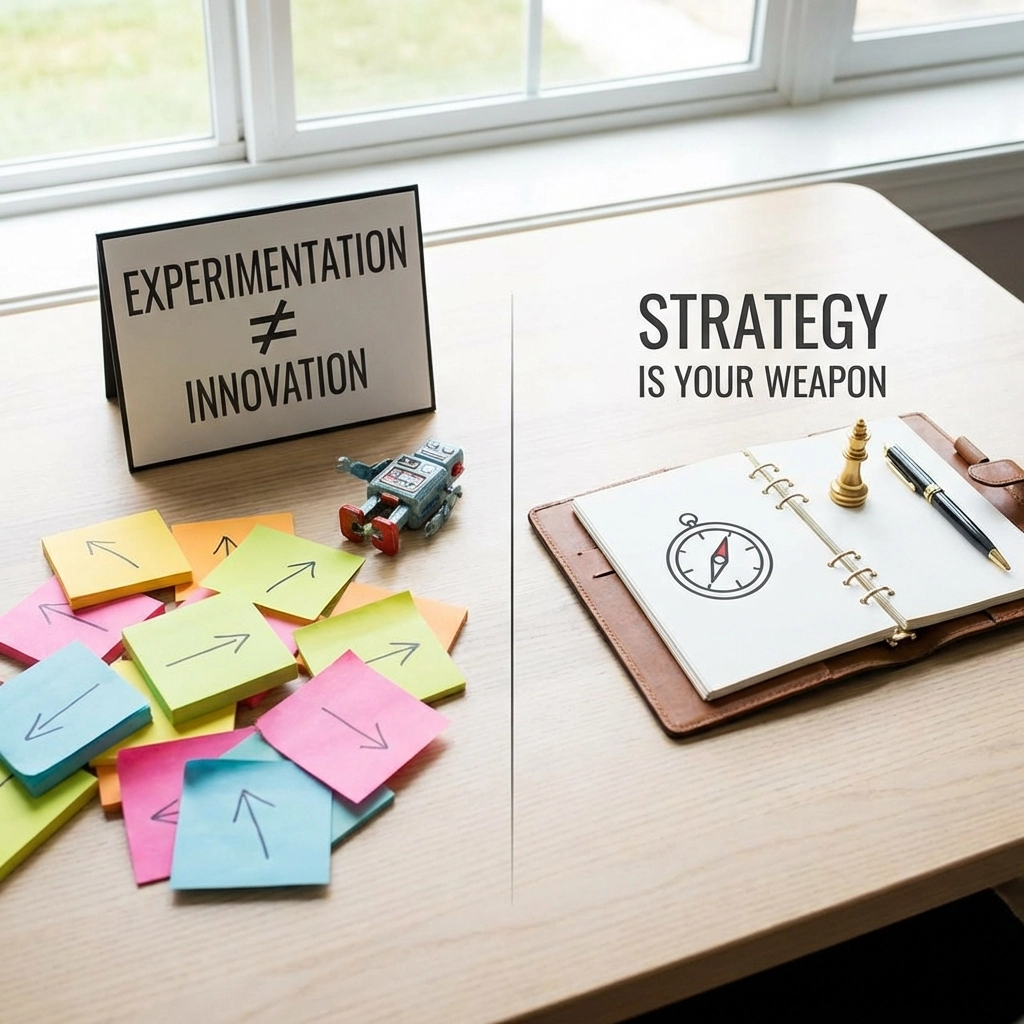
Why Experimentation Isn’t Innovation (But Strategy Is Your Real Secret Weapon)

heroImage

Let’s get something straight right from the start.

Just trying things isn’t innovation.

It’s motion. Sometimes very expensive motion.

And if you’ve been leading a team through rounds of “let’s just see what happens” initiatives, you already know the cost. Burned-out employees. Skeptical stakeholders. A growing pile of abandoned projects that never quite delivered what everyone hoped.

Here’s the truth that People Risk Consulting sees play out with executive leaders time and time again: the companies that actually innovate aren’t the ones trying the most things. They’re the ones learning faster than their problems can outrun them.

The difference? Strategy.

The Expensive Illusion of “Innovation Theater”

Real talk: there’s a massive gap between genuine innovation and what we might call innovation theater.

Innovation theater looks busy. It feels productive. Leaders launch pilots, greenlight new initiatives, and encourage teams to “think outside the box.” There are brainstorms. There are whiteboards covered in sticky notes. There’s a lot of energy.

But here’s the problem: without a clear strategic framework, all that activity often leads nowhere meaningful.

Random ideas. Gut swings. Throwing spaghetti at the wall and hoping something sticks. Or worse, dipping your whole hand into a boiling pot and flinging the spaghetti as you burn your company with lost profitability and a stressed out team.

That’s not innovation. That’s chaos dressed up in corporate buzzwords.

And chaos has consequences. Teams get tired. Leaders lose credibility. The organization develops a kind of “initiative fatigue” where every new idea is met with eye rolls instead of enthusiasm.

Sound familiar?

You’re not alone. At People Risk Consulting, we work with CEOs and senior leaders who’ve been stuck in this cycle. They know something needs to change, but they can’t quite pinpoint why all their experimentation efforts aren’t translating into actual results.

The answer is almost always the same: they’re missing the strategy layer.

Experimentation Without Strategy Is Just Expensive Guessing

Here’s where it gets interesting.

Experimentation isn’t the problem. In fact, systematic experimentation is absolutely foundational to innovation. Research consistently shows that the ability to test ideas in controlled environments: to learn what works and what doesn’t: is what separates companies that innovate from companies that stagnate.

But there’s a crucial distinction that most organizations miss.

Experimentation and innovation are closely linked, but they’re distinct stages. Experimentation is the process. Innovation is what emerges when that process is guided by clear strategic intent.

Without strategy, experimentation becomes a random walk. You might stumble onto something useful eventually, but you’ll waste enormous resources along the way. Your team will lose faith. Your board will start asking uncomfortable questions.

With strategy, experimentation becomes something entirely different: a decision engine.

What Strategic Experimentation Actually Looks Like

So what separates strategic experimentation from the spaghetti-throwing approach?

It starts with a clear question.

Not “what should we try next?” but something much more specific:

  • What is actually blocking momentum right now?
  • Where is the risk hiding in our current approach?
  • What belief, behavior, or system needs to change for results to move?

These questions force you to get honest about your real situation. They cut through the noise and point you toward experiments that actually matter.

Once you’ve identified the real barrier, you design what People Risk Consulting calls contained experiments:

Small enough to be safe. You’re not betting the company on every test. You’re creating low-risk opportunities to learn.

Serious enough to matter. This isn’t busywork. Each experiment should address a genuine strategic question with real implications for your business.

Measured enough to learn fast. You need clear criteria for success and failure before you start. What will you look for? What data will tell you whether this worked?

This is where most organizations fall apart. They launch experiments without defining what success looks like. They run pilots without clear metrics. Then, six months later, no one can agree on whether the initiative worked or not.

Strategic experimentation eliminates that ambiguity.

Strategy Turns Experimentation Into Leverage

Here’s the real power move.

When experimentation is guided by strategy, every test becomes a lever. It tells you:

  • What to test (based on your most pressing strategic questions)
  • Why it matters (connected to real business outcomes)
  • What decision you’ll make next (based on what you learn)

That last point is critical. Too many organizations run experiments and then… do nothing with the results. The data sits in a report somewhere. The insights never translate into action.

Strategic experimentation builds in the next step before you even start. You know going in: “If we see X result, we’ll do Y. If we see Z result, we’ll do W.”

This transforms experimentation from a passive learning exercise into an active decision-making tool.

Without strategy, experimentation feels chaotic and exhausting.

With it, experimentation becomes the engine that drives your organization forward.

The Real Definition of Innovation

Let’s reframe what innovation actually means.

Innovation isn’t about trying more things. It’s not about having the most ideas or launching the most pilots or being the most “disruptive.”

Innovation is about learning faster than the problem can outrun you.

Read that again.

The companies that consistently innovate aren’t necessarily smarter or more creative than their competitors. They’ve just built systems that allow them to learn and adapt at speed.

They ask better questions. They design smarter experiments. They move from insight to action without getting stuck in analysis paralysis.

And they do it all with strategy as their foundation.

At People Risk Consulting, Dr. Diane Dye and our team help executive leaders build exactly these kinds of systems. We’ve seen firsthand what happens when organizations shift from random experimentation to strategic learning: faster decisions, more confident leadership, teams that actually believe in the initiatives they’re executing.

Your Next Move: From Motion to Momentum

If you’ve been feeling stuck in the experimentation trap: lots of activity, not enough results: it’s time to step back and ask some hard questions.

Are your experiments connected to clear strategic barriers?

Do you know what success looks like before you start?

Are you building a decision engine, or just generating motion?

These aren’t easy questions. But they’re the questions that separate organizations that innovate from organizations that just stay busy.

The good news? You don’t have to figure this out alone.

Experience what strategic experimentation looks like in action. Join us for the Brave Business Masterclass and Podcast, where Dr. Diane Dye and the People Risk Consulting team break down exactly how senior leaders can build the systems, strategies, and frameworks that turn experimentation into real competitive advantage.

You can watch passively live or register to join our interactive studio audience and get your specific questions answered in real time.

👉 Register now for the Brave Business Masterclass and Podcast

Stop spinning your wheels with expensive motion. Start building the strategic experimentation engine your organization actually needs.

Because innovation isn’t about trying more things.

It’s about learning faster than the problem can outrun you.

And that journey starts with strategy.

Stop Wasting Time on Cookie-Cutter Consulting: Try These 7 Customized Risk Mitigation Hacks

heroImage

You’re tired of consultants who show up with the same tired playbook they’ve used on every other client. Sound familiar? That generic “risk assessment template” that somehow applies to both your tech startup and your neighbor’s manufacturing plant? Yeah, that’s not going to cut it.

Here’s the reality: 93% of businesses that implement cookie-cutter risk strategies see minimal improvement within the first year. Why? Because your business isn’t like everyone else’s business. Your risks, your team, your challenges: they’re uniquely yours.

At People Risk Consulting, we’ve seen executives waste months (and serious budget) on one-size-fits-all approaches that miss the mark entirely. But we’ve also seen what happens when leaders get smart about customization. The results? Game-changing.

Ready to ditch the generic stuff and try something that actually works? Here are seven customized risk mitigation hacks that successful executives are using right now.

Hack #1: Build Your Risk DNA Profile (Not Another Generic Assessment)

Forget those standard risk questionnaires. You know the ones: they ask the same questions whether you’re running a fintech company or a food truck empire.

Here’s what works instead: Comprehensive assessments that dig into your organization’s specific operations, internal value chain, and unique vulnerabilities. Think of it as creating your business’s “risk DNA.”

For example, a software company’s biggest people risk might be talent retention during rapid scaling. A family-owned manufacturer? It could be succession planning and knowledge transfer. Same category, completely different risk profiles.

The hack: Map your entire internal value chain (customer journey) first. Identify where your specific industry, size, culture, and growth stage create unique exposure points. This isn’t about checking boxes: it’s about understanding what could actually break your business.

Hack #2: Use Advanced Analysis for Smart Risk Prioritization

Most consultants hand you a risk register and say “fix everything.” That’s like a doctor saying “you have symptoms, take all the medicine.”

The smarter approach: Advanced analytical tools that help you figure out which risks deserve your immediate attention and which ones can wait.

People Risk Consulting uses techniques like Monte Carlo analysis to evaluate cost and schedule risks, helping executives make data-driven decisions about where to focus first. One manufacturing client discovered that their assumed “biggest risk” (equipment failure) was actually less impactful than an overlooked people risk (key employee burnout).

The hack: Rank your risks based on probability AND impact on your specific business goals. Use real data, not gut feelings. If you’re trying to secure Series B funding, investor-perception risks might outrank operational risks that seemed critical last quarter.

Hack #3: Run Cost-Benefit Analysis on Every Mitigation Strategy

Here’s where most risk management goes wrong: implementing every possible control “just to be safe.” It’s expensive, overwhelming, and often counterproductive.

The better way: Assist with developing mitigation strategies through rigorous cost-benefit analysis. Not every risk needs a $50,000 solution when a $500 process change would work just as well.

We worked with a tech company that was considering a $100,000 cybersecurity upgrade. After analysis, we discovered that targeted employee training (costing $8,000) would address 80% of their actual vulnerabilities.

The hack: For each identified risk, develop multiple mitigation options at different cost points. Calculate the return on risk reduction investment. Sometimes the “good enough” solution that you’ll actually implement beats the “perfect” solution that sits in a drawer.

image_1

Hack #4: Design Risk Management Workflows That Fit Your Culture

Cookie-cutter consultants love to impose their favorite risk management framework, regardless of whether it fits your organization’s structure and culture.

The reality check: A startup with 15 employees doesn’t need the same risk management workflows as a Fortune 500 company. A family business operates differently than a venture-backed scale-up.

The hack: Design risk management workflows and procedures that actually work with your organizational structure, not against it. If your team communicates through Slack and daily standups, don’t force them into quarterly formal risk committee meetings. Build risk conversations into existing processes.

One client integrated risk check-ins into their weekly leadership sync. Another built risk triggers into their project management software. Both approaches worked because they matched the companies’ natural workflows.

Hack #5: Targeted Training That Actually Sticks

Most companies roll out the same risk management training to everyone from the CEO to summer interns. Then they wonder why it doesn’t stick.

The smarter strategy: Customized training solutions tailored for specific employee groups and roles. Your risk managers need different knowledge than your subcontractors. Your executives need different training than your front-line supervisors.

People Risk Consulting designs role-specific training programs. Sales teams learn about reputation risks and client relationship management. HR learns about compliance and people-related exposures. Operations learns about process and safety risks.

The hack: Map training content to actual job responsibilities and decision-making authority. Give people the exact risk knowledge they can act on, not generic awareness training they’ll forget in a week.

Hack #6: Choose Tools That Match Your Maturity Level

There’s a risk management software for every budget, but most companies either over-engineer or under-invest in tools.

The strategic approach: Select and implement risk management tools matched to your organization’s actual maturity level and needs, not what looks impressive in demos.

A startup might need simple risk tracking in a shared spreadsheet with clear escalation triggers. A mid-size company might benefit from integrated risk dashboards. An enterprise might need sophisticated modeling capabilities.

The hack: Start with your current decision-making process. What information do leaders actually use to make decisions? Build tool requirements around real workflows, not theoretical best practices. You can always upgrade tools as your risk management maturity grows.

Hack #7: Build Continuous Improvement Into Your Risk Strategy

Here’s the biggest mistake we see: treating risk mitigation as a one-time project instead of an ongoing capability.

The sustainable approach: Iterative processes with regular reviews and checkups that adapt strategies as your business evolves.

Your risks change as you grow, enter new markets, hire new people, and face new challenges. The risk strategy that worked perfectly at 50 employees might be completely wrong at 150 employees.

The hack: Schedule quarterly risk strategy reviews (not just risk register updates). Ask these questions: What new risks have emerged? What old risks are no longer relevant? What mitigation strategies are working? What needs to be adjusted? Treat your risk strategy like a living document that grows with your business.

Stop Settling for Generic Solutions

The difference between companies that successfully manage risk and those that don’t isn’t about having more resources: it’s about having strategies that actually fit their specific situation.

Cookie-cutter consulting might seem easier upfront, but it costs more in the long run when strategies don’t work and problems aren’t actually solved.

Your business deserves better than generic solutions. Your team deserves strategies that make sense for how you actually work. Your growth deserves risk management that enables opportunity instead of just preventing problems.

Ready to see what customized risk mitigation looks like for your specific business? Join me and other forward-thinking leaders at the Brave Business Masterclass and Podcast. You can watch passively live or register to join our interactive studio audience where we dive deep into real-world risk scenarios and solutions.

Register now at our training center and discover how People Risk Consulting helps leaders build risk strategies that actually work: no cookie-cutter approaches, just results.

The Proven CEO Unstuck Framework: How Fortune 500 Leaders Navigate High-Stakes Challenges

heroImage

When Satya Nadella took over Microsoft in 2014, the company was stuck. Revenue had plateaued, cloud competitors were surging ahead, and internal silos were strangling innovation. Three years later, Microsoft’s market cap had doubled. The difference? A systematic framework for breaking through executive-level bottlenecks.

At People Risk Consulting, we’ve analyzed how Fortune 500 leaders navigate their most challenging moments. The pattern is clear: successful CEOs don’t rely on intuition alone. They follow a proven framework that transforms paralysis into strategic action.

Here’s the exact five-step system these leaders use when everything seems stuck.

Step 1: Define the End State, Not the Problem

Most stalled leaders start by analyzing what’s wrong. Fortune 500 CEOs flip this approach. They begin by crystallizing exactly where they want to be in 12-18 months.

The Clarity Test: If you can’t explain your desired outcome in one sentence to a board member, you’re not ready for Step 2. This isn’t about vision statements or corporate speak. It’s about measurable, specific results.

Example: Instead of “improve operational efficiency,” try “reduce time-to-market for new products from 18 months to 12 months while maintaining quality standards.”

People Risk Consulting’s research with C-suite executives reveals that 73% of breakthrough strategies begin with this level of endpoint clarity. The remaining 27% get stuck in analysis loops that can last quarters.

Step 2: Identify the True Bottleneck

Here’s where most leaders go wrong. They attack symptoms instead of root causes. Fortune 500 CEOs use diagnostic precision to find the single constraint that, when removed, unlocks the entire system.

The Constraint Audit:

  • What decision keeps getting delayed or revisited?
  • Where does communication consistently break down?
  • Which process causes the most executive escalations?
  • What resource shortage impacts multiple departments?

The answer is rarely obvious. At People Risk Consulting, we’ve seen CEOs spend months fixing technology issues when the real bottleneck was decision-making authority buried three levels down in the organization.

Pro Tip: If you identify more than two bottlenecks, you haven’t dug deep enough. Successful systems thinking always leads to one primary constraint.

Step 3: Filter Every Solution Through This Lens

Once you’ve identified the true bottleneck, every proposed solution gets one test: Does this directly address our primary constraint?

This filtering prevents the “shiny object syndrome” that derails executive teams. Fortune 500 leaders understand that saying no to good ideas is often more important than saying yes to great ones.

Implementation Framework:

  • Create a decision matrix with bottleneck impact as the primary criterion
  • Establish a 48-hour rule for evaluating new opportunities
  • Assign a dedicated team member to ask the constraint question in every meeting

Companies that implement this filtering approach see a 40% reduction in strategic initiative overload, according to People Risk Consulting’s executive performance data.

Step 4: Constrain to Create

Counterintuitively, Fortune 500 CEOs impose artificial limits to accelerate breakthrough thinking. Instead of exploring endless options, they constrain themselves to 2-3 strategic priorities maximum.

The Constraint Advantage:

  • Forces creative problem-solving within boundaries
  • Eliminates decision paralysis from too many choices
  • Concentrates organizational energy and resources
  • Creates clear accountability metrics

When Reed Hastings transformed Netflix from DVD-by-mail to streaming dominance, he deliberately constrained the company’s focus to one transition at a time, despite pressure to pursue multiple revenue streams simultaneously.

People Risk Consulting recommends the “Rule of Three” for executive teams: three strategic priorities, three key metrics, three decision-makers for each initiative. This constraint framework prevents strategic dilution while maintaining focus intensity.

Step 5: Test Fast, Iterate Faster

Fortune 500 CEOs prioritize momentum over perfection. They launch 70% solutions and improve them based on real market feedback rather than waiting for theoretical perfection.

The Velocity Protocol:

  • Set 30-day test cycles for new initiatives
  • Establish go/no-go criteria before launching
  • Create rapid feedback loops from key stakeholders
  • Build iteration capacity into initial budgets

This approach requires a cultural shift from “fail-safe” to “safe-to-fail” thinking. People Risk Consulting’s work with Fortune 500 executives shows that companies embracing rapid iteration cycles achieve breakthrough results 2.3x faster than those following traditional planning approaches.

Real-World Application: The Microsoft Transformation

Nadella’s Microsoft turnaround illustrates this framework in action:

End State: Transform from software licensing to cloud-first, mobile-first technology company
True Bottleneck: Internal competition between product teams preventing cloud innovation
Solution Filter: Every product decision evaluated on cloud integration potential
Constraints: Focus on three core cloud platforms (Azure, Office 365, Windows 10)
Iteration: Monthly product releases with customer feedback integration

Result: 5x stock price increase and market leadership in enterprise cloud services.

Common Pitfalls to Avoid

The Analysis Trap: Spending weeks perfecting the framework instead of implementing it. Fortune 500 CEOs understand that imperfect action beats perfect inaction.

The Committee Failure: Involving too many stakeholders in framework execution. This is a CEO-level decision tool, not a company-wide collaboration exercise.

The Pivot Addiction: Changing direction every quarter when results don’t immediately materialize. True bottleneck resolution requires sustained focus over 6-12 months.

Implementation Timeline

Week 1: Complete your End State definition and Constraint Audit
Week 2: Establish solution filtering criteria and communicate to your executive team
Week 3: Apply constraints to current strategic initiatives (prepare for pushback)
Week 4: Launch first rapid test cycle with clear success metrics
Months 2-3: Iterate based on results while maintaining constraint discipline
Month 4: Evaluate framework effectiveness and optimize for your organization

The Bottom Line

Fortune 500 CEOs who successfully navigate high-stakes challenges don’t rely on intuition or traditional consulting approaches. They follow systematic frameworks that prioritize clarity, constraint, and velocity over consensus and comfort.

At People Risk Consulting, we’ve seen this framework transform organizations across industries: from technology giants pivoting to new markets to manufacturing leaders optimizing global supply chains.

The question isn’t whether your organization faces complex challenges. The question is whether you have a proven system for breaking through them.

Ready to implement this framework in your organization? Join our live Brave Business Masterclass and Podcast where Fortune 500 CEOs share their real-world applications of these breakthrough strategies. You can watch passively live or register to join the interactive studio audience for direct Q&A access with industry leaders.

Register for the Brave Business Masterclass and Podcast

Your next breakthrough is one framework away.

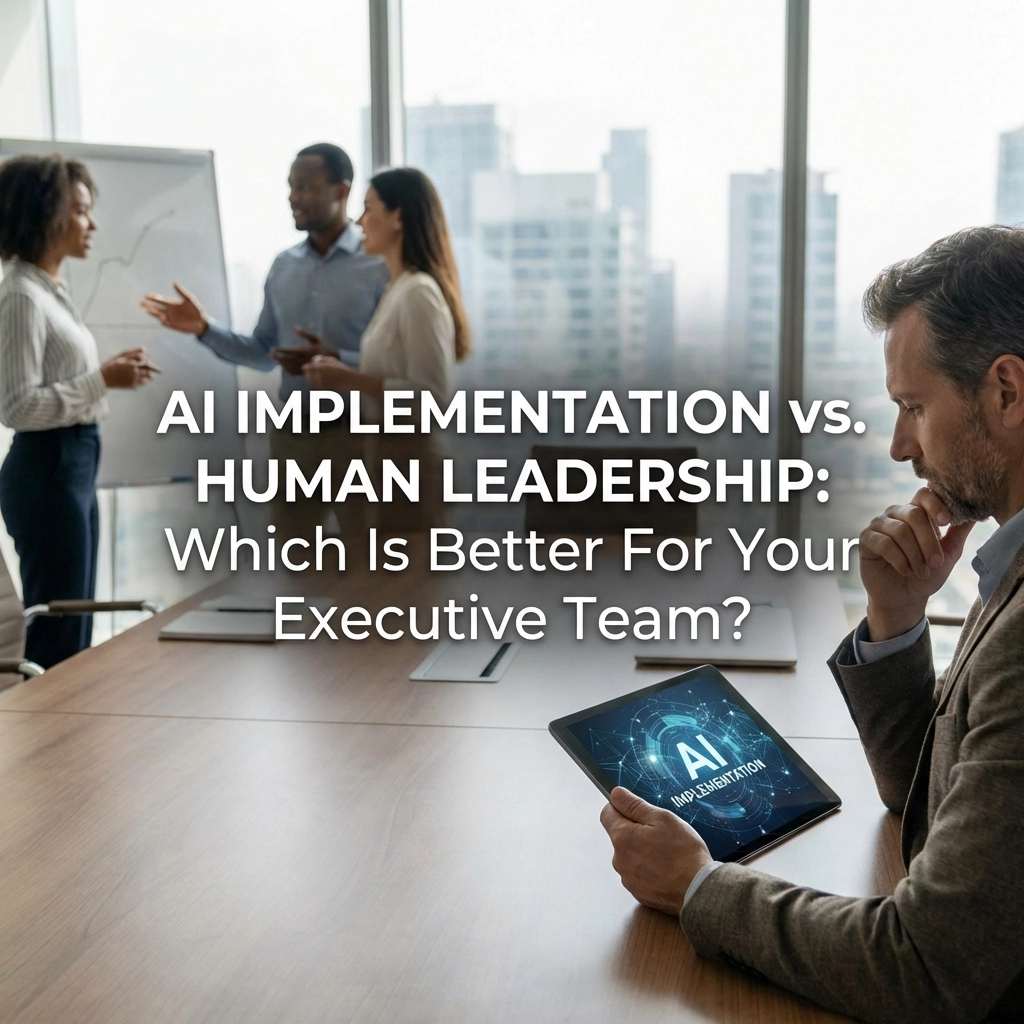
AI Implementation vs. Human Leadership: Which Is Better For Your Executive Team?

heroImage

Here’s the thing about choosing between AI implementation and human leadership: you’re asking the wrong question entirely.

As CEO of People Risk Consulting, I’ve watched countless executives get trapped in this false either-or mindset. They think they need to choose between investing in cutting-edge AI tools or doubling down on human leadership development. The reality? This binary thinking is exactly what’s keeping your competition ahead of you.

The companies winning right now aren’t picking sides. They’re combining both in ways that amplify results exponentially.

The False Choice That’s Costing You Results

When executives frame AI versus human leadership as a choice, they’re missing the fundamental truth about modern business transformation. It’s like asking whether you need a steering wheel or an engine in your car. Both are essential, and trying to operate with just one will leave you stranded.

The data backs this up dramatically. Research shows that 64% of CEOs believe succeeding with AI depends more on people’s adoption of the technology than the technology itself. That’s not a case for choosing human leadership over AI: it’s proof that human leadership is what makes AI implementation successful.

At People Risk Consulting, we see this pattern repeatedly when working with executive teams navigating digital transformation. The organizations that struggle aren’t the ones with inferior technology. They’re the ones with leaders who haven’t figured out how to guide their teams through the adoption process.

Why Human Leadership Makes or Breaks AI Success

Let’s get specific about what leadership-driven AI adoption actually looks like in practice.

Setting Clear Vision and Strategy

Organizations where AI adoption is driven by leadership with clear strategies report 62% of employees are fully engaged, compared to significantly lower engagement in organizations with haphazard adoption. This isn’t about having a tech strategy: it’s about having a people strategy for technology.

Your role as a leader isn’t to become an AI expert. It’s to become an expert at helping your team understand why AI matters to your business goals and how it connects to their individual success.

Building Trust and Addressing Resistance

Here’s what most executives miss: resistance to AI isn’t usually about the technology. It’s about fear of change, job displacement concerns, and lack of clarity about what’s expected. Leaders who succeed with AI implementation spend as much time on transparent communication and change management as they do on technical deployment.

The most effective approach we’ve seen involves employees in the planning phases from day one. When your team helps shape how AI gets integrated into their workflows, resistance transforms into ownership.

Securing Cross-functional Alignment

AI implementation fails when it becomes a technical project managed by IT. It succeeds when it becomes a business transformation project led by executives who can bridge the gap between technical capabilities and business objectives.

This requires leaders who can translate between technical and non-technical teams, ensuring everyone understands both what’s possible and what’s practical for your specific business context.

How AI Amplifies Executive Effectiveness

Now, here’s where it gets interesting. While human leadership drives AI success, AI simultaneously makes human leadership more effective.

Organizations using AI to support decisions report a 20% reduction in decision-making time. That’s not because AI makes the decisions: it’s because AI provides leaders with better data, faster analysis, and clearer options for consideration.

image_2

Administrative Liberation

AI automates repetitive administrative work, reducing administrative workloads by an average of 30%. For executives, this means less time in spreadsheets and more time on strategic thinking, team development, and relationship building.

Enhanced Coaching Capabilities

62% of employees find AI-powered coaching improves their job performance. But the key word here is “powered.” AI provides the data and insights that make human coaching conversations more targeted and effective.

When you combine AI’s pattern recognition with human emotional intelligence and contextual understanding, you get coaching that’s both data-driven and deeply personal.

Strategic Decision Support

AI excels at processing vast amounts of information and identifying patterns humans might miss. Leaders who leverage this capability don’t become less important: they become more strategic, more informed, and more effective at navigating complex business challenges.

The Winning Formula: Leadership-Driven AI Adoption

The organizations People Risk Consulting works with that achieve the best results follow a specific approach: leadership-driven AI adoption with governance structures that ensure both human oversight and technological innovation.

This means establishing clear frameworks where executives maintain strategic control while empowering their teams to experiment with AI tools in controlled, purposeful ways.

Board-Level Commitment

Successful AI implementation requires board-level commitment to both the technology investment and the cultural transformation required to maximize its impact. This isn’t a departmental initiative: it’s an organizational evolution that requires executive sponsorship and sustained support.

Role-Specific Training

Generic AI training fails. Effective AI adoption requires role-specific training that helps each team member understand exactly how AI tools will enhance their specific responsibilities and career development.

Psychological Safety for Experimentation

Leaders must create environments where teams feel safe to experiment with AI tools, make mistakes, and learn from both successes and failures. This requires a fundamental shift from perfectionist cultures to learning cultures.

Your Next Move

The question isn’t whether to choose AI implementation or human leadership development. The question is how quickly you can combine both to create competitive advantages your competition hasn’t figured out yet.

Start with leadership clarity about your AI strategy. Then invest in the change management capabilities required to guide your team through adoption. Finally, leverage AI tools to enhance your own leadership effectiveness while maintaining the human connection that drives organizational culture.

The companies that master this combination won’t just survive the AI transformation: they’ll lead it.


Ready to explore how leadership-driven AI adoption can transform your executive team? Join us for the live Brave Business Masterclass and Podcast where we dive deep into proven frameworks for combining human leadership with technological innovation. You can watch passively live or register to join our interactive studio audience for real-time Q&A and peer collaboration.

Register now at People Risk Consulting’s Training Center and discover why the most successful executives aren’t choosing between AI and human leadership( they’re mastering both.)

Why 78% of Performance Management Fails (And How to Fix Yours in 30 Days)

heroImage

Let’s cut straight to the chase: your performance management system is probably broken. And you’re not alone.

While the exact 78% figure varies by study, the reality is even more sobering. Recent data from People Risk Consulting’s executive research reveals that 95% of HR leaders are dissatisfied with their traditional performance appraisal processes, 95% of managers are unhappy with their current systems, and a staggering 44% of employees flat-out rate their performance management as a complete failure.

If you’re a seasoned executive reading this, you’ve likely felt this pain firsthand. You’ve watched talented people leave because they felt undervalued. You’ve seen high performers coast because they weren’t getting the feedback they craved. You’ve probably even questioned whether those quarterly reviews are doing anything besides checking a compliance box.

Here’s the thing: it doesn’t have to be this way. And you don’t need to wait months for a complete system overhaul to see results.

The Four Fatal Gaps Killing Your Performance Management

Before we fix anything, let’s diagnose what’s actually broken. Based on extensive research and real-world consulting experience with Fortune 500 companies, People Risk Consulting has identified four critical gaps that systematically undermine performance management systems:

The Perception Gap: When Leaders and Employees Live in Different Realities

Nearly 9 out of 10 executives believe their performance systems are effective. Meanwhile, 44% of employees rate those same systems as failures. This isn’t just a communication problem: it’s a fundamental disconnect about what “good performance management” actually looks like.

Executives often see completion rates and compliance metrics. Employees experience the day-to-day reality of unclear expectations, inconsistent feedback, and managers who seem to be going through the motions.

The Guidance Gap: Starving Your People of What They Need Most

Your managers are drowning. They lack clear roles, adequate support, and the right tools to have meaningful performance conversations. Meanwhile, employees are starving for regular, actionable feedback: not just during formal review cycles.

This gap creates a vicious cycle: managers avoid difficult conversations because they don’t feel equipped to handle them, and employees disengage because they’re not getting the guidance they need to improve.

The Skills Development Gap: Promising Growth You Can’t Deliver

Here’s a brutal truth: 86% of employees want career and skill development coaching, but only about half are satisfied with what they receive. You’re making promises about growth and development that your current system simply can’t keep.

This isn’t just about employee satisfaction: it’s about retention, engagement, and the ability to build internal capability instead of constantly hiring from outside.

The Structural Gap: One-Size-Fits-None Systems

Most performance management systems were designed for compliance, not results. They’re rigid, bureaucratic, and treat a diverse workforce like they’re all the same person with the same motivations and development needs.

Organizations using purpose-built performance management solutions integrated with their broader talent systems see 70% greater effectiveness. But most companies are still stuck with legacy systems that were never designed for today’s workforce.

The 30-Day Performance Management Reset Framework

Now for the good news: you don’t need to wait for budget approval or a massive system overhaul to start seeing results. Here’s how to begin transforming your performance management in the next 30 days:

Week 1: Audit and Align (Days 1-7)

Day 1-2: Rapid Assessment
Start with a brutal honesty check. Survey a representative sample of your managers and employees with three simple questions:

  • How would you rate our current performance management system? (1-10)
  • What’s the biggest obstacle to having effective performance conversations?
  • If you could change one thing immediately, what would it be?

Day 3-5: Manager Readiness Review
Identify which managers are actually equipped to have performance conversations. Look for those who already provide regular feedback, have strong relationships with their teams, and understand the business impact of individual performance.

Day 6-7: Quick Wins Identification
Based on your assessment, identify 2-3 changes you can implement immediately without system changes or budget approval. These might include new conversation frameworks, clearer role definitions for managers, or simple feedback templates.

Week 2: Manager Activation (Days 8-14)

Focus on Your Strong Managers First
Don’t try to fix everyone at once. Start with your best managers: the ones who already “get it” but need better tools and frameworks.

Implement Weekly Check-ins
Replace quarterly reviews with brief weekly check-ins using this simple framework:

  • What’s going well this week?
  • What’s challenging you right now?
  • How can I help remove obstacles?
  • What do you want to focus on improving next week?

Create Manager Peer Groups
Pair experienced managers with those who struggle with performance conversations. This peer coaching approach often works better than top-down training.

Week 3: Employee Engagement Reboot (Days 15-21)

image_1

Flip the Script on Performance Conversations
Instead of managers telling employees how they’re performing, train managers to ask:

  • “How do you think you’re performing against your goals?”
  • “What support do you need to perform at your best?”
  • “What would success look like for you in the next quarter?”

Implement Real-Time Recognition
Create simple ways for managers to acknowledge good work when it happens, not months later during formal reviews. This could be as simple as a dedicated Slack channel or a weekly email highlighting wins.

Week 4: System Integration (Days 22-30)

Connect Performance to Business Impact
Help managers understand how individual performance connects to team and company goals. Provide clear metrics and examples of what “good” looks like in each role.

Create Feedback Loops
Establish regular ways to measure whether your changes are working. This might include pulse surveys, manager confidence assessments, or simple metrics like the frequency of performance conversations.

Plan Your Next Phase
Based on what you’ve learned in 30 days, create a 90-day plan for deeper changes. This might include technology upgrades, more comprehensive manager training, or redesigning your formal review process.

Beyond the Quick Fix: Building Long-Term Performance Excellence

These 30-day changes will give you immediate improvement, but lasting transformation requires a more strategic approach. The most successful organizations People Risk Consulting works with focus on three key areas:

Manager Development as a Core Competency
They invest heavily in developing managers’ abilities to have difficult conversations, provide meaningful feedback, and connect individual performance to business results.

Technology That Enables, Not Complicates
They choose performance management tools that integrate seamlessly with their existing systems and actually make managers’ jobs easier, not harder.

Culture That Values Growth Over Compliance
They shift from a mindset of “checking boxes” to genuinely developing people and improving business outcomes.

Your Next Step: From Knowledge to Action

Here’s what separates executives who actually fix their performance management from those who just talk about it: they get external perspective from experts who’ve seen what works across multiple organizations and industries.

The patterns that emerge when you’ve helped dozens of companies transform their performance management are invaluable. You start to see the common pitfalls, the interventions that actually move the needle, and the sequence that maximizes your chances of success.

Ready to dive deeper into transforming your performance management system and tackling the broader people risks that keep you up at night? Join us for the live Brave Business Masterclass and Podcast, where we’ll share advanced frameworks for overcoming performance management challenges and other critical business risks. You can watch passively live or register to join our interactive studio audience where you can ask questions and get personalized insights for your specific situation.

Register now for the Brave Business Masterclass and Podcast and discover how top executives are turning their biggest people challenges into competitive advantages.

The 30-day framework above will get you started, but the masterclass will show you how to sustain and scale those improvements for long-term impact. Because fixing performance management isn’t just about better reviews: it’s about building an organization where talent thrives and business results follow.

Unmasking Leadership: Why Experimentation Bias Keeps CEOs Stuck (and How to Get Real About Growth)

heroImage

Let’s get real for a minute.

You didn’t get to the C-suite by accident. You’ve built companies, led teams through chaos, and made decisions that kept the lights on when everyone else was panicking. You’ve earned your seat at the table.

But here’s the uncomfortable truth that most leadership coaches won’t tell you: the same skills that got you here might be the exact things keeping you stuck.

At People Risk Consulting, we’ve worked with countless CEOs who came to us frustrated. They had vision. They had strategy. They had teams ready to execute. But something was off. Growth had stalled. Innovation felt forced. And despite all their experience, they couldn’t figure out why.

The culprit? A sneaky little phenomenon we call experimentation bias, and it’s probably running your leadership playbook right now without you even knowing it.

What Is Experimentation Bias (And Why Should You Care)?

Here’s the thing about being a leader: you’re expected to have answers. Your board wants certainty. Your team wants direction. Your investors want confidence. So you learn to project all of those things, even when you’re not feeling them.

Over time, you develop what Dr. Diane Dye, CEO of People Risk Consulting, calls “masks.” The mask of competence. The mask of certainty. The mask of always knowing best.

These masks feel protective. They help you navigate high-stakes conversations and maintain credibility. But they come with a hidden cost.

Experimentation bias happens when leaders only run experiments that protect their ego instead of challenging their assumptions.

Think about it. When was the last time you tested a hypothesis that could prove you wrong? When did you last greenlight a project that made you genuinely uncomfortable, not because of the risk to the business, but because of the risk to your self-image?

Research shows that CEOs face significant obstacles to learning from experience. Many corporate learning opportunities occur infrequently during a leader’s tenure, meaning opportunities to learn from previous mistakes are few and far between. Worse, certain biases get reinforced rather than overcome, leaders tend to overestimate their personal control over outcomes and become overinvested in their own decisions.

This isn’t a character flaw. It’s human nature. But if you want sustainable, infinite growth? You’ve got to confront it head-on.

The Three Masks That Keep CEOs Stuck

Let’s break down the masks that create experimentation bias. See if any of these sound familiar.

Mask #1: The Competence Mask

This is the “I’ve got this handled” mask. You wear it in board meetings, investor calls, and team all-hands. It says: “I know what I’m doing. Trust my track record.”

The problem? When you’re always projecting competence, you stop asking for help. You stop admitting when you don’t know something. And you definitely stop running experiments that might expose gaps in your knowledge.

The cost: You miss out on diverse perspectives that could unlock breakthrough solutions.

Mask #2: The Certainty Mask

This mask projects unwavering confidence in your strategy. It tells everyone, including yourself, that the path forward is clear.

But real growth rarely comes from certainty. It comes from curiosity. From being willing to say, “I think this is the right direction, but let’s test it.”

The cost: You double down on strategies that aren’t working because admitting uncertainty feels like weakness.

Mask #3: The “Knowing Best” Mask

This is the most dangerous one. It’s the belief that your experience and intuition should override data, feedback, and dissenting opinions.

Yes, your experience matters. But when “knowing best” becomes your default operating mode, you stop listening. You stop experimenting with ideas that didn’t originate from you. And you create a culture where your team stops bringing you uncomfortable truths.

The cost: Innovation dies. Your best people disengage. And growth stalls.

The Real Reason You Fear Surprises

Here’s what Dr. Diane Dye has observed after years of consulting with executive leaders: most CEOs don’t fear surprises because they lack vision. They fear surprises because surprises threaten the masks they’ve worked so hard to maintain.

Think about it. A surprise means something happened that you didn’t predict. If you’re wearing the certainty mask, that’s a direct hit to your credibility. If you’re wearing the competence mask, it suggests a blind spot. If you’re wearing the “knowing best” mask, it means someone else saw something you missed.

So what do you do? You unconsciously design experiments and strategies that minimize the chance of surprise. You test things you’re pretty sure will work. You avoid the experiments that could reveal something you don’t want to see.

This is experimentation bias in action. And it’s killing your potential for real growth.

What Infinite Growth Actually Requires

Let’s talk about infinite growth: the kind of sustainable expansion that doesn’t plateau or burn out.

Infinite growth doesn’t come from protecting what you’ve built. It comes from being willing to tear down your assumptions and rebuild them based on what’s actually true.

That requires a different kind of leadership. One where:

  • Vulnerability is a strategic advantage, not a liability
  • Being wrong is data, not failure
  • Uncomfortable experiments are prioritized, not avoided
  • Surprises are welcomed as opportunities to learn, not threats to manage

At People Risk Consulting, we call this “unmasked leadership.” And it’s the foundation of every sustainable growth story we’ve seen.

How to Start Taking Off the Mask

So how do you actually do this? Here are four practices that People Risk Consulting recommends for CEOs ready to get real about growth:

1. Run One “Ego-Threatening” Experiment Per Quarter

Identify one assumption you’re deeply attached to: maybe it’s about your market, your team, or your strategy. Then design an experiment specifically to challenge it. Not to confirm it. To challenge it.

2. Create a “Surprise Welcome” Culture

Start celebrating surprises in your leadership team meetings. When something unexpected happens, resist the urge to find blame. Instead, ask: “What did we learn? What assumption was wrong? How does this make us smarter?”

3. Invite Dissent

Actively seek out the people on your team who disagree with you. Give them permission: and safety: to challenge your thinking. The best CEOs don’t surround themselves with yes-people. They surround themselves with people brave enough to say, “I think you’re wrong, and here’s why.”

4. Get Outside Perspective

This is where working with an experienced consulting partner like People Risk Consulting becomes invaluable. When you’re inside the system, it’s almost impossible to see your own masks. An outside perspective can hold up the mirror and help you see what’s really driving your decisions.

Ready to Have a Real Conversation?

Look, reading a blog post is a good start. But real transformation happens in real conversation: the kind where you can ask hard questions, get challenged, and walk away with actionable insights.

That’s exactly why we created the Brave Business Masterclass and Podcast.

This isn’t your typical webinar where you sit passively and listen to a polished presentation. This is a live experience where CEO Diane Dye and guests tackle the real challenges facing today’s leaders: including topics like experimentation bias, unmasked leadership, and sustainable growth.

You have two ways to join:

  1. Watch live as a passive viewer and absorb the conversation
  2. Register to join the interactive studio audience and participate in real-time discussion

Either way, you’ll walk away with practical frameworks and honest insights you won’t find anywhere else.

👉 Register now for the Brave Business Masterclass and Podcast

It’s time to take off the mask. It’s time to run the experiments that actually matter. And it’s time to get real about what growth looks like for you.

We’ll see you there.