

AI Implementation vs. Human Leadership: Which Is Better For Your Executive Team?
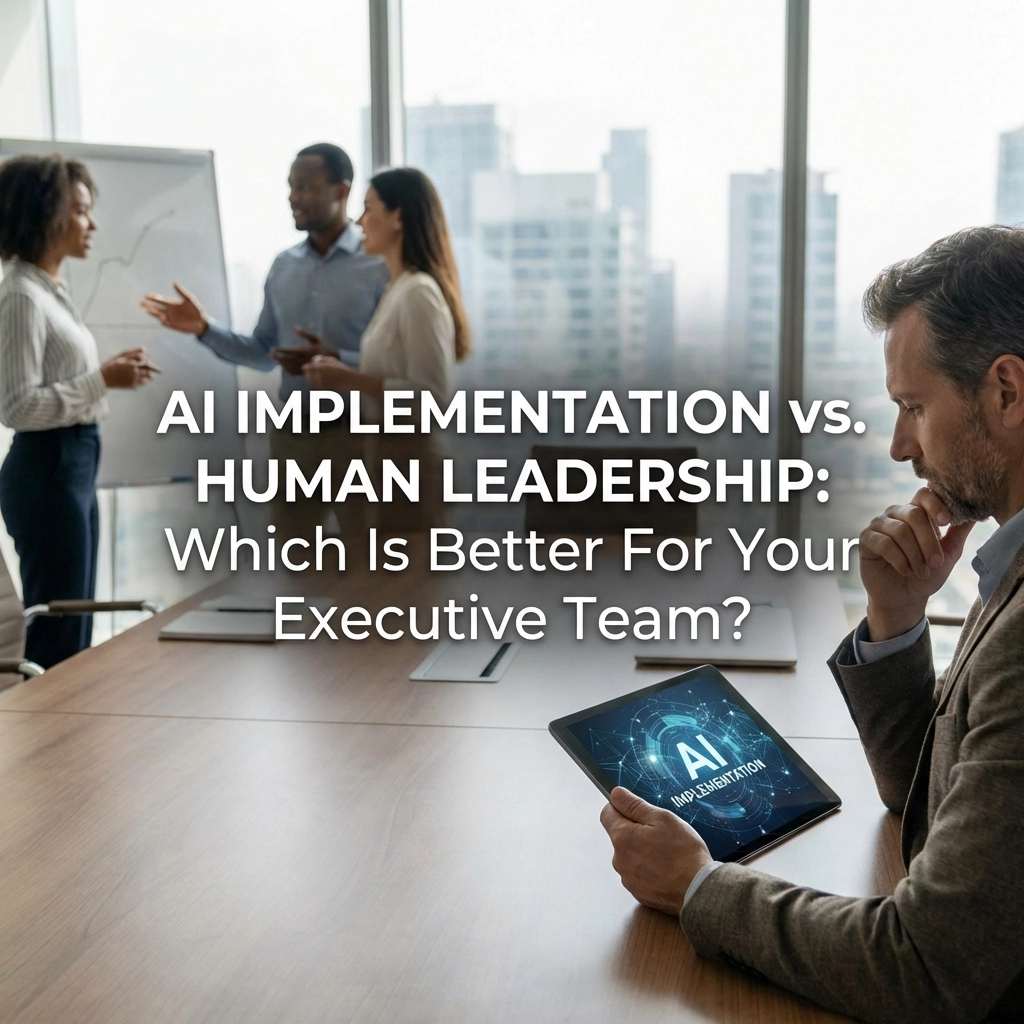
Here’s the thing about choosing between AI implementation and human leadership: you’re asking the wrong question entirely.
As CEO of People Risk Consulting, I’ve watched countless executives get trapped in this false either-or mindset. They think they need to choose between investing in cutting-edge AI tools or doubling down on human leadership development. The reality? This binary thinking is exactly what’s keeping your competition ahead of you.
The companies winning right now aren’t picking sides. They’re combining both in ways that amplify results exponentially.
The False Choice That’s Costing You Results
When executives frame AI versus human leadership as a choice, they’re missing the fundamental truth about modern business transformation. It’s like asking whether you need a steering wheel or an engine in your car. Both are essential, and trying to operate with just one will leave you stranded.
The data backs this up dramatically. Research shows that 64% of CEOs believe succeeding with AI depends more on people’s adoption of the technology than the technology itself. That’s not a case for choosing human leadership over AI: it’s proof that human leadership is what makes AI implementation successful.
At People Risk Consulting, we see this pattern repeatedly when working with executive teams navigating digital transformation. The organizations that struggle aren’t the ones with inferior technology. They’re the ones with leaders who haven’t figured out how to guide their teams through the adoption process.
Why Human Leadership Makes or Breaks AI Success
Let’s get specific about what leadership-driven AI adoption actually looks like in practice.
Setting Clear Vision and Strategy
Organizations where AI adoption is driven by leadership with clear strategies report 62% of employees are fully engaged, compared to significantly lower engagement in organizations with haphazard adoption. This isn’t about having a tech strategy: it’s about having a people strategy for technology.
Your role as a leader isn’t to become an AI expert. It’s to become an expert at helping your team understand why AI matters to your business goals and how it connects to their individual success.
Building Trust and Addressing Resistance
Here’s what most executives miss: resistance to AI isn’t usually about the technology. It’s about fear of change, job displacement concerns, and lack of clarity about what’s expected. Leaders who succeed with AI implementation spend as much time on transparent communication and change management as they do on technical deployment.
The most effective approach we’ve seen involves employees in the planning phases from day one. When your team helps shape how AI gets integrated into their workflows, resistance transforms into ownership.
Securing Cross-functional Alignment
AI implementation fails when it becomes a technical project managed by IT. It succeeds when it becomes a business transformation project led by executives who can bridge the gap between technical capabilities and business objectives.
This requires leaders who can translate between technical and non-technical teams, ensuring everyone understands both what’s possible and what’s practical for your specific business context.
How AI Amplifies Executive Effectiveness
Now, here’s where it gets interesting. While human leadership drives AI success, AI simultaneously makes human leadership more effective.
Organizations using AI to support decisions report a 20% reduction in decision-making time. That’s not because AI makes the decisions: it’s because AI provides leaders with better data, faster analysis, and clearer options for consideration.
Administrative Liberation
AI automates repetitive administrative work, reducing administrative workloads by an average of 30%. For executives, this means less time in spreadsheets and more time on strategic thinking, team development, and relationship building.
Enhanced Coaching Capabilities
62% of employees find AI-powered coaching improves their job performance. But the key word here is “powered.” AI provides the data and insights that make human coaching conversations more targeted and effective.
When you combine AI’s pattern recognition with human emotional intelligence and contextual understanding, you get coaching that’s both data-driven and deeply personal.
Strategic Decision Support
AI excels at processing vast amounts of information and identifying patterns humans might miss. Leaders who leverage this capability don’t become less important: they become more strategic, more informed, and more effective at navigating complex business challenges.
The Winning Formula: Leadership-Driven AI Adoption
The organizations People Risk Consulting works with that achieve the best results follow a specific approach: leadership-driven AI adoption with governance structures that ensure both human oversight and technological innovation.
This means establishing clear frameworks where executives maintain strategic control while empowering their teams to experiment with AI tools in controlled, purposeful ways.
Board-Level Commitment
Successful AI implementation requires board-level commitment to both the technology investment and the cultural transformation required to maximize its impact. This isn’t a departmental initiative: it’s an organizational evolution that requires executive sponsorship and sustained support.
Role-Specific Training
Generic AI training fails. Effective AI adoption requires role-specific training that helps each team member understand exactly how AI tools will enhance their specific responsibilities and career development.
Psychological Safety for Experimentation
Leaders must create environments where teams feel safe to experiment with AI tools, make mistakes, and learn from both successes and failures. This requires a fundamental shift from perfectionist cultures to learning cultures.
Your Next Move
The question isn’t whether to choose AI implementation or human leadership development. The question is how quickly you can combine both to create competitive advantages your competition hasn’t figured out yet.
Start with leadership clarity about your AI strategy. Then invest in the change management capabilities required to guide your team through adoption. Finally, leverage AI tools to enhance your own leadership effectiveness while maintaining the human connection that drives organizational culture.
The companies that master this combination won’t just survive the AI transformation: they’ll lead it.
Ready to explore how leadership-driven AI adoption can transform your executive team? Join us for the live Brave Business Masterclass and Podcast where we dive deep into proven frameworks for combining human leadership with technological innovation. You can watch passively live or register to join our interactive studio audience for real-time Q&A and peer collaboration.
Register now at People Risk Consulting’s Training Center and discover why the most successful executives aren’t choosing between AI and human leadership( they’re mastering both.)
