

CEO Growth Stalls Got You Stuck? 5 Steps to Turn Leadership Breakdowns Into Business Breakthroughs
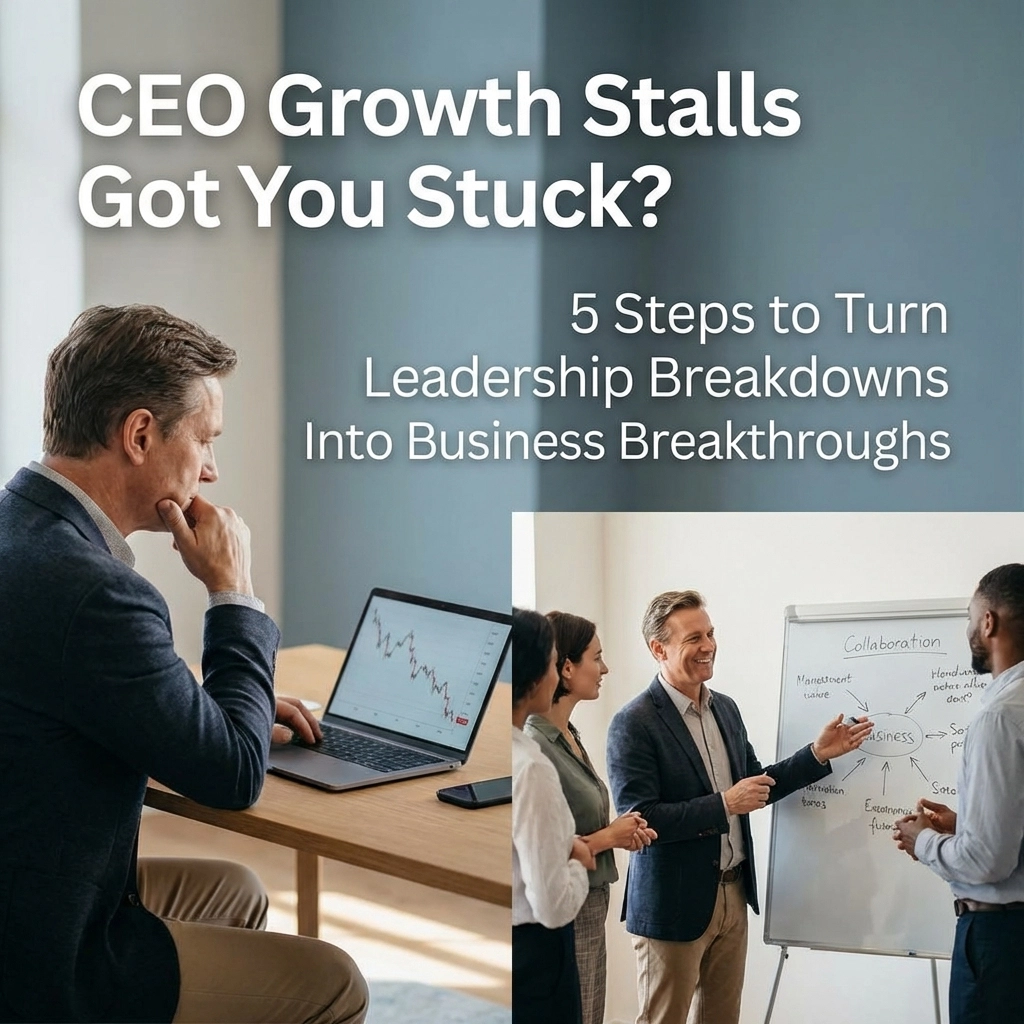
Growing a business is tough. Growing yourself as a CEO while scaling that business? That’s where things get really challenging. If your company’s growth has hit a plateau and you’re feeling like you’re pushing a boulder uphill every single day, you’re not alone: and more importantly, you’re probably the key to solving it.
The uncomfortable truth many CEOs face is that they often become the very bottleneck preventing their organization’s breakthrough. But here’s the good news: recognizing this pattern is your first step toward transforming leadership challenges into competitive advantages.
At People Risk Consulting, we’ve worked with hundreds of executives who’ve navigated these exact waters. The leaders who break through aren’t necessarily the smartest or most experienced: they’re the ones who master the art of strategic self-evolution. Let’s dive into the five proven steps that can turn your leadership breakdown into your business breakthrough.
Step 1: Acknowledge You Are the Ceiling (and the Key)
This might sting a little, but here’s the reality: if your company isn’t growing, there’s a good chance you’re the bottleneck. And paradoxically, that’s actually excellent news.
Many founder-CEOs and seasoned executives unintentionally create single points of failure where nothing moves without their explicit approval. Every decision flows through your desk. Every strategic conversation waits for your input. Every opportunity requires your green light. Sound familiar?
The result? Your business becomes a reflection of your personal bandwidth limitations rather than its true potential. Projects stall in your inbox. Teams wait for direction that never comes quickly enough. Market opportunities slip away while you’re buried in operational decisions that others could handle.
But here’s why this is actually great news: if you’re the ceiling, you’re also the key. Unlike external market factors or competitive pressures you can’t control, you have complete authority over the one variable that can unlock exponential growth: yourself.
The first breakthrough happens when you shift from denial (“My team isn’t stepping up”) to ownership (“I’m not creating the conditions for them to step up”). This mindset shift alone can be transformational for both you and your organization.
Step 2: Shift from Exertion Mode to Elevation Mode
Stop trying to muscle your way to success. If you’re relying on pure willpower, longer hours, and personal heroics to drive business results, you’re operating in what we call “exertion mode”: and it’s unsustainable.
The most successful CEOs People Risk Consulting works with have mastered the transition to “elevation mode.” Instead of pushing the business forward through sheer force, they build structures and systems that pull the business forward automatically.
Here’s what elevation mode looks like in practice:
Hire for breadth and depth. Bring in leaders who have both commercial experience and deep expertise. These aren’t just skilled executors: they’re strategic thinkers who can run entire business functions without your constant oversight.
Decentralize decision-making systematically. Create clear decision-making frameworks that allow your team to act independently within defined parameters. This doesn’t mean losing control: it means gaining leverage.
Invest in your own development. This might seem counterintuitive when you’re busy, but the ROI on CEO development is extraordinary. Every hour you invest in upgrading your leadership capabilities multiplies across your entire organization.
The goal is to evolve from being a “player coach” who’s still executing daily tasks to being a true “head coach” who can see around corners and anticipate market shifts while your team handles execution.
Step 3: Adopt a Growth Mindset Across Your Organization
Here’s a statistic that should grab your attention: companies with a growth mindset are 2.4 times more likely to outperform their peers, according to McKinsey research. But implementing a growth mindset isn’t about hanging motivational posters: it’s about fundamentally changing how your organization approaches problems and opportunities.
A true growth mindset in business means believing that your products, policies, team capabilities, and market position can all be improved through effort, learning, and strategic iteration. It’s the difference between asking “Why isn’t this working?” and “What would make this work better?”
Try these growth mindset diagnostic questions with your leadership team:
- “What am I not doing that I would start doing if I were launching a new company today?”
- “If I were our biggest competitor, how would I put us out of business?”
- “What assumptions about our market or customers have we never actually tested?”
- “Where are we saying ‘that’s just how we do things here’ instead of asking ‘what’s possible?'”
The answers to these questions often reveal blind spots that, once addressed, can unlock significant competitive advantages. Growth mindset isn’t just about optimism: it’s about systematic curiosity and continuous improvement.
Step 4: Refocus Your Strategy and Operations
When growth stalls, it’s tempting to look for completely new markets or revolutionary innovations. But often, the biggest opportunities are hiding in plain sight within your existing business.
Start with a strategic audit using proven frameworks. SWOT analysis can reveal hidden strengths and unaddressed weaknesses. Porter’s Five Forces helps you understand competitive dynamics you might be missing. Jobs-to-be-Done interviews with customers often uncover unmet needs that represent immediate revenue opportunities.
But here’s where many CEOs make a critical mistake: they neglect their existing customer base while chasing new prospects. Your current customers are your highest-probability growth opportunity. They already trust you, understand your value, and are often hungry for additional solutions.
Focus on strengthening these existing relationships by:
- Addressing their evolving needs with new services or products
- Introducing premium offerings that deliver higher value
- Creating systems to capture and act on customer feedback regularly
Simultaneously, audit your operations with fresh eyes. Look for manual processes that could be automated, redundant workflows that slow decision-making, and inefficient tool usage that frustrates your team. Often, operational improvements can deliver immediate productivity gains that compound over time.
Step 5: Appoint an Advisory Board and Seek External Expertise
One of the loneliest aspects of being a CEO is that you’re surrounded by people all day but can’t share your real doubts and concerns with your team. This isolation can lead to blind spots that become costly over time.
Building a hand-picked team of independent experts: whether through a formal advisory board, executive coaching, or peer advisory groups: provides the external perspective you need to break through plateaus.
The right external advisors bring three critical elements:
Fresh thinking. They’ve seen different industries, business models, and solutions. They can spot patterns and opportunities that are invisible to you because you’re too close to your business.
Accountability. Unlike your team, advisors have no vested interest in telling you what you want to hear. They can challenge your assumptions and push you toward uncomfortable but necessary decisions.
Strategic perspective. They help you see around corners and think beyond current constraints. This outside perspective often provides the well-timed insight that makes the difference between breakthrough and continued stagnation.
When People Risk Consulting partners with CEOs, we often serve this advisor role: bringing expertise from working with hundreds of similar businesses while maintaining the objectivity that internal teams can’t provide.
Your Next Move
Recognizing that you might be the bottleneck in your business isn’t a failure: it’s the beginning of your breakthrough. The five steps we’ve outlined aren’t just theoretical concepts; they’re practical frameworks that hundreds of successful CEOs have used to transform their leadership and unlock sustainable growth.
The question isn’t whether these principles work: it’s whether you’re ready to implement them systematically and consistently.
If you’re serious about turning your leadership challenges into competitive advantages, I invite you to join us for our live Brave Business Masterclass and Podcast. You can watch passively to absorb insights and strategies, or register to join our interactive studio audience where you can engage directly with expert facilitators and fellow business leaders facing similar challenges.
Ready to stop being the ceiling and start being the catalyst? Register for the Brave Business Masterclass and Podcast here and take the first step toward your breakthrough.
The most successful CEOs aren’t the ones who never hit growth plateaus: they’re the ones who use those plateaus as launching pads for their next level of success.
