

Why 85% of Workers Crave Agility But Your “Flexible” Workplace Is Still Failing
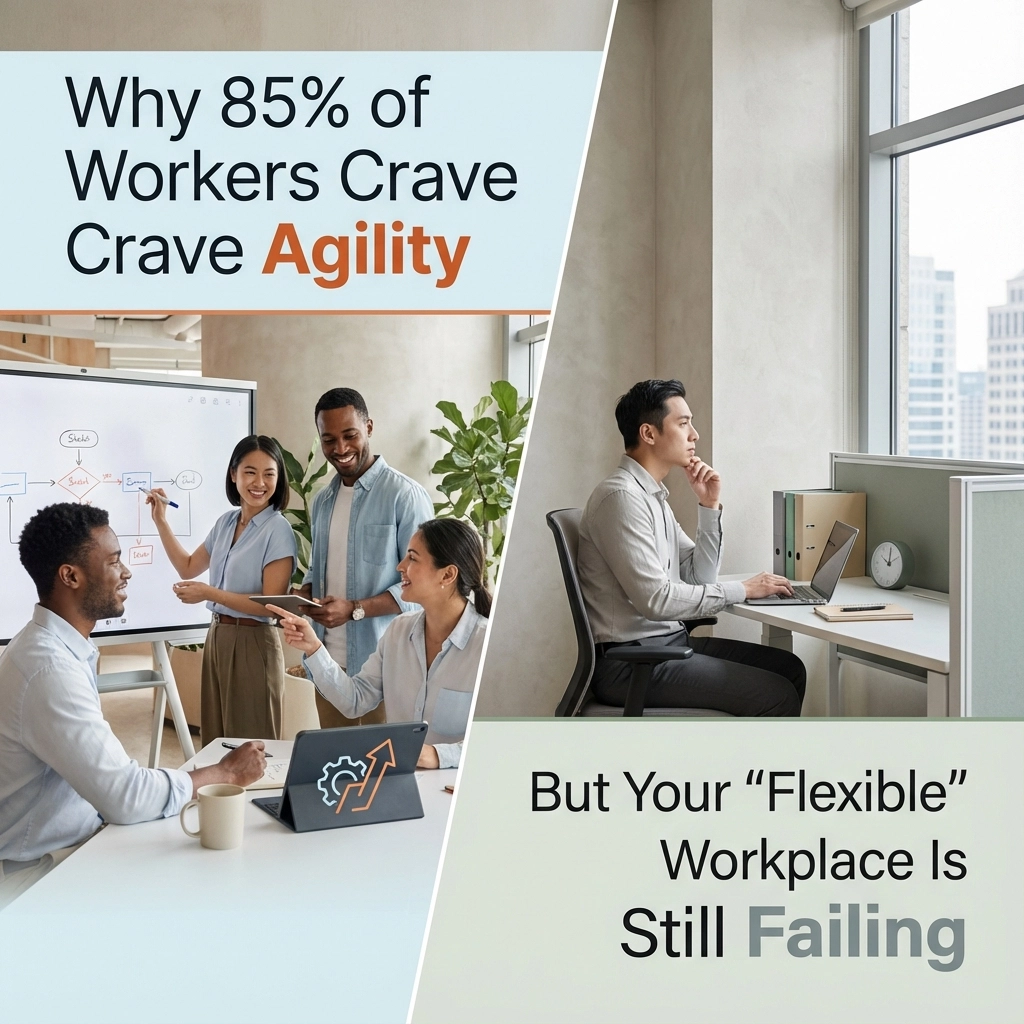
You think you’ve cracked the code on workplace flexibility. Your company offers remote work options. You’ve got hybrid policies. You even let people adjust their hours.
Think again.
85% of workers are desperately craving agility in their roles, yet your “flexible” workplace is still hemorrhaging talent faster than you can replace them. The brutal truth? You’re not offering flexibility. You’re offering performance theater.
And it’s costing you everything.
The $50 Million Blind Spot Every CEO Misses
Here’s what Diane Thompson, CEO of People Risk Consulting, sees when she walks into executive boardrooms: Leaders who confuse flexibility with agility. Leaders who think three days in the office versus two is strategic workforce planning.
You’re not broken. You’re at a critical opportunity.
The data doesn’t lie. 95% of HR professionals confirm that flexible working is the most in-demand benefit prospective employees seek. Yet only 58% of employers say all or most employees in their organization can actually work flexibly.
→ High demand meets restricted access
→ Creates immediate fairness crisis
→ Triggers talent exodus
The math is devastating. In the UK alone, 1.1 million workers changed jobs last year primarily due to lack of flexibility. In the US, 47% of workers plan to look for new positions in 2026. And here’s the kicker: 40% would immediately start job hunting if their current flexibility was removed.
That’s not employee entitlement. That’s market disruption happening in real time.
Unmasking the 3 Critical Flexibility Failures
Failure #1: The Checkbox Mentality
You implemented remote work policies because everyone else did. You created hybrid schedules because the consultants said you should. You’re checking boxes, not solving problems.
Real talk: Your employees see right through this performative flexibility.
When office attendance requirements rose 12% between Q1 2024 and Q3 2025, but actual attendance only increased 1-3%, that’s not employee defiance. That’s employees rejecting arbitrary mandates that don’t serve business outcomes.
Failure #2: The Communication Vacuum
You mandate three days in office. Why three? Why not two or four? Your people are left guessing because you never communicated the strategic reasoning behind your decisions.
Leading organizations that successfully implement flexible work arrangements share one critical trait: They’re intentional about who is eligible for hybrid or remote work, they communicate the ‘why’ for on-site requirements, and they establish shared collaboration hours.
→ No clear communication
→ Breeds employee resentment
→ Undermines policy effectiveness
Failure #3: The Productivity Paradox
You’re measuring presence instead of performance. Badge counts instead of business impact. This backwards approach is exactly why your flexibility initiatives are failing.
Companies focused on strategic flexibility for employee engagement consistently outperform those obsessing over “who’s in the building when.” The difference isn’t the policy: it’s the mindset.
The Agility Framework That Actually Works
Here’s what People Risk Consulting has discovered working with Fortune 500 executives: True workplace agility isn’t about where people work. It’s about how work gets done.
Quick Win #1: Outcome-Based Performance Metrics
Stop measuring: Hours worked, days in office, meeting attendance
Start measuring: Project completion rates, quality scores, innovation contributions
Quick Win #2: Structured Flexibility Models
Create clear frameworks that define:
- Which roles require on-site presence and why
- Collaboration windows when teams must be available
- Performance standards that apply regardless of location
Quick Win #3: Data-Driven Decision Making
Track the metrics that matter:
- Employee productivity by work arrangement
- Retention rates across different flexibility options
- Customer satisfaction scores by team structure
22% of workers would expect a pay raise to compensate for lost flexibility. When flexibility becomes a valued compensation component, treating it casually becomes an expensive mistake.
The Gentrification Effect: Why Some Companies Win While Others Lose
There’s a dangerous divide emerging in the marketplace. Older, established firms are cutting flexibility while younger, fast-growing companies are expanding it.
This creates a two-tier system where access to agile work depends on company age rather than work requirements. The companies doubling down on rigid structures? They’re becoming the workplace equivalent of expensive neighborhoods that price out the talent they need most.
The breakthrough insight: Your competition isn’t just other companies in your industry. It’s every organization offering the workplace agility your people crave.
Avoiding the 5 Most Expensive Missteps
Misstep #1: Treating All Roles the Same
Not every position requires the same flexibility approach. Customer service might need coverage hours. Creative teams might need collaboration time. Engineers might need deep focus periods.
Misstep #2: Ignoring Manager Training
Your managers are implementing your flexibility policies. If they don’t understand how to lead distributed teams effectively, your policies will fail regardless of how well-designed they are.
Misstep #3: Avoiding Difficult Conversations
Some employees will try to exploit flexibility. Some managers will resist it. Address these issues directly rather than creating policies that punish everyone for the actions of a few.
Misstep #4: Implementing Without Infrastructure
Flexible work requires technology, communication protocols, and cultural shifts. Rolling out policies without the supporting infrastructure is setting everyone up for frustration.
Misstep #5: Making Changes Based on Fear
“What if productivity drops? What if culture suffers? What if we lose control?” These fears drive bad decisions. Make changes based on data and strategic objectives, not anxiety.
The Bottom Line: Your Flexibility Strategy Is Your Talent Strategy
You can continue offering surface-level flexibility that satisfies no one and drives away top performers. Or you can build genuine workplace agility that becomes your competitive advantage.
The choice isn’t whether to offer flexibility. The choice is whether to do it strategically.
When Diane works with executive teams struggling with workforce transformation, she sees the same pattern repeatedly: Leaders who think they’re being flexible when they’re actually being rigid. Leaders who confuse accommodation with agility.
You’re not failing because flexibility doesn’t work. You’re failing because you’re implementing yesterday’s solutions to today’s workforce challenges.
Your Next Move
Stop treating workplace flexibility like a perk you grudgingly provide. Start treating it like the strategic workforce tool it actually is.
The companies getting this right aren’t just retaining talent: they’re attracting the highest performers who have choices about where to work. They’re not just avoiding the $50 million replacement costs of high turnover. They’re building cultures that drive innovation and growth.
Ready to transform your approach to workplace agility? Join Diane Thompson live on the Brave Business Masterclass and Podcast from People Risk Consulting. You can watch live passively or register to be in the interactive studio audience. Seats are limited—register here.
Because here’s what every successful CEO knows: In a world where 85% of workers crave agility, the companies that provide authentic flexibility win everything. The companies that fake it lose everyone.
The question isn’t whether your people want workplace agility. The question is whether you’re ready to provide it strategically.
Your move.
