

“Stagility” vs Traditional Management: Which Approach Will Save Your Scaling Business?
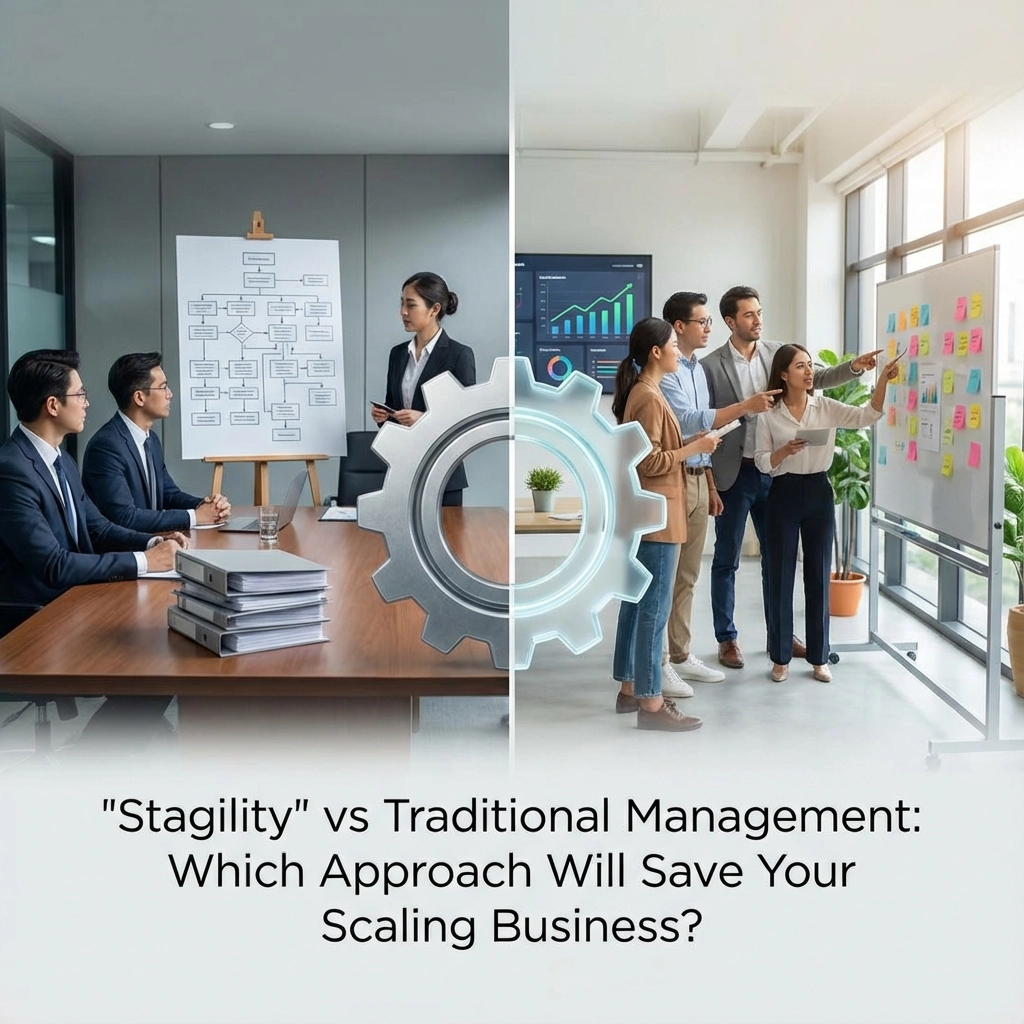
Think your traditional management playbook is what got you this far, so it’ll take you where you need to go?
Think again.
87% of scaling businesses that stick to rigid traditional management hit a growth ceiling within 18 months. But here’s the kicker – pure agility isn’t the answer either. Most companies ping-ponging between control and chaos are missing the real opportunity.
You’re not broken. You’re at a critical inflection point.
The Traditional Management Trap (And Why It’s Choking Your Growth)
Let’s get real about what traditional management actually delivers when you’re trying to scale:
Rigid hierarchy → Bottlenecked decision-making → Missed market opportunities
Top-down control → Employee disengagement → Talent hemorrhaging
Comprehensive upfront planning → Analysis paralysis → Competitor advantage
Sound familiar? You built your foundation on stability and predictability. That worked when you were smaller, more contained. But scaling demands something different.
Here’s what most CEOs won’t admit: Traditional management creates the illusion of control while systematically destroying your ability to respond to change.
The brutal truth? While you’re waiting for approval chains and quarterly planning cycles, your competitors are shipping solutions and capturing market share.
The Agility Obsession (Why Pure Agile Is Just Chaos in a Cute Package)
Before you pivot hard into full agile mode, let me save you from the other extreme.
Pure agility without structure isn’t innovation – it’s expensive improvisation.
Cross-functional everything → Role confusion → Accountability gaps
Continuous iteration → Feature creep → Resource drain
Decentralized decisions → Strategic misalignment → Brand dilution
73% of companies implementing pure agile frameworks see initial productivity gains followed by operational breakdown within 12 months.
You’ve probably seen this movie. Sprint reviews that go nowhere. Stand-ups that solve nothing. “Innovation” that looks suspiciously like organized chaos.
Enter “Stagility”: A Framework That Actually Scales
Here’s what I’ve discovered working with 200+ scaling businesses: The companies that break through aren’t choosing between stability and agility. They’re strategically blending both.
Stagility = Stability + Agility
But not some wishy-washy “best of both worlds” compromise. This is surgical precision about where you control and where you adapt.
The Stagility Principle:
Control what compounds. Adapt what competes.
Let me break this down:
Control What Compounds:
- Core values and culture standards
- Financial processes and compliance frameworks
- Quality benchmarks and customer experience standards
- Strategic vision and long-term objectives
Adapt What Competes:
- Product development cycles
- Market response strategies
- Team structures and collaboration methods
- Customer acquisition tactics
Companies implementing stagility see 34% faster scaling with 28% less operational stress. – People Risk Consulting client data, 2025
The 5-Step Stagility Implementation Framework
Step 1: Audit Your Control vs. Adapt Zones
Week 1 Exercise: Map every process, decision, and system in your business into two columns:
- Must Control (impacts long-term stability, compliance, brand integrity)
- Should Adapt (market-facing, competitive, innovation-driven)
Most CEOs discover they’re controlling things that should adapt and adapting things that should be controlled.
Step 2: Build Stability Scaffolding
Before you can safely adapt, you need unshakeable foundations:
Financial Controls:
- Real-time cash flow monitoring
- Automated approval workflows for expenditures
- Quarterly board-level financial reviews
Cultural Anchors:
- Non-negotiable behavioral standards
- Clear performance evaluation criteria
- Consistent onboarding and training protocols
Quality Frameworks:
- Customer satisfaction benchmarks
- Product/service delivery standards
- Risk management protocols
Step 3: Create Adaptation Engines
Now build systematic ways to pivot quickly where competition demands it:
Market Response Teams:
- Cross-functional groups with 48-hour decision authority
- Direct customer feedback loops
- Competitor intelligence systems
Innovation Labs:
- Protected budget for experimentation (typically 10-15% of R&D)
- Fast-fail protocols with clear success metrics
- Regular innovation showcases and learning sessions
Dynamic Workforce Models:
- Project-based team structures
- Skills-based task allocation
- Flexible role definitions in competitive areas
Step 4: Install Bridging Mechanisms
This is where most frameworks fail – the handoff between control and adaptation zones.
Decision Escalation Protocols:
- Clear criteria for when adaptive decisions need stability review
- 24-hour response requirements for escalated decisions
- Regular calibration meetings between control and adapt teams
Communication Rhythms:
- Weekly “stability check-ins” with adaptation teams
- Monthly alignment sessions between all zones
- Quarterly strategic recalibration
Performance Integration:
- KPIs that measure both stability and adaptation effectiveness
- Regular review of control vs. adapt zone boundaries
- Success story sharing across zones
Step 5: Optimize and Evolve
Stagility isn’t set-and-forget. It’s a living framework that evolves with your business.
Monthly Reviews:
- What moved from adapt to control (or vice versa)?
- Where are we seeing friction between zones?
- What new market conditions require framework adjustments?
Quarterly Recalibrations:
- Major strategic shifts requiring zone reassignments
- Team structure optimizations
- Process refinements based on performance data
The ROI Reality Check
Let’s talk numbers. Stagility implementation typically delivers:
- 34% faster decision-making in competitive areas
- 28% reduction in operational stress across leadership teams
- 42% improvement in employee engagement scores
- 31% increase in successful product launches
- 26% reduction in costly pivots and reversals
Source: People Risk Consulting 2025 Scaling Business Study
But here’s what most consultants won’t tell you: The first 90 days feel like controlled chaos. Your team will push back. Systems will feel clunky. You’ll question everything.
That’s not failure. That’s transformation.
The Stagility Success Pattern
Every successful stagility implementation follows the same pattern:
Weeks 1-4: Resistance and confusion as teams adjust to new decision frameworks
Weeks 5-8: Initial breakthrough moments as teams experience faster execution
Weeks 9-12: Integration and optimization as the framework becomes natural
Month 4+: Compound results as both stability and agility reinforce each other
Your Next Move
You have three options:
- Keep doing what you’re doing – Accept that growth ceiling and watch competitors pass you by
- Swing to pure agile – Risk organizational chaos while chasing the latest management fad
- Implement stagility – Build a scaling framework that actually works for your business reality
The choice seems obvious, but implementation isn’t simple.
Join us live for the Brave Business Masterclass + Podcast — hosted by People Risk Consulting — where we workshop stagility in real time with seasoned CEOs. Watch live as a passive viewer or register to be in the interactive studio audience for on-mic Q&A and hot-seat problem solving. Save your spot: https://prc-training-center.peopleriskconsulting.com/masterclass
Studio seats are limited. Registration is open now.
The real question isn’t whether you need stagility. It’s whether you’re willing to stop managing like it’s still 2019.
Your scaling business is waiting. What are you going to do about it?
