

7 Mistakes You’re Making with AI Implementation (and How to Fix Them Before They Tank Your Business)
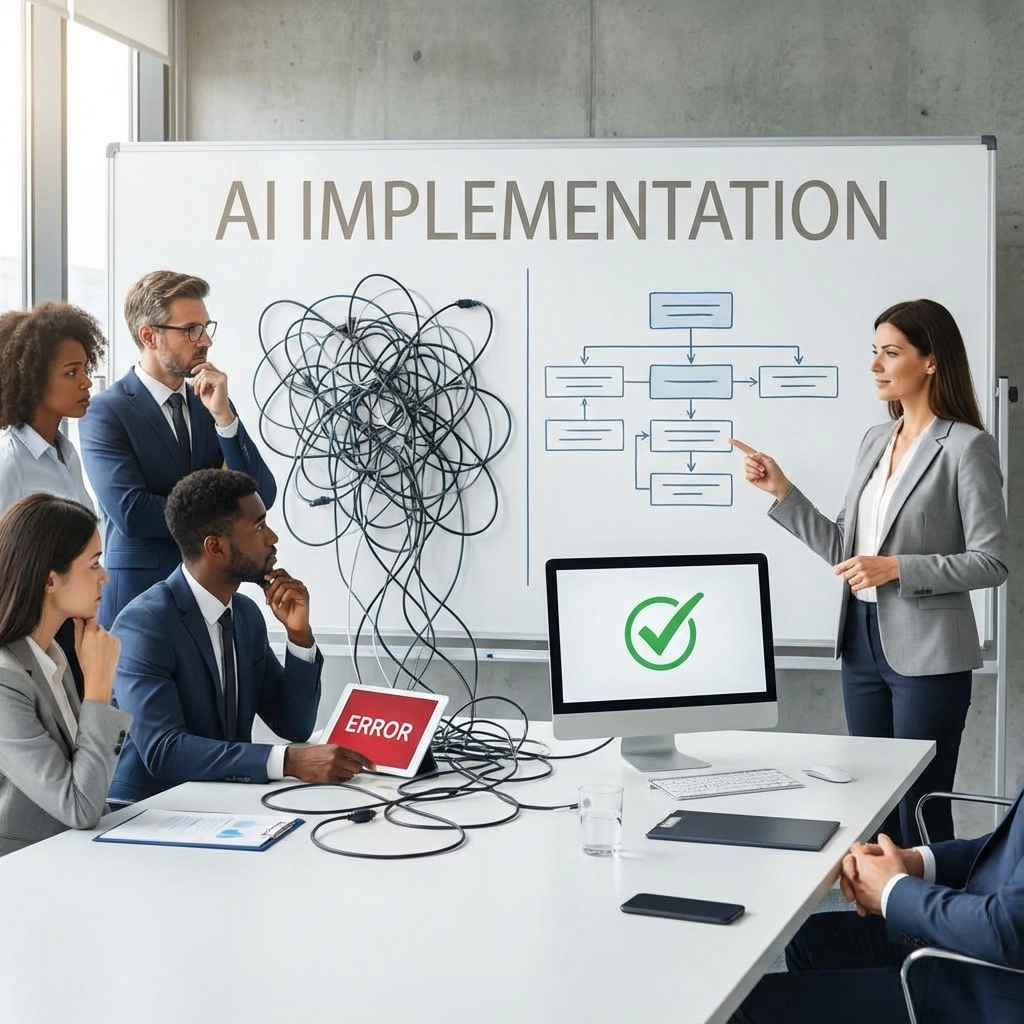
You think you’re ready for AI. You’ve got the budget. The board approval. The consultants lined up.
Think again.
87% of AI initiatives fail within the first 18 months. Not because the technology doesn’t work. But because leaders like you are making the same seven critical mistakes that transform promising AI investments into expensive learning experiences.
Here’s the real talk: You’re not broken. You’re at critical opportunity.
The companies winning with AI aren’t necessarily smarter. They’re just avoiding these predictable pitfalls while their competitors burn through budgets and blame the technology.
Mistake #1: Starting Without Strategic North Star
The breakdown: You’re implementing AI because everyone else is. No clear connection to business outcomes. No measurable objectives. Just expensive technology theater.
The opportunity: Transform AI from cost center to profit driver.
Your fix:
- Define success metrics before selecting any AI tools
- Connect every AI initiative to revenue, cost reduction, or competitive advantage
- Ask: “What specific business problem does this solve?” If you can’t answer in one sentence → stop
The real test: Can your CFO explain the ROI to the board without using the word “innovative”?
Mistake #2: Treating Data Like an Afterthought
The surface problem: Your AI models aren’t accurate enough.
The real problem: → Garbage data in = garbage decisions out.
You’re feeding your AI system the equivalent of junk food and expecting Olympic performance. Clean, organized data is the foundation 73% of executives overlook while chasing the latest AI trends.
Your transformation strategy:
- Audit current data quality before any AI investment
- Establish data governance protocols with clear ownership
- Test for bias across diverse datasets
- Create data pipelines that update in real-time
Critical question: Would you make million-dollar decisions based on your current data quality? If not, neither should your AI.
Mistake #3: Ignoring the Human Element
The mask you’re wearing: “Our people will adapt. They always do.”
The truth behind the mask: → Your team is quietly sabotaging AI initiatives because nobody asked for their input.

Change management isn’t HR fluff. It’s the difference between AI adoption and AI rebellion.
Your people-first approach:
- Involve end-users in AI solution selection
- Create feedback loops throughout implementation
- Position AI as augmentation, not replacement
- Celebrate early wins publicly
Remember: Technology transforms processes. People transform businesses.
Mistake #4: Chasing Complexity Over Value
The trap: Building sophisticated AI models that impress engineers but confuse executives.
The opportunity: → Simple solutions that drive measurable results.
You don’t need the most complex algorithm. You need the most effective one. The best AI implementation is the one your team actually uses.
Your simplification framework:
- Start with business outcome, work backward to technology
- Choose interpretable models over black boxes
- Prioritize user experience over technical sophistication
- Measure adoption rates, not just accuracy metrics
Test: Can a new employee understand and use your AI solution within their first week? If not, you’ve overcomplicated it.
Mistake #5: Rushing to Production
The pressure: Board wants results. Competition is moving. Time to market matters.
The reality: → Premature AI deployment creates bigger problems than delayed launches.
Quality compromises compound exponentially in AI systems. What starts as a minor accuracy issue becomes a customer trust crisis.
Your phased deployment strategy:
- Pilot with limited scope and controlled variables
- Validate results with broader team before scaling
- Build quality checkpoints into your timeline
- Plan for iteration, not perfection
Critical mindset shift: Fast failure beats slow disaster.
Mistake #6: Believing Your Own AI Hype
The dangerous assumption: AI will solve everything perfectly from day one.
The costly reality: → Unrealistic expectations create stakeholder disappointment and project abandonment.
AI is powerful. Not magical. Set expectations based on evidence, not enthusiasm.
Your reality-check protocol:
- Benchmark current performance before AI implementation
- Set incremental improvement targets
- Communicate limitations as clearly as capabilities
- Plan for ongoing optimization, not one-time implementation
Truth bomb: AI that improves your current process by 20% is more valuable than AI that promises 200% improvement but never delivers.
Mistake #7: Treating AI Like a One-Time Project
The project mentality: Build it, launch it, move on to the next initiative.
The growth mindset: → AI requires continuous iteration and improvement.
Successful AI implementations evolve constantly. Market conditions change. Data patterns shift. Customer behaviors evolve.
Your continuous improvement framework:
- Schedule regular model performance reviews
- Gather user feedback systematically
- Monitor for data drift and model degradation
- Build experimentation into your AI culture
Key insight: Companies that treat AI as ongoing experimentation outperform those treating it as one-time implementation by 340%.
Your Next Move: From AI Mistakes to AI Mastery
These seven mistakes aren’t character flaws. They’re predictable patterns that derail AI initiatives across industries.
You’re not behind. You’re at critical opportunity.
The question isn’t whether to implement AI. It’s whether you’ll learn from others’ expensive mistakes or repeat them yourself.
Ready to turn AI uncertainty into competitive advantage?
The same frameworks we use to help executives navigate these AI implementation challenges are detailed in our Creating Critical Opportunity workbook – including specific tools for evaluating AI readiness and building stakeholder alignment.
At People Risk Consulting, we’ve guided leadership teams through successful AI implementations by addressing the people risks that technology-focused consultants miss. Because AI transformation isn’t a technology problem. It’s a leadership opportunity.
Your AI implementation doesn’t have to join the 87% failure rate.
Applications are open for our executive masterclass on leading through technological uncertainty. Limited seats available for senior executives ready to transform AI challenges into strategic advantages.
Apply now – because your competition is making these mistakes right now.
