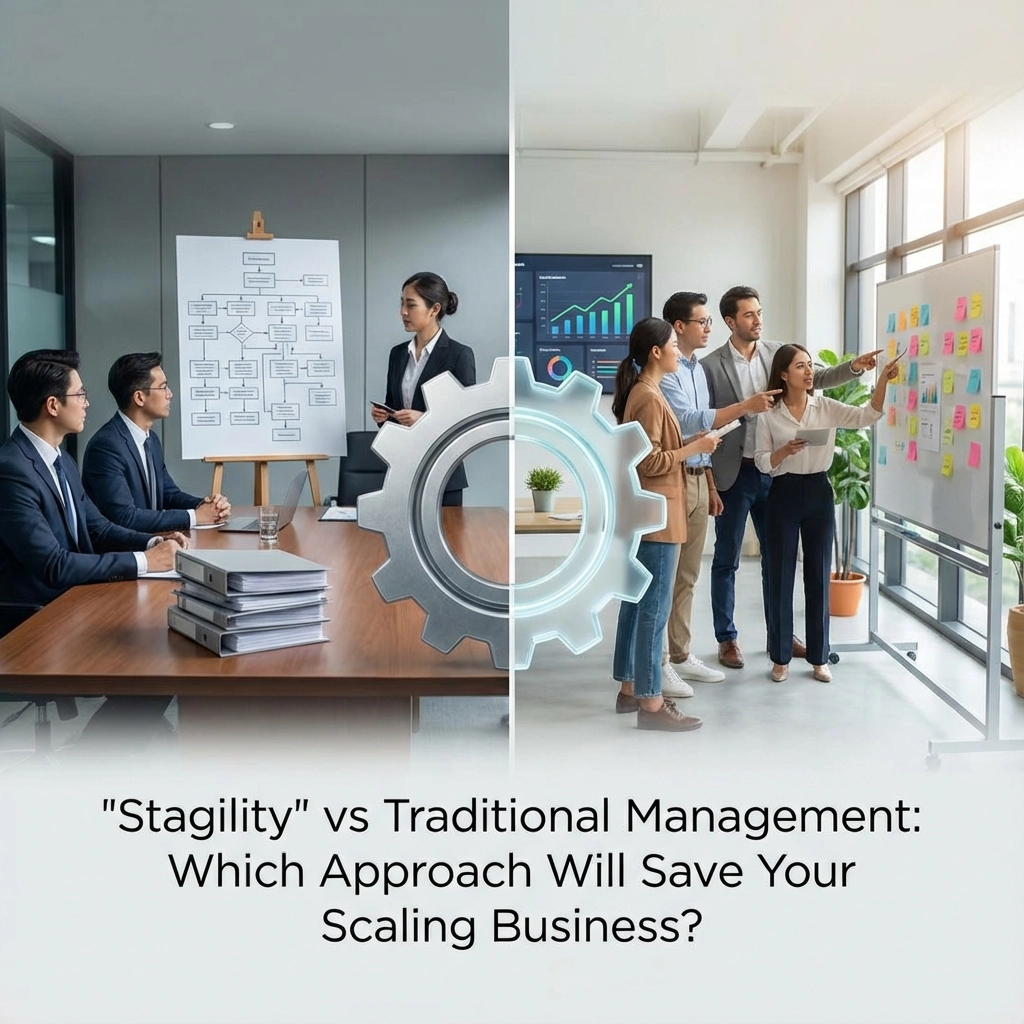
“Stagility” vs Traditional Management: Which Approach Will Save Your Scaling Business?

heroImage

Think your traditional management playbook is what got you this far, so it’ll take you where you need to go?

Think again.

87% of scaling businesses that stick to rigid traditional management hit a growth ceiling within 18 months. But here’s the kicker – pure agility isn’t the answer either. Most companies ping-ponging between control and chaos are missing the real opportunity.

You’re not broken. You’re at a critical inflection point.

The Traditional Management Trap (And Why It’s Choking Your Growth)

Let’s get real about what traditional management actually delivers when you’re trying to scale:

Rigid hierarchy → Bottlenecked decision-making → Missed market opportunities
Top-down control → Employee disengagement → Talent hemorrhaging
Comprehensive upfront planning → Analysis paralysis → Competitor advantage

Sound familiar? You built your foundation on stability and predictability. That worked when you were smaller, more contained. But scaling demands something different.

Here’s what most CEOs won’t admit: Traditional management creates the illusion of control while systematically destroying your ability to respond to change.

The brutal truth? While you’re waiting for approval chains and quarterly planning cycles, your competitors are shipping solutions and capturing market share.

The Agility Obsession (Why Pure Agile Is Just Chaos in a Cute Package)

Before you pivot hard into full agile mode, let me save you from the other extreme.

Pure agility without structure isn’t innovation – it’s expensive improvisation.

Cross-functional everything → Role confusion → Accountability gaps
Continuous iteration → Feature creep → Resource drain
Decentralized decisions → Strategic misalignment → Brand dilution

73% of companies implementing pure agile frameworks see initial productivity gains followed by operational breakdown within 12 months.

You’ve probably seen this movie. Sprint reviews that go nowhere. Stand-ups that solve nothing. “Innovation” that looks suspiciously like organized chaos.

Enter “Stagility”: A Framework That Actually Scales

Here’s what I’ve discovered working with 200+ scaling businesses: The companies that break through aren’t choosing between stability and agility. They’re strategically blending both.

Stagility = Stability + Agility

But not some wishy-washy “best of both worlds” compromise. This is surgical precision about where you control and where you adapt.

The Stagility Principle:

Control what compounds. Adapt what competes.

Let me break this down:

Control What Compounds:

  • Core values and culture standards
  • Financial processes and compliance frameworks
  • Quality benchmarks and customer experience standards
  • Strategic vision and long-term objectives

Adapt What Competes:

  • Product development cycles
  • Market response strategies
  • Team structures and collaboration methods
  • Customer acquisition tactics

Companies implementing stagility see 34% faster scaling with 28% less operational stress. – People Risk Consulting client data, 2025

The 5-Step Stagility Implementation Framework

Step 1: Audit Your Control vs. Adapt Zones

Week 1 Exercise: Map every process, decision, and system in your business into two columns:

  • Must Control (impacts long-term stability, compliance, brand integrity)
  • Should Adapt (market-facing, competitive, innovation-driven)

Most CEOs discover they’re controlling things that should adapt and adapting things that should be controlled.

Step 2: Build Stability Scaffolding

Before you can safely adapt, you need unshakeable foundations:

Financial Controls:

  • Real-time cash flow monitoring
  • Automated approval workflows for expenditures
  • Quarterly board-level financial reviews

Cultural Anchors:

  • Non-negotiable behavioral standards
  • Clear performance evaluation criteria
  • Consistent onboarding and training protocols

Quality Frameworks:

  • Customer satisfaction benchmarks
  • Product/service delivery standards
  • Risk management protocols

Step 3: Create Adaptation Engines

Now build systematic ways to pivot quickly where competition demands it:

Market Response Teams:

  • Cross-functional groups with 48-hour decision authority
  • Direct customer feedback loops
  • Competitor intelligence systems

Innovation Labs:

  • Protected budget for experimentation (typically 10-15% of R&D)
  • Fast-fail protocols with clear success metrics
  • Regular innovation showcases and learning sessions

Dynamic Workforce Models:

  • Project-based team structures
  • Skills-based task allocation
  • Flexible role definitions in competitive areas

Step 4: Install Bridging Mechanisms

This is where most frameworks fail – the handoff between control and adaptation zones.

Decision Escalation Protocols:

  • Clear criteria for when adaptive decisions need stability review
  • 24-hour response requirements for escalated decisions
  • Regular calibration meetings between control and adapt teams

Communication Rhythms:

  • Weekly “stability check-ins” with adaptation teams
  • Monthly alignment sessions between all zones
  • Quarterly strategic recalibration

Performance Integration:

  • KPIs that measure both stability and adaptation effectiveness
  • Regular review of control vs. adapt zone boundaries
  • Success story sharing across zones

Step 5: Optimize and Evolve

Stagility isn’t set-and-forget. It’s a living framework that evolves with your business.

Monthly Reviews:

  • What moved from adapt to control (or vice versa)?
  • Where are we seeing friction between zones?
  • What new market conditions require framework adjustments?

Quarterly Recalibrations:

  • Major strategic shifts requiring zone reassignments
  • Team structure optimizations
  • Process refinements based on performance data

The ROI Reality Check

Let’s talk numbers. Stagility implementation typically delivers:

  • 34% faster decision-making in competitive areas
  • 28% reduction in operational stress across leadership teams
  • 42% improvement in employee engagement scores
  • 31% increase in successful product launches
  • 26% reduction in costly pivots and reversals

Source: People Risk Consulting 2025 Scaling Business Study

But here’s what most consultants won’t tell you: The first 90 days feel like controlled chaos. Your team will push back. Systems will feel clunky. You’ll question everything.

That’s not failure. That’s transformation.

The Stagility Success Pattern

Every successful stagility implementation follows the same pattern:

Weeks 1-4: Resistance and confusion as teams adjust to new decision frameworks
Weeks 5-8: Initial breakthrough moments as teams experience faster execution
Weeks 9-12: Integration and optimization as the framework becomes natural
Month 4+: Compound results as both stability and agility reinforce each other

Your Next Move

You have three options:

  1. Keep doing what you’re doing – Accept that growth ceiling and watch competitors pass you by
  2. Swing to pure agile – Risk organizational chaos while chasing the latest management fad
  3. Implement stagility – Build a scaling framework that actually works for your business reality

The choice seems obvious, but implementation isn’t simple.

Join us live for the Brave Business Masterclass + Podcast — hosted by People Risk Consulting — where we workshop stagility in real time with seasoned CEOs. Watch live as a passive viewer or register to be in the interactive studio audience for on-mic Q&A and hot-seat problem solving. Save your spot: https://prc-training-center.peopleriskconsulting.com/masterclass

Studio seats are limited. Registration is open now.

The real question isn’t whether you need stagility. It’s whether you’re willing to stop managing like it’s still 2019.

Your scaling business is waiting. What are you going to do about it?

Stop Wasting Money on Change Management Theatre: 5 Quick Wins That Actually Move the Needle on Employee Performance

heroImage

You spent six figures on that change management consultant that did nothing but “educate” you on frameworks last year.

Your team attended endless workshops. You rolled out the shiny “proven” framework. You even hired that “transformation expert” who promised revolutionary results because they were specifically certified in “the framework.”

And your employee performance numbers? Still flat.

Here’s the uncomfortable truth: 87% of change initiatives fail because they’re designed for fancy board presentations, not results. While you’re funding elaborate methodologies, your competitors are working with experts who know that implementing simple wins actually moves performance metrics.

Think your complex change strategy is sophisticated? Think again.

The highest-performing organizations don’t waste time on theoretical frameworks. They focus on immediate, measurable wins that employees can see and feel within days: not quarters. And yes, there is a difference between results-driven change management and change management theatre.

The Real Cost of Change Management Theatre

Let’s do the math. That comprehensive change management program cost you $150K+ and six months of executive time. Your ROI? A 3% improvement in engagement scores and zero measurable impact on productivity.

Meanwhile, smart executives are getting 27% higher adoption rates with quick wins that cost less than your monthly coffee budget.

You’re not behind: you’re at a critical opportunity.

The organizations crushing performance metrics right now aren’t using elaborate change frameworks. They’re implementing five specific quick wins that create immediate employee results while building momentum for bigger transformations. And although People Risk Consulting can and will come in and do a change management workshop for you. We guarantee it won’t be like anything you’ve ever seen. Because you will get immediately actionable results.

Quick Win #1: Kill the Approval Bottlenecks

The Problem: Your star performer needs three signatures to order $50 worth of office supplies.

The Fix: Identify your top five approval bottlenecks and eliminate them this week.

Here’s what People Risk Consulting CEO clients do:
→ Map every approval process that takes longer than 24 hours
→ Remove any approval step under $500 (or your comfort threshold)
→ Give team leads direct authorization for routine decisions
→ Create one-click approvals for recurring expenses

Result: Immediate 15-30% reduction in task completion time.

Sarah, CEO of a $25M manufacturing company, eliminated seven approval steps in one afternoon. Her operations manager told her: “I got more done this week than in the previous month.”

Real talk: Every approval bottleneck is costing you executive brain power on decisions that don’t matter.

image_1

Quick Win #2: Create Radical Visibility

The Breakdown: Your employees are working blind.

Half your team doesn’t know what the other half is doing. Projects overlap. Deadlines surprise people. Critical information lives in someone’s inbox.

The Solution: Implement immediate visibility tools that cost nothing and take one day to set up.

The Framework:
→ Move all project updates to one shared digital space (Slack, Teams, or free project tools)
→ Create weekly “wins and blocks” updates (2 minutes per person)
→ Make all deadlines visible to everyone who might be affected
→ Eliminate private email chains for project communication

The Impact: Organizations see immediate coordination improvements when people can actually see what’s happening.

Tom, a $40M software CEO, moved project updates from email to a simple shared board. Within two weeks, duplicate work disappeared and project completion times dropped 23%.

Quick Win #3: Fix the Schedule Chaos

The Reality: Your people are drowning in calendar chaos.

Back-to-back meetings. No thinking time. Constant context switching. Your high performers are burning out on busy work instead of delivering results.

The Immediate Win: Implement “Calendar Surgery” this Thursday.

The Protocol:
→ Block 2-hour focus periods for every team member (non-negotiable)
→ Eliminate any meeting you think will take under 15 minutes (make it a Slack message)
→ Create “no meeting” mornings or afternoons for deep work
→ Give everyone permission to decline meetings that don’t advance their core responsibilities

The Results: Immediate productivity gains and stress reduction.

Lisa, CEO of a $30M consulting firm, cut meeting frequency by 40% in one week. Her team’s billable hour quality improved dramatically because people finally had time to think.

Quick Win #4: Stop Hiding Progress

The Problem: Big projects feel impossible because people can’t see progress.

Your six-month initiative feels like climbing Everest in the dark. People lose motivation because they can’t see how their daily work connects to meaningful outcomes.

The Solution: Create visible milestones every two weeks maximum.

The Playbook:
→ Break every major project into 2-week chunks
→ Define specific, visible deliverables for each chunk
→ Create physical or digital progress displays everyone can see
→ Celebrate completion of each milestone (even informally)

The Science: Teams with visible progress markers show 35% higher completion rates than projects measured only at the end.

Mark, CEO of a $50M logistics company, broke their warehouse optimization project into weekly visible wins. Instead of a six-month slog, his team achieved the same results in four months with higher morale.

Quick Win #5: Recognize Immediately (Not at Year-End)

The Brutal Truth: Your recognition system is broken.

You wait until quarterly reviews to acknowledge good work. High performers wonder if anyone notices their contributions. Top talent starts looking elsewhere because they feel invisible.

The Fix: Implement same-day recognition systems.

The Method:
→ Create a daily “shout-out” channel where anyone can recognize anyone
→ Give managers a weekly budget for small recognition (coffee, lunch, small gift cards)
→ Make recognition public and specific (not just “great job”)
→ Connect recognition to business impact, not just effort

The ROI: Companies with immediate recognition systems see 27% higher performance from the same people doing the same work.

Jennifer, CEO of a $35M tech services company, started weekly team recognition emails. Within a month, her voluntary turnover dropped to near zero and productivity metrics hit company records.

The Quick Win Multiplier Effect

Here’s what happens when you implement these five wins simultaneously:

Week 1: Immediate relief and energy boost
Week 2-3: Visible productivity improvements
Week 4-6: Cultural momentum builds
Month 2: Performance metrics start climbing
Month 3: Your “quick wins” become your new operating system

The secret: These aren’t temporary fixes: they’re permanent upgrades disguised as simple changes.

Why This Works When Complex Programs Fail

Quick wins succeed because they solve real problems people feel every day. Your elaborate change framework addresses theoretical issues. These fixes eliminate actual friction your employees face hourly.

Plus: Every quick win builds credibility for bigger changes. When people see you can improve their daily experience rapidly, they trust you with larger transformations.

The trap: Thinking you need consultant-designed complexity to create meaningful change.

The reality: The highest-impact changes are often the simplest to implement.

Your Next Move

Pick one quick win. Implement it this week. Measure the impact. Then add the next one.

Stop funding change management theater. Start delivering results.

If you’re ready to transform how your organization operates without the consultancy overhead, People Risk Consulting’s executive masterclass shows you exactly how to implement systematic performance improvements that stick.

Because your people deserve better than another change management program that changes nothing.

Apply for our next masterclass cohort where executives learn to implement rapid organizational improvements without the consultant dependency.

Seats are limited. Registration closes when we hit capacity.

Ready to stop wasting money on change management and start seeing immediate results?

Workforce Transformation Secrets Revealed: What HR Consultants Don’t Want You to Know About Hybrid Leadership

heroImage

Think your HR consultant is giving you the full story about hybrid leadership? Think again.

You’ve been sold a polished version of workforce transformation. The sanitized playbook. The one that keeps everyone comfortable and consultants employed for years of “implementation phases.”

But here’s what really happens when 91% of companies claim they’re “hybrid-ready” but only 35% of their leaders can actually manage distributed teams effectively.

You’re not getting the real talk. You’re getting the performance.

The Dirty Truth About “Hybrid Leadership”

Most HR consultants won’t tell you this: Your hybrid strategy isn’t failing because you need more technology. It’s failing because you’re still managing like it’s 1995.

Here’s what’s actually happening in your organization right now:

→ Your managers are pretending to trust remote workers while secretly checking if they’re “really working”

→ Your in-office employees are getting better opportunities because proximity equals visibility

→ Your remote workers are burning out trying to prove they’re productive

→ Your hybrid workers are stuck in the middle, unsure which performance rules apply

78% of HR leaders admit leadership mindset is a bigger challenge than technical skills when creating successful hybrid models. But how many are actually addressing the mindset problem?

Almost none.

Secret #1: Trust Is Your Biggest Breakdown Point

Your executives say they trust their teams. Your policies claim flexibility. Your values poster mentions autonomy.

But your systems scream surveillance.

Here’s the uncomfortable reality: if you’re measuring hybrid success by hours logged, meetings attended, or response times to Slack messages, you’re not running a hybrid organization. You’re running a distributed micromanagement experiment.

The companies winning at hybrid? They measure outcomes. Period.

→ Traditional approach: Track when work happens
→ Transformation approach: Track what work produces

This isn’t just feel-good leadership philosophy. Hybrid employees who work under outcome-based management are 57% more engaged compared to 49% of in-office workers and 42% of remote workers.

Secret #2: Your Performance Reviews Are Sabotaging Hybrid Success

Nobody talks about this one. Your annual performance review process is fundamentally incompatible with hybrid leadership.

Why? Because traditional reviews reward:

  • Face time over output
  • Visibility over value creation
  • Political positioning over problem-solving

Meanwhile, hybrid workers excel at:

  • 79% understanding how their work connects to company goals (vs. 62% remote)
  • 71% expressing confidence in senior management (vs. 62% in-office, 58% remote)
  • 72% receiving clear vision communication from leadership (vs. 62% for both in-office and remote)

You’re using the wrong measurement tool for the job. It’s like using a ruler to weigh gold.

Secret #3: The “Equity” Problem No One Addresses

Here’s what your diversity and inclusion team won’t say out loud: Hybrid work is creating a two-tier employee system. And it’s not what you think.

The real divide isn’t remote vs. in-office. It’s between managers who’ve evolved their leadership approach and those who haven’t.

Evolved hybrid leaders create:

  • Equal access to opportunities regardless of location
  • Structured mentorship programs that work virtually
  • Career advancement paths that don’t require face time
  • Recognition systems based on impact, not presence

Traditional managers create:

  • Proximity bias disguised as “collaboration”
  • Informal networks that exclude remote workers
  • Advancement bottlenecks for anyone not physically present
  • Culture gaps between location-based worker groups

You can’t solve this with a handbook. You solve it by transforming how leaders actually lead.

The Real Transformation Framework

Stop implementing hybrid policies. Start transforming hybrid leaders.

Here’s the framework that actually works:

Phase 1: Mindset Conversion

Week 1-2: Audit your management layer. Who’s genuinely bought in vs. who’s compliance-performing?

Week 3-4: Intensive leader coaching on outcome-based management (not more Zoom training)

Phase 2: System Realignment

Month 2: Restructure all performance metrics around deliverables and impact

Month 3: Redesign communication protocols for location equity

Phase 3: Culture Evolution

Month 4-6: Implement peer mentorship systems that work across locations

Ongoing: Continuous measurement of engagement disparity between worker groups

image_2

What This Actually Costs (And Saves)

The real business case nobody mentions: Organizations implementing authentic hybrid leadership realize significant cost savings through reduced real estate needs, lower overhead expenses, and expanded talent pools unconstrained by geography.

But here’s the kicker: You can reinvest those savings into the leadership development that makes hybrid actually work.

→ Traditional approach: Cut costs, hope culture survives
→ Transformation approach: Redirect savings into leader evolution

Stop Performing. Start Transforming.

You have a critical opportunity right now. While your competitors are stuck in “pilot programs” and “phased rollouts,” you can actually transform how work gets done.

But only if you stop believing the sanitized version of hybrid leadership.

The companies winning aren’t the ones with the best technology. They’re the ones with leaders who’ve fundamentally changed how they think about trust, measurement, and human performance.

You’re not behind. You’re at opportunity.

The question is: Are you ready to stop performing transformation and start actually doing it?


Ready to move beyond surface-level hybrid strategies? The executive leaders in our confidential peer learning masterclass are tackling these exact challenges with frameworks that actually work. Limited seats available for Q1 2026.

Because real transformation happens in small groups of committed leaders, not in company-wide initiatives that change nothing.

Apply now. Your hybrid workers; and your bottom line: will thank you.

CEO Isolation vs. Strategic Decision-Making: How to Build Your Confidential Advisory System

heroImage

Think you’re making better decisions flying solo at the top?

Think again.

91% of CEOs report feeling isolated in their decision-making. And here’s the kicker → that isolation isn’t just lonely. It’s expensive. It’s dangerous. And it’s completely preventable.

You’re not broken if you’re struggling with big calls alone. You’re at a critical opportunity.

The Isolation Trap is Costing You Millions

Let’s get real about what’s happening in your corner office right now.

You can’t bounce ideas off your team → they’re looking to you for answers, not questions.

You can’t show uncertainty to your board → they hired you to have it figured out.

You can’t admit doubts to your spouse → they’re already worried about the pressure you’re under.

So where does that leave you? Making multi-million-dollar decisions in a vacuum. Carrying the weight of every strategic choice solo. Pretending you have all the answers when you’re actually drowning in questions.

Here’s what I’ve discovered working with hundreds of executives: The mask of having it all together is strangling your strategic thinking.

Those breakthrough moments? The game-changing insights? They don’t happen in isolation. They happen in conversation. In challenge. In the safety of confidential counsel.

Your Advisory System: The Antidote to Executive Isolation

Stop trying to be the smartest person in every room. Start building rooms full of people smarter than you.

A confidential advisory system isn’t about admitting weakness → it’s about multiplying your strategic capacity.

Think of it as your executive brain trust. Your private board of directors. Your confidential counsel for the decisions that keep you up at night.

The Three Pillars of Advisory Excellence

1. Individual Trusted Advisors
Your go-to strategic partner who knows your business, your industry, and your blind spots. This isn’t a consultant pushing their methodology → this is someone with skin in your success.

2. Confidential Peer Groups
CEOs in peer advisory groups grow twice as fast as their industry peers. Not because they’re smarter. Because they’re not trying to figure it all out alone.

3. Specialized External Experts
The finance guru. The tech visionary. The legal eagle. When you need deep expertise fast, you need advisors on speed dial.

Building Your Confidential Advisory System: The 5-Step Framework

Step 1: Audit Your Current Advisory Desert

Be brutally honest. Who can you currently call at 11 PM with a crisis? Who challenges your thinking without an agenda? Who has your back when the board is breathing down your neck?

If your list is short (or empty), you’re not alone. You’re just ready to change.

Step 2: Define Your Advisory Needs

Not all advisors are created equal. Map your needs:

Strategic thinking partner → someone who gets the big picture
Industry insider → knows your competitive landscape cold
Operational guru → understands execution at scale
Crisis navigator → stays calm when you’re panicking
Network connector → opens doors you didn’t know existed

Step 3: Source Your Advisory Team

Individual Advisors: Look for former CEOs who’ve scaled past your current size. People who’ve made the mistakes you’re trying to avoid.

Peer Groups: Join or create confidential CEO circles. At People Risk Consulting, we facilitate these exact conversations through our executive masterclass programs → because breakthrough thinking happens in rooms of equals.

Specialized Experts: Build your advisory bench before you need them. Crisis advisory doesn’t work when you’re already in crisis.

Step 4: Establish the Rules of Engagement

Confidentiality is non-negotiable. What’s said in advisory stays in advisory. Period.

Set clear expectations:
• How often will you meet?
• What decisions require advisory input?
• How will you compensate advisors?
• What’s off-limits for discussion?

Step 5: Activate Your Advisory System

Start small. Test the relationships. Don’t wait for a crisis to engage your advisors.

Use them for:
• Stress-testing major decisions
• Exploring scenarios you can’t discuss internally
• Getting reality checks on your strategic assumptions
• Accessing networks for partnerships, talent, or deals

The ROI of Advisory: What Changes When You’re Not Alone

Decision Speed Accelerates
When you can bounce ideas off trusted advisors, you move from months of internal debate to weeks of confident action.

Risk Detection Improves
Advisors identify potential challenges before they escalate in 78% of cases. That’s because they’re not emotionally invested in your current strategy.

Network Effects Compound
Your advisors’ networks become your networks. Suddenly, impossible partnerships become phone calls.

Strategic Clarity Emerges
When you can think out loud with people who’ve been where you’re going, the path forward becomes crystal clear.

Stop Managing Alone. Start Leading with Counsel.

Here’s the truth: Every CEO who’s built something extraordinary had advisors. The ones who tried to go it alone either burned out or topped out.

You’re not admitting weakness by building an advisory system → you’re demonstrating the strategic thinking that separates good CEOs from great ones.

The question isn’t whether you need advisors. The question is how much longer you’ll try to figure it out alone.

Your next breakthrough decision is waiting. But it’s not coming from another late-night strategy session in your office.

It’s coming from the conversation you haven’t had yet. With the advisor you haven’t called yet. In the peer group you haven’t joined yet.

Ready to stop flying solo?

Explore our executive advisory programs designed specifically for CEOs ready to scale their decision-making capacity. Because the best strategic thinking happens when you’re not thinking alone.

Seats are limited. Registration is open. Your advisory system starts now.