
The $50M Plateau: Why Your Growth Strategy Isn’t Working (And the Framework That Breaks Through)

heroImage

You think you’ve cracked the code. Think again.

Your company just hit $50 million in revenue. You’re feeling invincible. The same hustle that got you here will carry you to $100 million, right?

Wrong.

91% of companies that reach $50M never break $100M. They get stuck. Paralyzed. Watching competitors zoom past while their “proven” strategies suddenly stop working.

You’re not broken. You’re at a critical opportunity.

The strategies that built your empire? They’re now your biggest bottleneck.

The Brutal Truth About the $50M Wall

Here’s what nobody tells you about reaching $50 million: Growth is no longer limited by hustle. It’s limited by structure.

Your early-stage tactics → Market saturation in your core segment

Your scrappy competitive edge → Competitors have caught up and matched your offering

Your “we can handle anything” mentality → Capacity constraints choking your delivery capability

Your original business model → Hard limits on addressable market size

At People Risk Consulting, I see this breakdown every single day. CEOs who dominated their first $50M suddenly can’t figure out why the next $20M feels impossible.

The mask you’re wearing? “We just need to do more of what worked.”

That mask is suffocating your growth.

The Framework That Breaks Through: The 3-Vector Strategy

Stop trying to scale what’s broken. Start building what works at $50M+.

Vector 1: Adjacent Customer Expansion

Your current customers → New customer segments with similar pain points

Example: A B2B software company serving mid-market manufacturing expands to mid-market logistics companies with identical operational challenges.

The Test: Can you deliver 80% of your current value to this new segment without rebuilding your entire solution?

Vector 2: Complementary Solution Stacking

Your core offering → Enhanced ecosystem of related services

Example: A consulting firm adds training programs, then certification, then software tools that support their core methodology.

The Test: Does this addition increase customer lifetime value by 3x while requiring less than 50% additional operational overhead?

Vector 3: Business Model Transformation

Your transaction-based revenue → Predictable recurring revenue streams

Example: A project-based agency transitions to retainer + performance-based hybrid model with 18-month minimum commitments.

The Test: Can you maintain 70%+ margins while reducing customer acquisition costs by half?

image_1

The Validation Protocol: $25K Truth Tests

Here’s where most CEOs blow it. They commit $500K to an untested strategy instead of spending $25K to validate demand first.

Phase 1: Hypothesis Definition (Week 1)

Write this exact statement: “We believe [specific customer segment] will pay [$X] for [specific solution] because [validated problem].”

Example: “We believe mid-market logistics companies will pay $15K/month for our operational efficiency consulting because they’re losing $2M annually to inefficient route planning.”

Phase 2: Pilot Commitments (Weeks 2-8)

→ Identify 3 potential pilot customers
→ Secure signed pilot agreements with real money commitments
→ Deliver minimum viable solution
→ Track acquisition costs, time to value, and profit margins

Investment: $25K-$50K maximum

Success Benchmark: 70% pilot conversion rate to full contracts

Phase 3: ROI Evaluation (Week 9)

If pilots generate 3x ROI or higher → Move to Phase 4
If pilots generate less than 3x ROI → Iterate or abandon

Phase 4: Scale Investment (Weeks 10-24)

For validated opportunities: Invest $300K-$750K based on confirmed demand through real customer commitments.

The Protected Innovation Budget: Your Secret Weapon

Here’s the breakthrough insight 87% of $50M+ CEOs miss:

You need 2-5% of your revenue ($1-2.5M for a $50M company) dedicated exclusively to growth validation and pilot programs.

This budget must be completely protected from operational demands.

Why? Because every quarter, your team will try to raid this budget for “urgent” operational needs. The moment you allow that, you’re back on the hamster wheel.

The Rule: This budget only gets spent on testing new growth vectors. Period.

Real Talk: What Actually Moves the Needle

You want to know why your current growth strategy isn’t working? You’re still thinking like a $10M company trying to get to $20M.

At $10M: Growth = More customers doing more of the same thing

At $50M: Growth = New ways to create value for expanded market segments

The shift is brutal. It requires abandoning 70% of what made you successful and building entirely new capabilities.

Most CEOs can’t make this leap alone. They need peer perspectives from other leaders who’ve successfully broken through the $50M ceiling.

The 4-Step Revenue Framework for Systematic Growth

Step 1: Data Definition and Collection
→ Map your most profitable customer segments
→ Identify repeat purchase behaviors and patterns
→ Analyze messaging effectiveness across the customer journey

Step 2: Opportunity Modeling
→ Combine marketing mix modeling with customer behavior analysis
→ Evaluate SKU-level profitability
→ Identify high-margin entry products that predict repeat revenue

Step 3: Strategic Testing Roadmap
→ Create structured experiments with clear hypotheses
→ Define success metrics before testing begins
→ Build incrementality testing to validate new revenue vs. captured existing demand

Step 4: Scale with Proven Incrementality
→ Focus resources on validated high-ROI opportunities
→ Eliminate programs that only capture existing demand
→ Double down on initiatives generating new customer acquisition and retention

Your Next Critical Decision

You have two choices:

Choice 1: Keep doing more of what got you to $50M and watch your growth flatline for the next 3 years.

Choice 2: Implement a systematic framework for breaking through to $100M+ with protected innovation budget and validated growth vectors.

The window for this decision is closing. Every quarter you delay implementing this framework, your competitors get further ahead and your market position becomes harder to defend.

Ready to break through the $50M plateau?

Join the next cohort of CEOs who’ve successfully scaled past $100M using these exact frameworks. Apply for our executive masterclass here – seats are limited to 12 participants to ensure maximum peer learning and personalized strategy development.

Don’t let the $50M plateau become your ceiling. Make it your launchpad.
Are You Making These 7 Common AI Integration Mistakes? (And How to Fix Them Before They Cost You Talent)

heroImage

You think AI is your competitive advantage. Think again.

91% of executives say AI will drive their growth strategy in 2026. But here’s the brutal truth: most of you are doing it wrong. And it’s not just costing you money, it’s bleeding your best talent.

I’m Diane, CEO of People Risk Consulting, and I’ve watched too many smart leaders turn AI adoption into an organizational disaster. The breakdowns always follow the same pattern. Seven predictable mistakes that transform your innovation initiative into a talent exodus.

You’re not broken. You’re at a critical opportunity.

Let me show you exactly where you’re going wrong. And more importantly, how to fix it before your competition figures this out.

The Hidden Cost: Why AI Mistakes Drive Away Your Best People

Here’s what no one tells you about AI integration failures. They don’t just impact your ROI. They create a talent crisis.

When employees watch leadership fumble AI implementation → they lose confidence in strategic direction. When they’re left out of the conversation → they assume their jobs are next on the chopping block. When training is an afterthought → your highest performers start updating their LinkedIn profiles.

58% of companies that botch AI integration see a 23% increase in voluntary turnover within 18 months.

Let’s unpack the seven mistakes that create this cascade. More importantly, let’s fix them.

Mistake #1: Launching AI Without Clear Goals

“We need AI to stay competitive.”

Sound familiar? Of course it does. Because that’s not a goal, that’s panic disguised as strategy.

60% of companies see zero meaningful returns on AI investments because they never defined what success looks like. You’re throwing technology at problems you haven’t clearly identified.

The Fix: Before you buy another AI tool, answer these three questions:

  • What specific business outcome will this AI initiative drive?
  • How will we measure success in 90 days?
  • Which processes will fundamentally change, and how?

Your framework: SMART + AI = Strategic, Measurable, Achievable, Relevant, Time-bound goals with clear Artificial Intelligence applications.

Example: “Reduce customer service response time by 40% within 6 months using AI-powered ticket routing and automated responses for tier-1 inquiries.”

That’s a goal. Everything else is expensive experimentation.

Mistake #2: Treating Employees Like Obstacles Instead of Assets

Your people are terrified. And you’re making it worse.

Most leaders announce AI initiatives like military operations. Top-down. No input. No explanation. Just “Here’s the new system. Use it.”

Result: Employee resistance that kills your timeline and budget.

The truth: Your employees aren’t resistant to AI. They’re resistant to being blindsided by change that affects their livelihood.

The Fix: Flip the script. Make them co-creators, not casualties.

  • Involve department leaders in vendor selection
  • Create AI champions from your existing high performers
  • Communicate how AI amplifies their expertise rather than replaces it
  • Share early wins and celebrate employee innovations with AI tools

Mistake #3: Skipping Training (Then Wondering Why Nothing Works)

“We bought the software. They’ll figure it out.”

No. They won’t.

Untrained teams using AI tools make catastrophic errors. Bad prompts. Poor data interpretation. Over-reliance on outputs they don’t understand.

73% of AI implementation failures trace back to inadequate training programs.

The Fix: Training isn’t optional. It’s foundational.

Your training program needs three components:

  1. Technical proficiency – How to use the tools effectively
  2. Critical evaluation – When to trust AI outputs and when to question them
  3. Integration strategies – How AI fits into existing workflows
image_1

Pro tip: Train trainers first. Identify your tech-savvy employees who can become internal AI coaches. They’ll drive adoption faster than any external consultant.

Mistake #4: Feeding Your AI System Garbage Data

Your AI is only as good as your data. And let’s be honest: your data is probably a mess.

Common data disasters:

  • Inconsistent formats across departments
  • Missing or incomplete records
  • Outdated information that skews results
  • No standardized input protocols

→ Garbage data creates garbage insights. Garbage insights destroy credibility. Destroyed credibility kills AI adoption.

The Fix: Data hygiene before AI deployment.

Start with one department. Clean their data completely. Use that success as a proof of concept for organization-wide data standards.

Mistake #5: Replacing Human Judgment with Artificial Intelligence

AI is a powerful co-pilot. It’s a terrible captain.

The biggest mistake? Treating AI like an oracle instead of a tool. Your executives start deferring strategic decisions to algorithms. Your managers stop asking “why” and start blindly following recommendations.

Result: Strategic thinking atrophies. Innovation dies. Your best people leave for companies that value human insight.

The Fix: Establish clear boundaries for AI decision-making.

AI excels at: Pattern recognition, data processing, repetitive tasks, initial analysis
Humans excel at: Strategic thinking, relationship building, creative problem-solving, ethical judgment

Mistake #6: Ignoring Ethics Until It’s Too Late

Ethics isn’t a nice-to-have. It’s a business-critical requirement.

Companies that treat AI ethics as an afterthought face:

  • Legal liability from biased algorithms
  • Employee trust erosion
  • Customer backlash
  • Regulatory scrutiny

Companies with established AI governance frameworks see 31% higher employee satisfaction scores during AI integration.

The Fix: Build ethics into your foundation, not your facade.

Create an AI Ethics Committee with representatives from HR, Legal, Operations, and frontline employees. Address these questions before deployment:

  • How will we identify and correct algorithmic bias?
  • What privacy protections are in place for employee and customer data?
  • How do we maintain transparency in AI-driven decisions?
  • What’s our process for AI output auditing?

Mistake #7: Treating AI Like a One-Time Project Instead of Organizational Evolution

You pilot one AI tool. It works. You celebrate success and move on.

Six months later: Your AI implementation has hit a wall. It doesn’t scale. It doesn’t integrate. It creates more problems than it solves.

58% of companies hit critical bottlenecks that increase costs by 28% because they didn’t plan for scale from day one.

The Fix: Design for scale from the start.

Your AI strategy needs:

  • Modular architecture that grows with your business
  • Integration protocols for multiple AI tools
  • Change management processes for continuous evolution
  • Performance monitoring that tracks long-term impact

The Path Forward: Your AI Integration Recovery Plan

If you’re making these mistakes, you’re not broken. You’re at a critical opportunity.

Most of your competitors are making the same errors. The companies that fix these problems first will dominate their markets.

Your 30-day recovery plan:

  1. Week 1: Audit your current AI initiatives against these seven mistakes
  2. Week 2: Gather employee feedback on AI tools and training needs
  3. Week 3: Establish clear success metrics and ethical guidelines
  4. Week 4: Create your scaling roadmap and communication strategy

The competitive advantage isn’t in having AI. It’s in implementing AI in a way that amplifies your people instead of alienating them.

Want to dive deeper into building AI strategies that protect and develop your talent? Our executive masterclass covers advanced frameworks for technology integration without the typical implementation disasters.

Join our next cohort and learn how top CEOs are turning AI adoption into competitive talent advantages.

Remember: Your people are your differentiator. AI should make them more valuable, not more replaceable. Get this right, and you’ll have both technological capability and the human capital to leverage it.

Get it wrong, and you’ll have expensive software and empty desks.

The choice is yours. Choose wisely.

How to Create “Stagility” in Your Organization: The 5-Step Framework for Scaling Without Breaking

heroImage

Think you need to choose between stability and agility to scale your business? Think again.

Most CEOs believe they’re facing an impossible choice: maintain the stability that got them here, or embrace the agility needed for tomorrow. This false dilemma is killing growth at organizations across every industry.

Here’s what 73% of executives don’t realize: The companies winning at scale aren’t choosing sides. They’re mastering “stagility”: the art of being simultaneously stable and agile.

You’re not stuck between two bad options. You’re sitting on the biggest competitive advantage of the next decade.

The Scale-Breaking Problem Most CEOs Can’t See

Your organization is probably breaking right now. Not failing: breaking. There’s a difference.

→ Processes that worked at $10M revenue are suffocating growth at $50M
→ Teams that thrived with 50 people are drowning with 200
→ Systems that felt agile now feel like cement

87% of fast-growing companies report that their original structures become growth barriers within 18 months of major expansion.

But here’s the real problem: Most leaders respond by choosing extremes. They either lock down everything (stability) or tear everything apart (agility). Both approaches destroy what they’re trying to protect.

What Stagility Actually Means (And Why It’s Your Secret Weapon)

Stagility isn’t a buzzword: it’s a survival strategy. The term combines stability and agility into a framework that lets you scale without snapping.

Think of it like this: A skyscraper doesn’t sway in the wind because it’s rigid. It sways because it’s designed to flex while maintaining its foundation. That’s stagility in action.

Companies mastering stagility are seeing remarkable results:

  • 35% faster time-to-market on new initiatives
  • 42% improvement in employee retention during growth phases
  • 28% reduction in operational breakdowns during scaling
image_1

The 5-Step Stagility Framework That’s Changing Everything

Here’s the step-by-step system People Risk Consulting has developed working with hundreds of scaling organizations. This isn’t theory: this is what actually works in the real world.

Step 1: Anchor Your Identity (Before Everything Else Changes)

The Problem: When everything’s changing, people lose their sense of who the company is and what it stands for.

The Solution: Create three unshakeable anchors:

  • Purpose Anchor: What will never change about why you exist
  • Values Anchor: The non-negotiables that guide every decision
  • Culture Anchor: How people actually behave when no one’s watching

Action Items:
□ Define your company’s unchangeable core in one sentence
□ Identify 3-5 values that you’d fire people for violating
□ Document the behaviors that represent your culture at its best
□ Communicate these anchors to every person, every quarter

Real Example: When Haier transformed into 4,000+ micro-enterprises, they anchored around “inverted triangle” customer-first thinking. Everything else could change, but that couldn’t.

Step 2: Build Flexible Job Architecture (Not Rigid Job Descriptions)

The Problem: Traditional job descriptions become straitjackets during rapid growth.

The Solution: Design roles around capabilities and outcomes, not tasks.

→ Move from “Marketing Manager” to “Growth Capability Owner”
→ Shift from task lists to outcome expectations
→ Create skill clusters that can be combined in different ways

Action Items:
□ Map every role to 3-5 core capabilities instead of 20+ tasks
□ Define success metrics that stay constant regardless of how work gets done
□ Create “capability swap” opportunities between teams
□ Build skills inventories that show who can do what

The Bottom Line: When people own outcomes instead of tasks, they adapt naturally as needs change.

Step 3: Implement Selective Automation with Human Guardrails

The Problem: Organizations either automate everything or nothing: both approaches fail during scaling.

The Solution: Automate the routine, amplify the human.

The Stagility Automation Rules:

  • Automate anything that happens the same way 80%+ of the time
  • Keep humans in charge of exceptions, relationships, and strategy
  • Build manual override capabilities into every automated process
  • Train teams to work with automation, not despite it

Action Items:
□ Audit your processes: Which repeat identically? Which require judgment?
□ Start with your highest-volume, lowest-stakes processes first
□ Create “human checkpoints” in every automated workflow
□ Train teams on when to override automation

Step 4: Create Adaptive Leadership Structures

The Problem: Traditional hierarchies either strangle innovation or create chaos.

The Solution: Build leadership that can be both directive and distributed.

Here’s how the best scaling companies are restructuring leadership:

Distributed Decision Rights:

  • Strategic decisions: Executive team
  • Operational decisions: Department heads
  • Tactical decisions: Individual contributors

Adaptive Communication Loops:

  • Weekly: Tactical coordination
  • Monthly: Strategic alignment
  • Quarterly: Vision and priorities reset
image_2

Action Items:
□ Map every type of decision to the right leadership level
□ Create escalation paths that don’t require 5 approvals
□ Establish regular “reality check” sessions between leadership levels
□ Build feedback loops that flow up, down, and across the organization

Step 5: Install Continuous Capability Building

The Problem: Most companies either overtrain (wasting money) or undertrain (limiting growth).

The Solution: Build learning that adapts to your actual growth needs.

The Stagility Learning Framework:

  • Foundation Skills: Everyone needs these, regardless of role
  • Function Skills: Department-specific capabilities
  • Future Skills: Emerging capabilities you’ll need in 6-12 months

Action Items:
□ Define the 5 foundation skills every employee must have
□ Map function-specific skill requirements to business outcomes
□ Identify 3 future skills your organization will need next year
□ Create learning paths that people can pursue based on business needs and personal interest

Key Insight: The companies winning at stagility aren’t just training people: they’re building internal capability to continuously upskill based on changing needs.

Where Most Organizations Get Stagility Wrong

Mistake #1: Thinking Stagility Means “Stable Sometimes, Agile Sometimes”
Wrong. True stagility means being stable and agile simultaneously. Your core identity stays rock-solid while your methods stay flexible.

Mistake #2: Implementing Stagility from the Bottom Up
Stagility starts with leadership. If your executive team isn’t modeling the balance, your organization can’t achieve it.

Mistake #3: Measuring the Wrong Things
Most companies measure efficiency OR innovation. Stagile organizations measure both: and the relationship between them.

The Real Return on Stagility Investment

Here’s what happens when you get stagility right:

Year 1: Teams stop breaking under growth pressure
Year 2: Innovation accelerates without sacrificing quality
Year 3: You become the company others try to copy

Organizations implementing stagility frameworks report 67% fewer “growth crises” and 45% faster recovery from operational disruptions.

But here’s the thing most CEOs miss: Stagility isn’t a destination. It’s a capability. The moment you think you’ve “achieved” it is the moment you start losing it.

Your Stagility Starting Point

You don’t need to overhaul everything tomorrow. Start with Step 1: anchoring your identity. Once people know what won’t change, they can handle everything that will.

This Week:
□ Gather your leadership team
□ Define your three anchors
□ Communicate them to your organization

This Month:
□ Implement flexible job architecture for one department
□ Identify your first automation opportunities
□ Establish new decision rights

This Quarter:
□ Launch your continuous capability building program
□ Measure both stability and agility metrics
□ Iterate based on what’s working

The companies mastering stagility aren’t the ones with perfect processes. They’re the ones with adaptive processes. They’re the ones willing to stay anchored in purpose while staying flexible in method.

Your organization isn’t broken because it can’t choose between stability and agility. You’re at a critical opportunity to master both.

Ready to build stagility into your organization’s DNA? People Risk Consulting’s executive masterclasses dive deep into implementing these frameworks with peer groups of scaling CEOs. Registration is limited to maintain intimate cohort dynamics.

The question isn’t whether your organization needs stagility. The question is whether you’ll build it before your competitors do.

The CEO Isolation Crisis: Why Smart Leaders Are Choosing Confidential Peer Learning Over Traditional Consulting

heroImage

Think your executive coach has all the answers? Think again.

You’re sitting in another strategy session with your $500-per-hour consultant. They’re brilliant. They have the frameworks. The case studies. The MBA credentials that could wallpaper your office.

But here’s what they don’t have: They’ve never signed the front of a paycheck for 500 employees during a market downturn.

Welcome to the CEO isolation crisis. And it’s costing you more than you realize.

The Mask Is Suffocating Your Growth

50% of CEOs report feeling isolated in their roles. 61% say this isolation negatively impacts their strategic decision-making.

You’re not broken. You’re at a critical opportunity.

The isolation isn’t your fault → It’s baked into the role. As your company scales, your early advisors can’t relate to your increasingly complex challenges. Your employees can’t give you real feedback because they’re worried about their jobs. Your board members have competing agendas.

You’re performing the “everything’s fine” mask while drowning in decision fatigue behind closed doors.

image_1

Traditional Consulting’s Fatal Flaw

Here’s the uncomfortable truth about traditional consulting:

It’s built on the expert-student model. Someone who’s never run a $50M+ company is teaching you how to run yours.

Don’t get me wrong. Consultants bring valuable frameworks and outside perspective. But they miss something critical:

The emotional weight of decisions that affect hundreds of families
The 3 AM anxiety attacks when market shifts threaten everything you’ve built
The impossible balance of being vulnerable enough to learn but strong enough to lead

26% of executives report depression symptoms compared to 18% in the general workforce. The pandemic made it worse. You’re missing family moments. Cycling through guilt. Wondering if anyone truly understands the pressure you’re under.

Traditional consulting treats symptoms. Peer learning addresses the root.

Why Smart CEOs Are Making the Switch

Remember Sarah, CEO of a $75M logistics company? She spent two years working with top-tier consultants on her expansion strategy. Smart people. Great analysis.

But when supply chain disruptions hit, guess who gave her the breakthrough? Another CEO who’d navigated similar chaos six months earlier.

Here’s what the research reveals:

CEOs participating in peer advisory groups make decisions 37% faster and achieve 42% higher revenue growth compared to those operating in isolation.

It’s not magic. It’s distributed cognition.

The Confidential Peer Learning Advantage

Think of it this way: Would you rather learn chess from a chess master who’s never played under pressure, or from grandmasters who’ve won tournaments?

Confidential peer learning gives you the grandmasters.

The Five Breakthrough Benefits:

1. Early Warning Systems
Other leaders spot market cycles and disruptions before they hit your radar. You get real-time intelligence from people living through similar challenges.

2. Proven Strategy Arsenal
Access battle-tested solutions from adjacent industries. What worked in fintech might revolutionize your manufacturing processes.

3. Emotional Armor
70% of new CEOs report needing more support. Peer groups provide psychological safety where you can admit uncertainty without losing credibility.

4. Decision Acceleration
No more analysis paralysis. When facing tough calls, you have a trusted brain trust that’s been there before.

5. Innovation Cross-Pollination
Your biggest breakthrough often comes from connecting dots across industries. Peer learning makes those connections inevitable.

The Confidential Component Changes Everything

“But what about competitive intelligence? Industry secrets?”

Smart peer learning groups aren’t industry-specific. They’re challenge-specific.

The CEO dealing with rapid scaling in healthcare shares common ground with the CEO navigating growth in manufacturing. The fundamental leadership challenges transcend industry.

Plus, confidentiality agreements ensure what’s shared in the room stays in the room. You get the vulnerability without the risk.

image_2

The Traditional vs. Peer Learning Framework

Traditional Consulting:

  • Expert → Student dynamic
  • Theoretical solutions
  • One-way knowledge transfer
  • Expensive ongoing dependency
  • Limited to consultant’s experience

Confidential Peer Learning:

  • Leader ↔ Leader collaboration
  • Battle-tested solutions
  • Multi-directional wisdom sharing
  • Sustainable ongoing resource
  • Unlimited collective experience

Here’s the kicker: You don’t just receive value. You create it.

When you share your breakthrough with supply chain optimization, you’re not just helping another CEO. You’re reinforcing your own learning and building relationships that compound over decades.

The Real ROI of Breaking Isolation

Let’s talk numbers:

  • 37% faster decision-making = Competitive advantage in rapidly changing markets
  • 42% higher revenue growth = Direct bottom-line impact
  • Reduced executive burnout = Sustainable performance over time
  • Access to deal flow and partnerships = Opportunities that never hit the open market

But the intangible benefits matter more:

Sleeping better knowing you’re not facing challenges alone
Making bold moves with confidence because peers have your back
Leading authentically instead of wearing the “perfect CEO” mask

Your Next Move: Breaking the Isolation Cycle

You have three choices:

  1. Stay isolated and keep grinding through decisions alone
  2. Double down on traditional consulting and hope they eventually understand your reality
  3. Join a confidential peer learning cohort and multiply your decision-making capacity

The isolation crisis isn’t going away. Market complexity is increasing. The stakes keep rising.

You’re not meant to figure this out alone.

The People Risk Consulting Approach

At People Risk Consulting, we’ve seen what happens when smart leaders stop pretending they have all the answers. Our confidential peer learning cohorts bring together seasoned CEOs facing similar inflection points.

No theory. No untested frameworks. Just proven leaders sharing what actually works.

The next cohort launches with limited seats. Registration is open for executives ready to trade isolation for acceleration.

Ready to stop leading alone?

Explore our executive masterclass programs and discover how confidential peer learning can transform your decision-making and multiply your growth.

The mask you’re wearing is suffocating your potential. It’s time to breathe.

Stuck at $50M? The Hidden Growth Barriers 87% of Executives Don’t See Coming

heroImage

Think your $50M revenue plateau is about market conditions? Competition? Economic headwinds?

Think again.

87% of executives blame external factors for their growth stagnation. But here’s the uncomfortable truth most CEOs refuse to face: Your biggest growth barriers aren’t outside your company. They’re sitting in your boardroom.

At People Risk Consulting, we’ve dissected dozens of companies stuck at the $50M mark. What we’ve discovered will challenge everything you believe about scaling.

The $50M Mirage: Why Smart Leaders Hit Invisible Walls

You built something incredible. From startup to $50M feels like conquering Everest. Your systems worked. Your team delivered. Your leadership style got results.

But the very strengths that got you here are now killing your growth.

Governance and operational inefficiencies become the primary constraints at exactly the $50M threshold. The processes that supported your scrappy $5M company? They’re fracturing under the weight of complexity.

Here’s what’s really happening → Your success created the perfect conditions for failure.

image_1

The Five Hidden Assassins of $50M+ Growth

1. The CEO Bottleneck Trap

You’re still making decisions that should happen three levels down. Every approval runs through you. Your calendar is packed with operational meetings instead of strategic planning.

The brutal reality? Founders who built their companies often struggle to delegate decision-making authority, creating bottlenecks that slow execution.

This isn’t about ego. It’s about unconscious control patterns that worked when you were smaller but now choke growth at scale.

The fix → Implement decision rights frameworks. Define what decisions require your input versus what can be delegated. Time-box your involvement in operational issues.

2. The Scalability Breakdown

Your once-efficient systems are now digital duct tape holding everything together. Customer onboarding takes weeks instead of days. Your team spends more time fighting internal friction than serving clients.

Systems become overloaded, workflows break down, and operational infrastructure cannot sustain expanded business.

The reality check → What got you to $50M won’t get you to $100M. Period.

The solution → Audit every system, process, and workflow. Anything that requires manual intervention at scale needs reimagining. Build for 10x, not 2x growth.

3. The Decision Paralysis Disease

Remember when you could pivot in 24 hours? Now simple decisions take weeks. Bureaucratic approvals pile up. Cross-functional collaboration moves at the speed of molasses.

Slow decision-making extends cycles from days to weeks, causing market opportunities to slip away.

Here’s what’s happening → You’ve created organizational diabetes. Information flow is clogged. Decision pathways are unclear.

The intervention → Create decision velocity metrics. Track how long key decisions take. Identify bottlenecks. Eliminate approval layers that don’t add real value.

4. The Talent Hemorrhage Crisis

Your best performers are walking out the door. Not because of money. Because they see what you don’t: structural constraints that limit their impact.

Top performers recognize structural constraints before leadership often does, departing when they encounter inefficiencies.

The wake-up call → High performers don’t leave companies. They leave broken systems.

The retention strategy → Exit interview honestly. What friction are they experiencing? What opportunities do they see that you’re missing? Fix the environment, not just the compensation.

5. The Innovation Strangulation

You’re so focused on optimizing existing revenue streams that innovation dies. New product development stalls. Market expansion gets shelved. Risk tolerance plummets.

The dangerous pattern → Success breeds conservatism. Conservatism breeds stagnation.

The breakthrough → Allocate specific resources to experimentation. Create protected space for innovation. Measure learning, not just revenue.

image_2

The $50M Breakthrough Framework

Phase 1: Diagnostic Reality Check

Week 1-2: Complete organizational health assessment

  • Map current decision flows
  • Identify system breaking points
  • Survey talent retention risks
  • Audit innovation pipeline

Phase 2: Infrastructure Redesign

Week 3-8: Rebuild for scale

  • Implement automated workflows
  • Redesign org structure for delegation
  • Create clear decision rights
  • Establish performance dashboards

Phase 3: Talent Transformation

Week 9-12: Unlock human potential

  • Address top performer concerns
  • Eliminate bureaucratic friction
  • Create advancement pathways
  • Build learning culture

Phase 4: Growth Acceleration

Week 13+: Execute with precision

  • Launch innovation initiatives
  • Expand market presence
  • Scale successful systems
  • Monitor velocity metrics

The Hidden Truth About $50M Companies

Most executives at this level aren’t broken. They’re at a critical opportunity.

The skills that made you successful → analytical thinking, hands-on leadership, personal accountability → are exactly what you need to solve this challenge.

But you need new frameworks. New systems. New approaches.

Breaking Through: The People Risk Consulting Advantage

We’ve guided 200+ executives through this exact transition. Not through generic consulting frameworks, but through peer learning cohorts with leaders facing identical challenges.

The difference? You’re not getting advice from someone who’s never built what you’ve built. You’re learning from executives who’ve broken through the $50M barrier and scaled to $100M+.

Recent client results:

  • 152% revenue growth in 18 months (Manufacturing CEO)
  • Eliminated 40% of operational friction (SaaS Founder)
  • Reduced decision cycles from weeks to days (Services Executive)
image_3

Your Next Move

The $50M plateau isn’t permanent. It’s a transition point.

The question isn’t whether you can break through. The question is how quickly you can identify and eliminate the hidden barriers holding you back.

Ready to unmask what’s really limiting your growth?

Our next executive cohort starts in February. Seats are limited to 12 senior leaders. No PowerPoint presentations. No generic frameworks. Just real solutions from executives who’ve solved exactly what you’re facing.

Apply for the executive breakthrough masterclass here.

Or keep doing what you’ve always done. Just don’t expect different results.

The choice → and your company’s future → is yours.


Dr. Diane Dye, Founder and CEO of People Risk Consulting, has guided 200+ executives through critical growth transitions. Her executive peer learning cohorts have generated over $2.3B in additional revenue for member companies.

Are Annual Performance Reviews Dead? How Top CEOs Are Replacing Them in 2026

heroImage

Think your annual performance review process is working? Think again.

Here’s the brutal truth: 91% of companies still cling to annual performance reviews, yet only 14% of employees believe they actually drive performance improvement. You’re spending months preparing elaborate review cycles that deliver zero growth.

Your competitors aren’t just abandoning this broken system. They’re replacing it with something that actually works.

The Performance Review Breakdown Is Real

Let’s stop pretending everything’s fine. The data from People Risk Consulting’s executive research reveals a devastating disconnect:

72% of employees don’t trust their organization’s performance management systems
61% of managers admit the current process fails to drive results
$3.5 billion wasted annually on performance review administration that produces no measurable outcomes

→ Traditional annual reviews create delayed feedback loops
→ Employees receive unusable insights months after the fact
→ Critical growth opportunities vanish while you wait for “review season”

You’re not broken. You’re at a critical opportunity to unlock performance potential your competitors are missing.

image_1

What Top CEOs Discovered in 2026

The executives who cracked this code didn’t just tweak their review process. They completely reimagined performance management.

Apple’s CEO eliminated annual reviews entirely. Block’s leadership team replaced them with continuous growth conversations. One Fortune 100 financial services firm saw 23% higher employee engagement within six months of overhauling their approach.

The secret? They stopped performing and started partnering.

Here’s what they implemented instead:

1. Real-Time Performance Intelligence

Traditional approach: Wait 12 months to address performance gaps.
New framework: Continuous performance visibility with weekly check-ins.

• Managers identify skill gaps within 30 days, not 365
• Goals adjust as business priorities evolve
• Employees receive coaching when it actually matters

Result: Companies using this approach report 31% faster skill development and 28% higher goal achievement rates.

2. AI-Powered Bias Detection

Annual reviews are contaminated with recency bias, favoritism, and subjective interpretation. Smart leaders deployed artificial intelligence to:

Eliminate rating bias through data-backed performance insights
Surface early warning signals of disengagement before talent walks
Automate workflow management so managers focus on growth, not paperwork

One People Risk Consulting client discovered their “top performers” in annual reviews were actually contributing 15% less value than previously overlooked team members. The AI revealed the truth their subjective process missed.

3. The Trust-Building Revolution

Here’s where most leaders get it wrong. They think performance management is about evaluation. The breakthrough companies understand it’s about collaboration.

Instead of: “Here’s what you did wrong.”
They say: “What can we work on together?”

This shift creates:
→ More honest conversations about actual challenges
→ Earlier insights into barriers blocking success
→ Employees feeling “respected, heard, and treated like a partner”

4. Dynamic Goal Architecture

Static annual objectives are organizational death. By the time December arrives, your January priorities are irrelevant.

The new model: Goals that breathe with your business.

• Monthly recalibration based on market shifts
• Cross-functional alignment that prevents silos
• Employee ownership of their growth trajectory

Companies using dynamic goal-setting report 47% higher adaptability to market changes.

The Implementation Framework That Actually Works

You can’t just replace annual reviews with “continuous feedback” and expect magic. Here’s the step-by-step approach that drives results:

Phase 1: Foundation (Weeks 1-4)

Audit current system gaps through employee and manager feedback
Define performance partnership principles that guide all conversations
Train managers on growth-focused dialogue techniques

Phase 2: Pilot Launch (Weeks 5-12)

Select 2-3 high-performing teams for initial rollout
Implement weekly check-in structure with clear conversation frameworks
Measure early indicators: engagement scores, goal progression, retention signals

Phase 3: Scale and Optimize (Weeks 13-24)

Expand to remaining departments based on pilot learnings
Integrate AI tools for bias detection and performance insights
Establish quarterly calibration sessions for system refinement

image_2

The Competitive Advantage You’re Missing

While your competitors debate whether to keep annual reviews, the leaders who eliminated them are capturing talent, accelerating development, and building cultures where peak performers actually want to stay.

The mask is off. Your people know the current system doesn’t work. They’re waiting for you to lead the change.

Your choice: Keep performing the annual review theater, or start building a performance partnership that drives real growth.

This isn’t about HR innovation. This is about competitive survival.

The executives mastering this transformation aren’t just improving employee satisfaction. They’re seeing:

23% reduction in voluntary turnover among high performers
31% faster skill development and capability building
$2.3 million average annual savings from reduced hiring and training costs
47% improvement in cross-functional collaboration and goal alignment

Your Next Move

The annual performance review era ended in 2025. The question isn’t whether to evolve: it’s how fast you can implement what’s already working.

Ready to stop performing and start partnering?

People Risk Consulting’s Performance Partnership Masterclass shows you exactly how to implement the frameworks driving results for Fortune 500 leaders. We’ll walk you through the AI tools, conversation templates, and measurement systems that eliminate performance management waste.

Limited seats available. Registration closes this quarter.

Apply now and join the executives who’ve already made the shift.

Your people are waiting for real performance partnership. Your competitors are already building it.

Don’t let another review cycle pass you by.

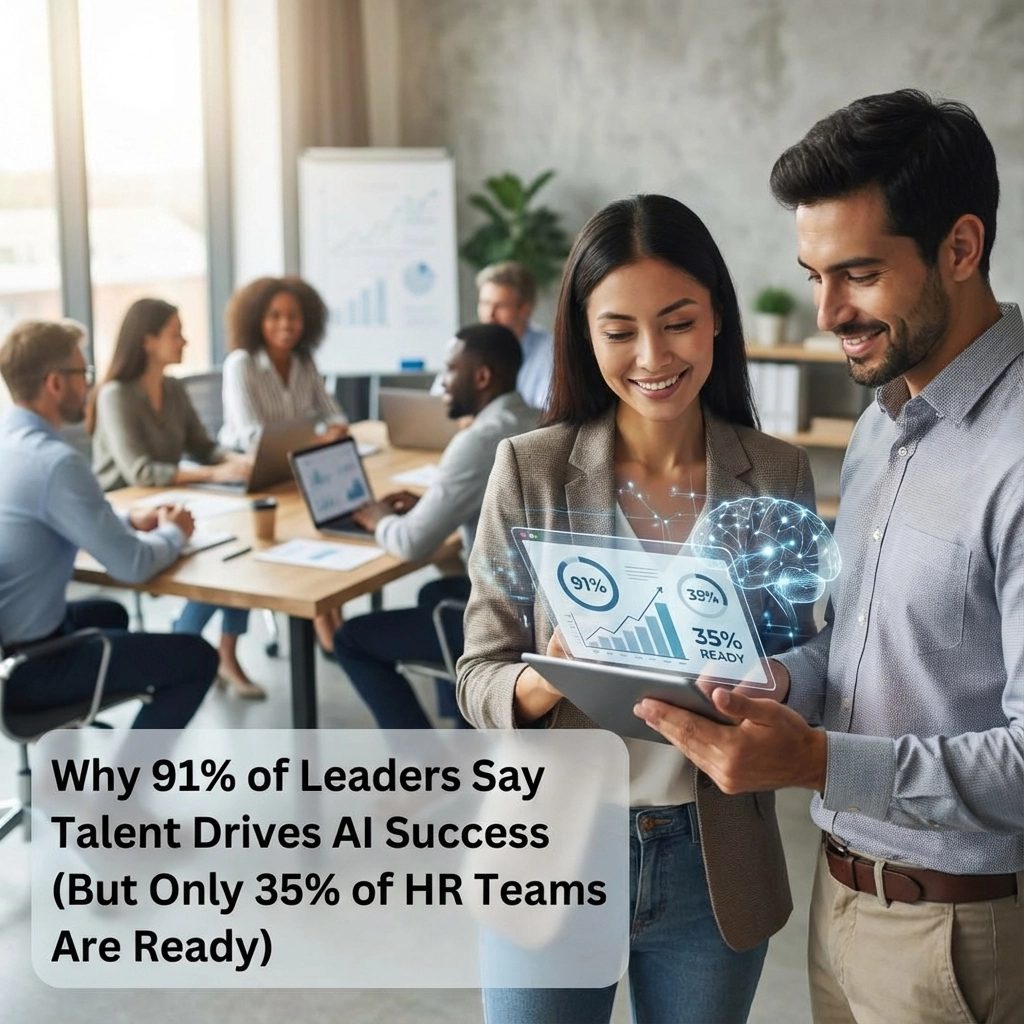
Why 91% of Leaders Say Talent Drives AI Success (But Only 35% of HR Teams Are Ready)

heroImage

You think you’ve got AI transformation figured out. Your strategy deck is polished. Your budget is approved. Your timeline is aggressive but achievable.

Think again.

While you’re busy mapping out your AI roadmap, there’s a massive breakdown happening right under your nose. 91% of leaders recognize that talent drives AI success, yet organizations are catastrophically unprepared to actually develop that talent. The numbers don’t lie: only 35% of employees feel confident they have the skills needed to succeed in their evolving roles.

This isn’t a training problem. This is a leadership alignment crisis that’s about to torpedo your AI transformation before it even begins.

The Great AI Talent Disconnect

Here’s what’s really happening in boardrooms across America right now:

Executive teams are making bold AI commitments → HR teams are getting zero input on strategy → Employees are panicking about job security → Training programs are failing spectacularly → AI initiatives stall out.

image_1

The breakdown starts at the top. Only 21% of organizations involve HR leadership in AI strategy decisions. You’re essentially planning a talent revolution without consulting the people who actually understand your talent.

This is the executive mask problem in action. You’re performing confidence about AI readiness while ignoring the human infrastructure required to make it work.

Why Your AI Training Is Already Failing

Let’s get real about what’s happening with your current talent development:

62% of employees rate their organization’s AI training as average to poor
• Only 25% of employees consider their company’s talent development programs highly effective
• 43% of workers cite AI/machine learning skills as their biggest gap
• 31% identify leadership skills as their greatest weakness

The critical issue? 78% of leaders believe they have AI figured out, but only 39% of employees agree.

You’re not seeing what your people are actually experiencing. While you’re confident about your AI strategy, your workforce is drowning in skill gaps and uncertainty.

The Hidden Cost of This Misalignment

This talent-strategy disconnect isn’t just an HR problem. It’s a growth bottleneck that will cost you millions.

When People Risk Consulting analyzes failed AI transformations, we consistently find the same pattern:

Technical implementation succeedsHuman adoption failsROI never materializesLeadership blames the technology

The real culprit? You treated AI transformation like a technology project instead of a people transformation project.

Organizations with leadership-driven AI adoption strategies report significantly higher engagement and positive workplace culture. Yet only 17% of companies have leadership-driven AI adoption with clear strategies and policies. The majority? They’re winging it.

The 5-Step Framework to Bridge the AI Talent Gap

You’re not broken. You’re at a critical opportunity to get this right before your competition does. Here’s how executive leaders are closing the talent-strategy divide:

Step 1: Include HR Leadership in AI Strategy From Day One

Stop treating HR as an implementation partner. Make them a strategy partner.

The shift: HR leadership sits at the AI strategy table, not in the training room afterward.

The result: Talent implications get baked into every AI decision, not retrofitted later.

Step 2: Audit Your Real Talent Readiness (Not Your Assumed Readiness)

Your leadership team’s confidence in AI readiness is likely overinflated by 40%.

The shift: Conduct confidential skill assessments that reveal actual capability gaps, not perceived ones.

The result: You build training programs based on reality, not assumptions.

Step 3: Create AI Learning Cohorts, Not Individual Training

Only 25% of employees rate traditional talent development programs as highly effective. The problem? Isolated learning doesn’t stick.

The shift: Build peer-learning cohorts where employees experiment with AI tools together.

The result: Knowledge transfer happens organically, and adoption accelerates naturally.

image_2

Step 4: Address the Leadership Skills Crisis First

Here’s the uncomfortable truth: 31% of your people say leadership skills are their biggest gap, yet you’re focused entirely on technical AI skills.

The shift: Develop AI leadership capabilities before AI technical capabilities.

The result: Your managers can actually guide their teams through transformation instead of just mandating it.

Step 5: Measure Talent Development ROI, Not Just Training Completion

The old metric: How many employees completed AI training?

The new metric: How many employees are successfully applying AI tools to improve their work?

The shift: Track behavioral change and performance improvement, not attendance.

The result: You know if your talent development is actually working or just checking boxes.

The Innovation Opportunity Hidden in This Crisis

Most executives are treating the AI talent gap like a problem to solve. Smart executives are treating it like a competitive advantage to capture.

While your competitors are struggling with the same 35% confidence crisis, you can leapfrog them by getting talent alignment right from the start.

The companies that figure out how to develop AI-ready talent will dominate their industries. The companies that don’t will be disrupted by the companies that do.

Which category are you choosing?

The Real Question Every CEO Should Ask

It’s not “How do we implement AI?”

It’s “How do we build an organization where our people can successfully partner with AI to drive unprecedented growth?”

That’s a fundamentally different question. And it requires a fundamentally different approach.

Ready to Close the Gap?

The 91% of leaders who recognize talent drives AI success aren’t wrong. They’re just approaching it wrong.

You don’t need better AI training. You need better AI leadership development. You need to stop treating this like a technology transformation and start treating it like the business model innovation it actually is.

At People Risk Consulting, we’ve developed frameworks that help executive leaders bridge the talent-strategy divide before it becomes a growth bottleneck. Our masterclass program brings together cohorts of executives who are navigating this exact challenge.

The bottom line: Your AI transformation will succeed or fail based on your people’s ability to adapt, not your technology’s ability to perform.

The question is whether you’re going to address the talent reality or keep performing the strategy fantasy.

Registration is open. Seats are limited. Your competition is already making the shift.

Apply now.

The CEO Mask Problem: Why ‘Everything’s Fine’ Is Killing Your Growth (And What to Do Instead)

heroImage

Think your “everything’s fine” approach is protecting your company?

Think again.

That carefully curated CEO mask you’re wearing isn’t fooling anyone. Your team knows you’re struggling. Your board senses the tension. Your customers feel the uncertainty rippling through every interaction.

But here’s what’s really happening: while you’re busy performing confidence, your competitors are getting real about their challenges: and leaving you behind.

The Mask Is Choking Your Growth (And You Know It)

Let me be direct. That polished executive persona you’ve perfected? It’s creating a culture of fear where innovation goes to die.

When you project an image of having everything figured out, you’re essentially telling your entire organization that vulnerability equals weakness. → Your best people stop bringing you problems. → Critical issues stay hidden until they explode. → Growth stalls because no one dares to experiment or fail.

image_1

Research shows that 73% of executives admit to wearing a “professional mask” that conflicts with their authentic selves, yet these same leaders report decreased team performance and innovation.

You’re not protecting anything. You’re suffocating it.

The brutal truth? Your team already knows you’re imperfect. The mask just signals that you’re willing to lie about it. And if you’re lying about your own struggles, what else are you being dishonest about?

What “Everything’s Fine” Actually Costs You

Here’s what happens when CEOs default to performance mode instead of presence:

Decision paralysis disguised as strategic thinking. You delay tough calls because making them would crack the facade. Meanwhile, your competition moves faster because their leaders aren’t constrained by maintaining an image.

Talent exodus from the top. Your best executives leave for environments where they can be honest about challenges and collaborate on real solutions. They’re tired of pretending everything’s working when it clearly isn’t.

Innovation drought. When the culture rewards looking good over being real, your teams optimize for safety instead of breakthrough thinking. → Surface-level solutions become the norm. → Real transformation becomes impossible.

Stakeholder trust erosion. Investors and partners can sense when you’re performing versus leading. They start questioning not just your strategies, but your fundamental integrity as a leader.

You’re not building confidence. You’re building a house of cards.

The Leadership Paradox That’s Destroying Your Credibility

Here’s the contradiction killing your effectiveness: You’re trying to be a “warm, caring human being at home” while feeling pressure to “kick ass and take names” at work.

This internal split isn’t just psychologically exhausting: it’s strategically stupid.

The most effective leaders don’t perfect their image. They perfect their craft.

While you’re managing perceptions, breakthrough leaders are:

  • Building systems that surface problems early
  • Creating cultures where failure accelerates learning
  • Developing teams that outperform because they can speak truth to power
  • Establishing themselves as the kind of leader people follow into uncertainty

The 5-Step Framework: From Performing to Leading

Step 1: Acknowledge the System You’re Actually Operating In

Stop pretending you have unlimited runway to figure things out. The CEO role is inherently isolating: every gesture gets magnified, and candid feedback becomes scarce.

→ Schedule structured reality checks with external coaches, peer networks, and key stakeholders
→ Create feedback mechanisms that bypass your usual filters
→ Set specific checkpoints at 6, 12, and 18 months to test your assumptions

Step 2: Lead With Emotional Restraint, Not Emotional Performance

Modern executive leadership is shifting from signaling speed and aggressive expansion toward demonstrating ballast: the ability to steady teams and resist the urge to appear constantly active.

The leaders thriving under systemic pressure don’t collapse into it because they’ve made space for pause, clarity, and listening to others.

Step 3: Build Context Before You Reshape Culture

Move slowly enough to understand how decisions actually get made, where influence really sits, and what unwritten rules govern behavior in your organization.

This prevents you from fixing symptoms rather than causes. It also earns credibility before you push for change.

image_2

Step 4: Show Up Authentically in Key Moments

  • Engage with informal networks instead of just formal reporting structures
  • Participate meaningfully in cultural rituals rather than just observing them
  • Use storytelling to signal priorities instead of relying on policy memos
  • Ask for help publicly when you need it

Authentic presence sends clearer messages than any carefully managed public persona.

Step 5: Create Permission for Others to Drop Their Masks Too

When you stop performing perfection, you give your entire organization permission to focus on performance instead of image management.

→ Celebrate intelligent failures publicly
→ Share your own learning moments in leadership communications
→ Reward truth-telling over politics
→ Build systems that make it safe to surface problems early

What This Looks Like in Practice

Let me give you a real example. One People Risk Consulting client: a CEO of a $50M software company: came to us because his growth had stalled at 15% annually when the board expected 30%.

His “everything’s fine” approach had created a culture where:

  • Department heads hid resource constraints until projects failed
  • Innovation teams pitched safe improvements instead of breakthrough ideas
  • Customer success metrics looked good on paper but churn was accelerating

Six months after dropping the mask:

  • Revenue growth hit 28% as teams started collaborating on real solutions
  • Employee engagement scores increased by 40%
  • Customer retention improved by 22% because the company could finally address systemic service issues

The transformation wasn’t about changing strategy. It was about changing the fundamental honesty of leadership.

image_3

The Competitive Advantage You’re Missing

While you’re managing your image, your competitors are building something more valuable: genuine organizational resilience.

Companies led by authentic executives adapt faster because:

  • Problems surface early instead of festering
  • Teams experiment boldly because failure isn’t career suicide
  • Innovation accelerates because energy goes toward solutions, not politics
  • Top talent stays because they can do their best work

You think the mask protects you. Actually, it’s making you irrelevant.

Your Next Move: Drop the Performance, Embrace the Craft

Here’s what changes immediately when you stop performing and start leading:

Week 1: Your direct reports will test whether this authenticity is real or just another performance. Stay consistent.

Month 1: You’ll discover problems you never knew existed because people finally feel safe bringing them to you.

Month 3: Innovation pipeline starts filling with bolder ideas because teams aren’t optimizing for looking good anymore.

Month 6: Talent retention improves as your best people realize they can build something meaningful here.

Year 1: Growth metrics start reflecting the cultural transformation as authentic leadership creates authentic performance.

The Bottom Line

The “everything’s fine” mask isn’t protecting your authority: it’s undermining it.

Your people need you grounded, honest, and fully present. Not perfect.

The paradox that changes everything: Leaders who stop pretending everything is fine actually gain more authority and trust, not less.

Ready to drop the mask and start leading for real? The People Risk Consulting Masterclass gives you the frameworks and peer support to make this transition without losing your edge.

Because the choice isn’t between looking strong and being weak.

It’s between performing leadership and actually leading.

Which one are you ready to choose?

How to Protect Your Top Talent During AI Transformation: The Executive’s 5-Step Risk Management Guide

heroImage

Think your AI transformation is protecting your company’s future?

Think again.

While you’re busy implementing shiny new AI tools, your top talent is quietly updating their LinkedIn profiles. And the executives who survive the next 18 months won’t be the ones with the fanciest AI stack: they’ll be the ones who cracked the code on talent protection during transformation.

Here’s the brutal truth: 94% of employees will leave companies that don’t invest in their development during AI transitions. But here’s what People Risk Consulting discovered after working with hundreds of executives through AI transformations: you’re not facing a talent crisis. You’re sitting on the biggest retention opportunity of your career.

The Real Risk You’re Missing

Most CEOs think AI transformation risk looks like this: technology failures, implementation costs, productivity dips.

Wrong.

The real risk? Your best people are three conversations away from walking out the door. And it’s not because they’re afraid of AI: it’s because you’re treating AI transformation like a technology project instead of a people project.

image_1

Your top performers aren’t scared of AI. They’re scared of being ignored during your AI transformation.

Here’s what’s really happening in your organization right now:

→ High-performers feel disconnected from AI strategy decisions
→ Middle managers are overwhelmed by new tools without proper support
→ Your most innovative employees are being recruited by AI-native companies
→ Traditional retention tactics are failing because the rules changed overnight

Your 5-Step Executive Risk Management Framework

Stop treating talent protection like an HR afterthought. Start treating it like the strategic imperative it is.

Step 1: Deploy Predictive Intelligence Before the Flight Risk Hits

You wouldn’t run your business on quarterly financials alone. So why are you managing talent retention with annual reviews?

The Breakdown: Your current retention strategy is reactive. You’re having retention conversations after people have mentally checked out.

The Fix: Implement AI-powered early warning systems that identify flight risk 90 days before resignation letters hit your desk.

Here’s your immediate action plan:

  • Install sentiment analysis tools that monitor team communication patterns
  • Track performance review language for disengagement signals
  • Flag employees receiving external recruiting outreach
  • Monitor skill development requests as leading indicators

Real Talk: People Risk Consulting clients using predictive retention analytics reduce executive turnover by 40% within six months. The technology exists. The question is whether you’ll use it before your competitors do.

Step 2: Personalize Career Pathing at Scale

Your employees don’t want job titles anymore. They want skill evolution.

Traditional career ladders are dead. Your top talent wants to know how AI will amplify their expertise, not replace it.

The Framework:

  • Map individual employee skills against AI collaboration opportunities
  • Create learning paths that position AI as a capability multiplier
  • Design “AI partnership” roles that blend human creativity with machine efficiency
  • Establish clear progression from AI-assisted to AI-leading positions

The Secret: Companies that redesign careers around human-AI collaboration see 3x higher retention rates among high performers.

Don’t promote people up. Promote people forward.

Step 3: Transform Your Management Layer into AI-Augmented Coaches

Your managers are drowning. And when managers drown, top talent follows.

Most executives make this critical mistake: they give managers AI tools without AI management training. Result? Tool overwhelm and team disengagement.

The Solution: Turn your management layer into real-time coaching powerhouses.

Here’s the step-by-step approach:

  1. Equip managers with employee sentiment dashboards → Real-time insights into team engagement and stress levels
  2. Train on data-driven coaching conversations → Transform gut-feeling check-ins into precise interventions
  3. Implement weekly AI-assisted performance discussions → Replace monthly one-on-ones with continuous calibration
  4. Create manager peer learning cohorts → Share AI management best practices across your leadership team

Managers using AI-augmented coaching see 60% improvement in employee satisfaction scores within 90 days.

image_2

Step 4: Build Burnout Prevention into Your Operating System

Burnout isn’t a wellness problem. It’s a business continuity risk.

During AI transformation, burnout patterns change faster than traditional monitoring can detect. Your highest performers are burning out in new ways: cognitive overload from tool switching, decision fatigue from constant optimization, and identity confusion from role evolution.

Your Burnout Prevention Protocol:

  • Deploy continuous pulse surveys (weekly, not quarterly)
  • Monitor AI tool usage patterns for overwork signals
  • Track decision-making velocity as a stress indicator
  • Create “AI detox” periods for cognitive reset

The Insight: Companies that proactively address AI transformation burnout retain 85% more senior talent than reactive organizations.

Stop treating employee wellness like a nice-to-have. Start treating it like operational excellence.

Step 5: Create Meaningful Human-AI Collaboration Experiences

Here’s where most executives get it backwards: they try to prove AI won’t replace humans instead of proving humans become exponentially more valuable with AI.

Your top talent doesn’t want reassurance. They want evidence that your AI transformation will make them unstoppable.

The Strategic Approach:

  • Identify high-impact projects where AI amplifies human creativity
  • Create cross-functional AI innovation teams led by your best performers
  • Document and celebrate human-AI collaboration success stories
  • Position your company as the place where careers get AI-accelerated

The Results: Organizations that successfully position AI as career acceleration (not career threat) see 90% retention rates among high performers during transformation.

The Critical Success Factor You Can’t Ignore

Your retention success during AI transformation comes down to one thing: relevance.

Your employees need to feel that your organization is the most relevant place for their career growth in an AI-powered future. Not safe. Not comfortable. Relevant.

Here’s the litmus test: Can your top performers clearly articulate how your AI transformation will make them more valuable in the marketplace?

If not, they’re already interviewing elsewhere.

Your Next Move

The window for proactive talent protection is closing fast. While your competitors are losing their best people to AI transformation chaos, you have 90 days to implement this framework and become the company people fight to join.

The executives who master talent protection during AI transformation won’t just survive the next 18 months: they’ll emerge with stronger teams, deeper bench strength, and competitive advantages that take years to replicate.

Your top talent isn’t waiting for you to figure this out.

The question is: Are you ready to protect what you’ve built?

People Risk Consulting has guided over 200 executives through successful AI transformations without losing critical talent. The frameworks work. The strategies scale. The results speak for themselves.

Learn more about our executive masterclass on AI transformation talent strategies

Registration opens next month. Seats are limited to 25 executives per cohort.

Your people are your competitive advantage. Protect them like it.

Struggling with Employee Performance? 5 Steps to Turn Your Biggest People Risks into Competitive Advantages

heroImage

Your star performer just gave notice. Your middle managers are drowning. Your latest hire isn’t cutting it.

Think performance issues are your biggest liability? Think again.

Here’s the real talk: 73% of executives believe their biggest competitive advantage comes from how well they develop and deploy human capital. Yet most leaders are still playing defense when employee performance breaks down.

You’re treating symptoms → ignoring the critical opportunity sitting right in front of you.

image_1

The Performance Paradox Nobody’s Talking About

Every performance breakdown is actually a breakdown in your system. Not your people. Your system.

That underperforming employee? They’re showing you exactly where your processes, expectations, and development frameworks have gaps. That team conflict? It’s exposing communication bottlenecks you didn’t know existed.

You’re not broken. You’re at opportunity.

At People Risk Consulting, we’ve seen this pattern across hundreds of executive teams: the companies that transform their biggest people risks into competitive advantages don’t just survive disruption: they dominate their markets.

Here’s the 5-step framework that turns performance problems into profit drivers.

Step 1: Stop Managing Symptoms → Start Architecting Outcomes

Your current approach: Monitor. Measure. Micromanage.

The breakthrough approach: Architect every role for strategic impact first, performance second.

Most leaders make this fatal mistake → they try to improve performance without connecting individual work to business outcomes. Result? Busy employees producing minimal value.

Here’s what actually works:

Map every position to revenue drivers – If you can’t draw a direct line from someone’s daily work to your P&L, that role needs restructuring
Use the Critical Opportunity Method – Identify which 3 outputs from each role create the most business value, then design everything else around supporting those outcomes
Replace job descriptions with impact statements – Instead of listing tasks, define the measurable change each person creates in your organization

image_2

Real example: One manufacturing CEO we worked with increased productivity 34% in 90 days by repositioning every role around efficiency metrics instead of activity metrics.

The bottom line: When people understand how their work moves the needle, performance problems often solve themselves.

Step 2: Transform Expectations Into Competitive Intelligence

Most performance conversations happen too late. Way too late.

You’re having the “improvement” discussion after months of mediocre output → missing the critical opportunity to course-correct early and extract maximum value from every hire.

The reframe that changes everything: Treat expectation-setting as competitive intelligence gathering.

Here’s the advanced framework:

Weekly expectation audits – Spend 15 minutes each week with direct reports clarifying not just what needs to happen, but how excellence looks in your specific context
Bidirectional transparency – Ask employees what they need from you to exceed expectations, then actually provide it
Culture integration mapping – Connect performance standards to your company’s competitive advantages so people understand why certain behaviors matter

Result: Instead of reactive management, you’re proactively shaping performance before problems emerge.

The data backs this up: Companies with clear, regularly updated performance expectations see 51% better employee engagement and 12% higher productivity.

That’s not just good HR. That’s strategic advantage.

Step 3: Build Capability Faster Than Your Competition

Here’s where most leadership teams completely miss the mark.

They think training is about fixing problems → instead of seeing skill development as the fastest way to outpace competitors.

Think different: Every skill gap in your organization is a competitive gap waiting to be closed.

The breakthrough approach:

Gap-to-advantage mapping – Identify the 3 skill areas where improvement would create the biggest competitive differentiation, then build development programs around those specific capabilities
70-20-10 development architecture – 70% practical application, 20% peer learning, 10% formal training (most companies do this backwards)
Mentorship as competitive strategy – Pair your highest performers with developing talent to accelerate capability transfer while creating retention incentives

Real talk: The companies winning in 2026 aren’t just training their people. They’re building capability faster than market change demands.

One executive in our recent cohort increased team capability scores 45% in 6 months using this framework. Revenue impact? $2.3M in new opportunities they could pursue because their team could actually execute.

Step 4: Replace Control With Competitive Advantage

Micromanagement kills performance. But so does unclear accountability.

The solution isn’t less oversight → it’s smarter oversight focused on outcomes instead of activities.

Here’s the framework that actually works:

Autonomy architecture – Define the boundaries clearly, then give people complete freedom within those boundaries to achieve results
Results-only work environment (ROWE) – Measure output and impact, not hours or location or methods
Trust multiplier systems – Create feedback loops that increase autonomy for high performers while providing more support for those still developing

image_4

The research is clear: Companies that embrace results-oriented management see 23% higher productivity and 67% less employee burnout.

But here’s the competitive advantage piece most leaders miss: When your team operates with high autonomy and clear accountability, you can respond to market changes faster than competitors who are still managing through command-and-control structures.

Speed of execution becomes your differentiator.

Step 5: Engineer Recognition Into Revenue Growth

Most recognition programs are feel-good initiatives with no business impact.

The advanced approach: Engineer recognition systems that directly drive the behaviors that create competitive advantage.

This isn’t about employee appreciation. This is about behavioral architecture that accelerates your strategic priorities.

The framework:

Value-linked recognition – Only recognize behaviors that directly contribute to your competitive advantages (innovation, speed, quality, customer impact, etc.)
Peer-to-peer multiplication – Create systems where high performers recognize and develop other high performers, creating cultural momentum
Concrete reward architecture – Use specific incentives (bonuses, development opportunities, equity, flexibility) tied to measurable business outcomes

For struggling performers: Deploy the Performance Realignment Protocol instead of traditional PIPs:

  1. Week 1-2: Deep dive into role-fit and resource gaps
  2. Week 3-6: Intensive development with daily check-ins
  3. Week 7-8: Autonomous execution with weekly success metrics
  4. Week 9-12: Full integration or transition planning

Success rate: 68% of employees in this program exceed expectations within 90 days.

image_5

The Critical Opportunity Method in Action

Want to see this framework in practice? Here’s exactly how one CEO transformed her biggest people risk into a $5M revenue opportunity:

The situation: Marketing director producing mediocre campaigns, team morale dropping, competition gaining market share.

Traditional approach: Performance improvement plan, micromanaging, eventual termination.

Critical Opportunity Method:

  • Step 1: Realigned role to focus on competitive differentiation instead of campaign volume
  • Step 2: Weekly expectation sessions revealed she needed better market intelligence
  • Step 3: Enrolled her in advanced digital marketing certification while pairing her with our top growth consultant
  • Step 4: Gave her complete autonomy over strategy with clear revenue accountability
  • Step 5: Created recognition system tied to market share gains

Result: 18 months later, that same marketing director led the strategy that captured their biggest competitor’s key accounts. Revenue impact: $5.2M in new business.

You’re not managing people problems. You’re architecting competitive advantages.

Your Next Move

The companies dominating 2026 aren’t the ones with the most talent. They’re the ones who transform people risks into people advantages fastest.

Every performance issue in your organization right now is actually a competitive opportunity disguised as a problem.

Ready to turn your biggest people risks into your strongest competitive advantages?

The Critical Opportunity Method we use with executive teams is available in our comprehensive workbook. Get your copy and start transforming performance breakdowns into business breakthroughs.

Get Creating Critical Opportunity on Amazon →

Want the full transformation framework? Our Executive Masterclass walks you through implementing all 5 steps with your specific team challenges.

Apply for the next cohort here →

Because the best time to transform people risks into competitive advantages was yesterday. The second best time is right now.